

16. Incubate the plate overnight at 37
C.
17. Day 2: Perform colony PCR to check the size of the insert
DNA. Aliquot 100 μL of sterile MilliQ water into 0.2 mL PCR
tubes (see Note 4).
18. To create a stock of each individual colony, pick a small colony
using a sterile pipette tip, streak the pipette tip onto another
MT/neomycin plate, and grow at 37
C for more than 6 h.
19. Dip the same pipette tip into MilliQ water in a 0.2-mL
PCR tube.
20. Boil the Brevibacillus cells on a thermal cycler by incubating the
tubes at 95
C for 5 min.
21. Centrifuge the boiled samples at 6000 Â g for 1 min at room
temperature.
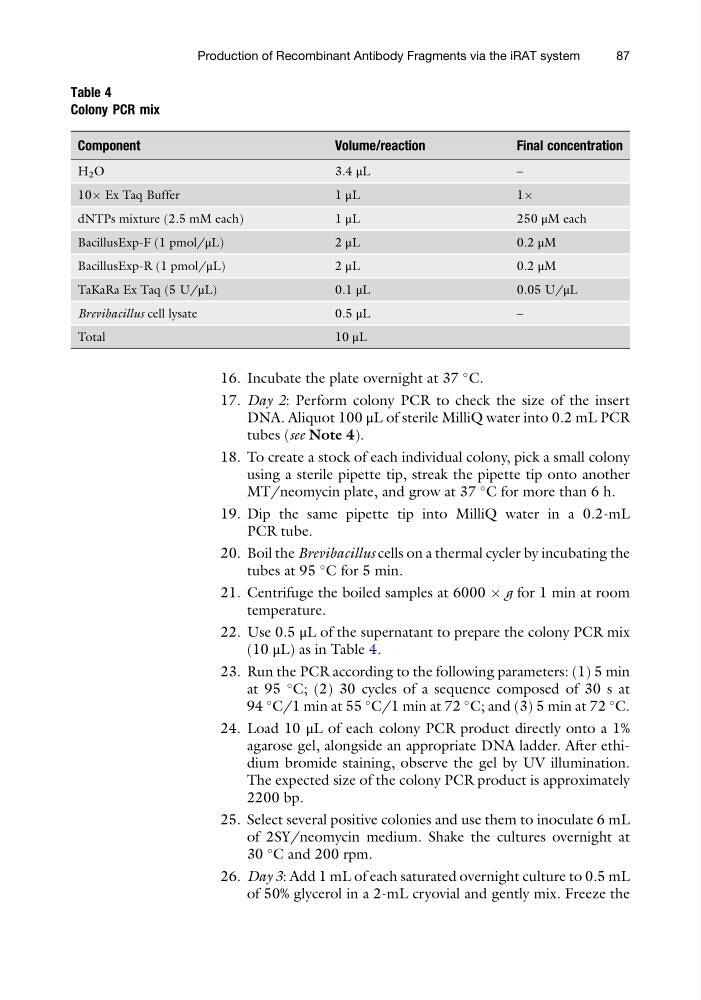
22. Use 0.5 μL of the supernatant to prepare the colony PCR mix
(10 μL) as in Table 4.
23. Run the PCR according to the following parameters: (1) 5 min
at 95
C; (2) 30 cycles of a sequence composed of 30 s at
94
C/1 min at 55
C/1 min at 72
C; and (3) 5 min at 72
C.
24. Load 10 μL of each colony PCR product directly onto a 1%
agarose gel, alongside an appropriate DNA ladder. After ethidium bromide staining, observe the gel by UV illumination.
The expected size of the colony PCR product is approximately
2200 bp.
25. Select several positive colonies and use them to inoculate 6 mL
of 2SY/neomycin medium. Shake the cultures overnight at
30
C and 200 rpm.
26. Day 3: Add 1 mL of each saturated overnight culture to 0.5 mL
of 50% glycerol in a 2-mL cryovial and gently mix. Freeze the
Table 4
Colony PCR mix
Component
Volume/reaction
Final concentration
H 2 O
3.4 μL
–
10Â Ex Taq Buffer
1 μL
1 Â
dNTPs mixture (2.5 mM each)
1 μL
250 μM each
BacillusExp-F (1 pmol/μL)
2 μL
0.2 μM
BacillusExp-R (1 pmol/μL)
2 μL
0.2 μM
TaKaRa Ex Taq (5 U/μL)
0.1 μL
0.05 U/μL
Brevibacillus cell lysate
0.5 μL
–
Total
10 μL
Production of Recombinant Antibody Fragments via the iRAT system
87
C.
17. Day 2: Perform colony PCR to check the size of the insert
DNA. Aliquot 100 μL of sterile MilliQ water into 0.2 mL PCR
tubes (see Note 4).
18. To create a stock of each individual colony, pick a small colony
using a sterile pipette tip, streak the pipette tip onto another
MT/neomycin plate, and grow at 37
C for more than 6 h.
19. Dip the same pipette tip into MilliQ water in a 0.2-mL
PCR tube.
20. Boil the Brevibacillus cells on a thermal cycler by incubating the
tubes at 95
C for 5 min.
21. Centrifuge the boiled samples at 6000 Â g for 1 min at room
temperature.
22. Use 0.5 μL of the supernatant to prepare the colony PCR mix
(10 μL) as in Table 4.
23. Run the PCR according to the following parameters: (1) 5 min
at 95
C; (2) 30 cycles of a sequence composed of 30 s at
94
C/1 min at 55
C/1 min at 72
C; and (3) 5 min at 72
C.
24. Load 10 μL of each colony PCR product directly onto a 1%
agarose gel, alongside an appropriate DNA ladder. After ethidium bromide staining, observe the gel by UV illumination.
The expected size of the colony PCR product is approximately
2200 bp.
25. Select several positive colonies and use them to inoculate 6 mL
of 2SY/neomycin medium. Shake the cultures overnight at
30
C and 200 rpm.
26. Day 3: Add 1 mL of each saturated overnight culture to 0.5 mL
of 50% glycerol in a 2-mL cryovial and gently mix. Freeze the
Table 4
Colony PCR mix
Component
Volume/reaction
Final concentration
H 2 O
3.4 μL
–
10Â Ex Taq Buffer
1 μL
1 Â
dNTPs mixture (2.5 mM each)
1 μL
250 μM each
BacillusExp-F (1 pmol/μL)
2 μL
0.2 μM
BacillusExp-R (1 pmol/μL)
2 μL
0.2 μM
TaKaRa Ex Taq (5 U/μL)
0.1 μL
0.05 U/μL
Brevibacillus cell lysate
0.5 μL
–
Total
10 μL
Production of Recombinant Antibody Fragments via the iRAT system
87