

In-fusion HD (Takara) cloning. NEBuilder HiFi cloning kit uses
the same technology as Gibson Assembly, although with higher
efficiency and better performance especially on short (<250 bp)
fragments.
These technologies are available as user-friendly cloning kits,
which provide the reagents necessary for the assembly of two or
more DNA fragments in a ligation-free reaction. However, preliminary work is still needed, as for the SLIC reaction, to produce
DNA fragments with homologous sequence overhangs. A guide for
primer design is described in Subheading 3.2, and the preparation
of all DNA fragments, including linearization of the vector backbone, is described in Subheading 3.3.
Similar to the SLIC reaction, the purity of the fragments is
critical for their successful assembly. PCR and restriction digestion
products should be cleaned up or gel purified, if necessary, to
remove undesired by-products (see Note 7) before proceeding to
cloning.
1. On ice, set up a 20 μL reaction containing 1Â master mix and
all DNA fragments in the selected molar ratio. We typically
work with 100 ng of vector and a molar ratio of 1:2:2:2, vector
to inserts (see Note 5), when assembling the dual promoter
unit and two cDNA fragments. A negative control reaction, in
which one of the fragments is omitted, may be set up in parallel.
2. Incubate the reaction at 50
C for 60 min. The samples can be
kept on ice until transformation or stored at À20
C.
3. Use 2–5 μL of the assembled product to transform 50 μL of
E. coli competent cells (Pir1 cells for plasmids with an R6Kγ
replication origin). Plate the transformation mixture on LB
agar plates containing the appropriate antibiotic and incubate
overnight at 37
C. If a control experiment was included,
significantly more colonies should be obtained in the presence
of all inserts than in the negative control.
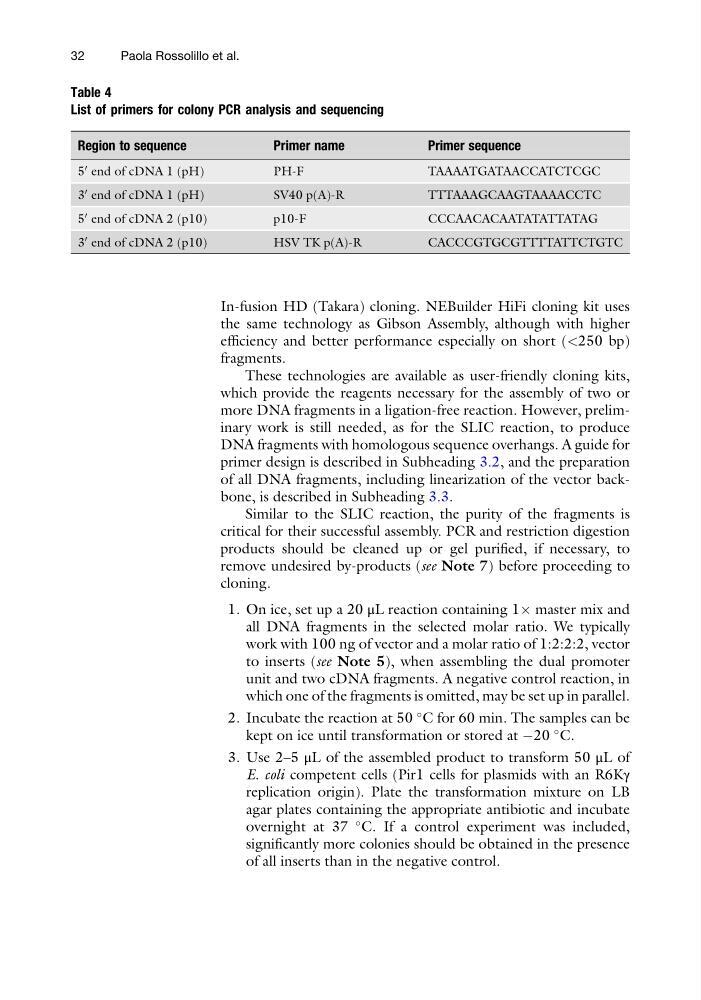
Table 4
List of primers for colony PCR analysis and sequencing
Region to sequence
Primer name
Primer sequence
5
0 end of cDNA 1 (pH)
PH-F
TAAAATGATAACCATCTCGC
3
0 end of cDNA 1 (pH)
SV40 p(A)-R
TTTAAAGCAAGTAAAACCTC
5
0 end of cDNA 2 (p10)
p10-F
CCCAACACAATATATTATAG
3
0 end of cDNA 2 (p10)
HSV TK p(A)-R
CACCCGTGCGTTTTATTCTGTC
32
Paola Rossolillo et al.
the same technology as Gibson Assembly, although with higher
efficiency and better performance especially on short (<250 bp)
fragments.
These technologies are available as user-friendly cloning kits,
which provide the reagents necessary for the assembly of two or
more DNA fragments in a ligation-free reaction. However, preliminary work is still needed, as for the SLIC reaction, to produce
DNA fragments with homologous sequence overhangs. A guide for
primer design is described in Subheading 3.2, and the preparation
of all DNA fragments, including linearization of the vector backbone, is described in Subheading 3.3.
Similar to the SLIC reaction, the purity of the fragments is
critical for their successful assembly. PCR and restriction digestion
products should be cleaned up or gel purified, if necessary, to
remove undesired by-products (see Note 7) before proceeding to
cloning.
1. On ice, set up a 20 μL reaction containing 1Â master mix and
all DNA fragments in the selected molar ratio. We typically
work with 100 ng of vector and a molar ratio of 1:2:2:2, vector
to inserts (see Note 5), when assembling the dual promoter
unit and two cDNA fragments. A negative control reaction, in
which one of the fragments is omitted, may be set up in parallel.
2. Incubate the reaction at 50
C for 60 min. The samples can be
kept on ice until transformation or stored at À20
C.
3. Use 2–5 μL of the assembled product to transform 50 μL of
E. coli competent cells (Pir1 cells for plasmids with an R6Kγ
replication origin). Plate the transformation mixture on LB
agar plates containing the appropriate antibiotic and incubate
overnight at 37
C. If a control experiment was included,
significantly more colonies should be obtained in the presence
of all inserts than in the negative control.
Table 4
List of primers for colony PCR analysis and sequencing
Region to sequence
Primer name
Primer sequence
5
0 end of cDNA 1 (pH)
PH-F
TAAAATGATAACCATCTCGC
3
0 end of cDNA 1 (pH)
SV40 p(A)-R
TTTAAAGCAAGTAAAACCTC
5
0 end of cDNA 2 (p10)
p10-F
CCCAACACAATATATTATAG
3
0 end of cDNA 2 (p10)
HSV TK p(A)-R
CACCCGTGCGTTTTATTCTGTC
32
Paola Rossolillo et al.