

2. Load 1/10 of the reaction volume on a 1% agarose gel with a
molecular weight marker to verify that the digestion is complete and resulted in the expected products.
3. Treat with Calf Alkaline Phosphatase: add one unit of Calf
Alkaline Phosphatase (New England Biolabs) per microgram
of DNA in the restriction reaction. Increase the reaction volume to 50 μl and add 1/10 of the volume of CIAP buffer.
Incubate at 37
C for 1 h. The Alkaline Phosphatase will
eliminate phosphate groups from DNA extremities and will
prevent the re-circularization of the plasmid.
4. Purify the linearized plasmid using clean-up columns following
the instruction manual, elute bound DNA in 30 μL, and determine the concentration of the extracted DNA
spectrophotometrically.
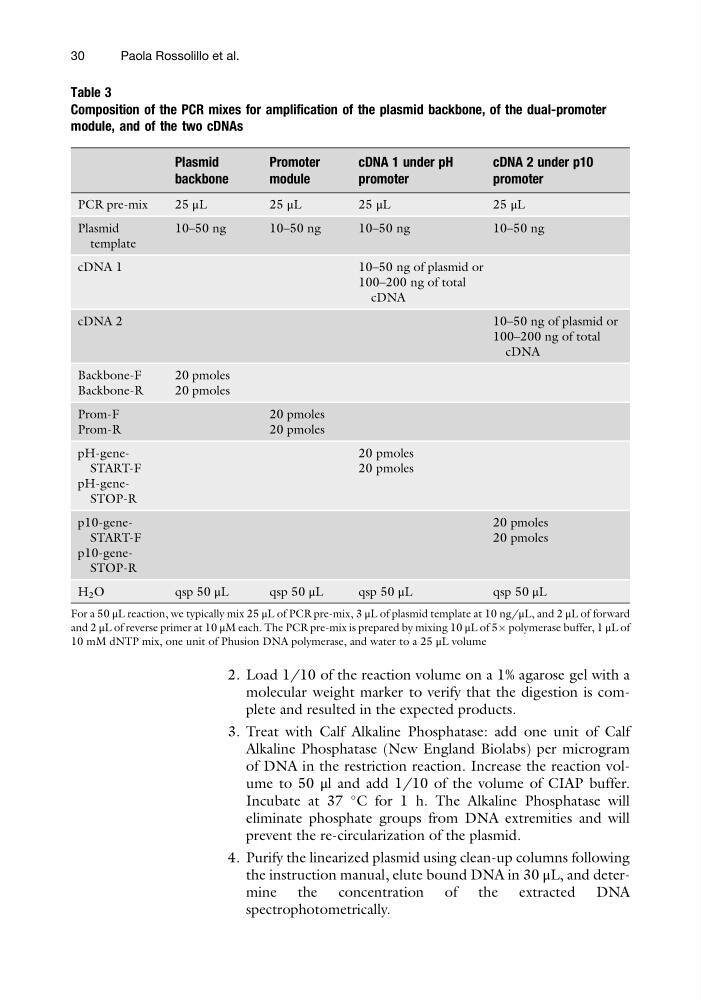
Table 3
Composition of the PCR mixes for amplification of the plasmid backbone, of the dual-promoter
module, and of the two cDNAs
Plasmid
backbone
Promoter
module
cDNA 1 under pH
promoter
cDNA 2 under p10
promoter
PCR pre-mix
25 μL
2 5μL
2 5μL
2 5 μL
Plasmid
template
10–50 ng
10–50 ng
10–50 ng
10–50 ng
cDNA 1
10–50 ng of plasmid or
100–200 ng of total
cDNA
cDNA 2
10–50 ng of plasmid or
100–200 ng of total
cDNA
Backbone-F
Backbone-R
20 pmoles
20 pmoles
Prom-F
Prom-R
20 pmoles
20 pmoles
pH-geneSTART-F
pH-geneSTOP-R
20 pmoles
20 pmoles
p10-geneSTART-F
p10-geneSTOP-R
20 pmoles
20 pmoles
H 2 O
qsp 50 μL
qsp 50 μL
qsp 50 μL
qsp 50 μL
For a 50 μL reaction, we typically mix 25 μL of PCR pre-mix, 3 μL of plasmid template at 10 ng/μL, and 2 μL of forward
and 2 μL of reverse primer at 10 μM each. The PCR pre-mix is prepared by mixing 10 μL of 5Â polymerase buffer, 1 μL of
10 mM dNTP mix, one unit of Phusion DNA polymerase, and water to a 25 μL volume
30
Paola Rossolillo et al.
molecular weight marker to verify that the digestion is complete and resulted in the expected products.
3. Treat with Calf Alkaline Phosphatase: add one unit of Calf
Alkaline Phosphatase (New England Biolabs) per microgram
of DNA in the restriction reaction. Increase the reaction volume to 50 μl and add 1/10 of the volume of CIAP buffer.
Incubate at 37
C for 1 h. The Alkaline Phosphatase will
eliminate phosphate groups from DNA extremities and will
prevent the re-circularization of the plasmid.
4. Purify the linearized plasmid using clean-up columns following
the instruction manual, elute bound DNA in 30 μL, and determine the concentration of the extracted DNA
spectrophotometrically.
Table 3
Composition of the PCR mixes for amplification of the plasmid backbone, of the dual-promoter
module, and of the two cDNAs
Plasmid
backbone
Promoter
module
cDNA 1 under pH
promoter
cDNA 2 under p10
promoter
PCR pre-mix
25 μL
2 5μL
2 5μL
2 5 μL
Plasmid
template
10–50 ng
10–50 ng
10–50 ng
10–50 ng
cDNA 1
10–50 ng of plasmid or
100–200 ng of total
cDNA
cDNA 2
10–50 ng of plasmid or
100–200 ng of total
cDNA
Backbone-F
Backbone-R
20 pmoles
20 pmoles
Prom-F
Prom-R
20 pmoles
20 pmoles
pH-geneSTART-F
pH-geneSTOP-R
20 pmoles
20 pmoles
p10-geneSTART-F
p10-geneSTOP-R
20 pmoles
20 pmoles
H 2 O
qsp 50 μL
qsp 50 μL
qsp 50 μL
qsp 50 μL
For a 50 μL reaction, we typically mix 25 μL of PCR pre-mix, 3 μL of plasmid template at 10 ng/μL, and 2 μL of forward
and 2 μL of reverse primer at 10 μM each. The PCR pre-mix is prepared by mixing 10 μL of 5Â polymerase buffer, 1 μL of
10 mM dNTP mix, one unit of Phusion DNA polymerase, and water to a 25 μL volume
30
Paola Rossolillo et al.