

and assembly of the linearized vector and DNA fragments in Subheadings 3.3–3.5. In Subheading 3.6, the use of restriction-free
(RF) cloning for modification of existing constructs is illustrated.
3.1 Principles
of Homology-Based
Technologies
for Fragment
Assembly
Several seamless cloning technologies are now available to assemble
multiple DNA fragments into a destination plasmid without introducing undesired nucleotides or scar sequences between vector and
insert. Homology-based techniques—Gibson Assembly [15],
In-Fusion Cloning (Clontech™, [16]), and SLIC [17]—rely on
PCR to add homologous sequence overhangs to the DNA fragments to be assembled adjacently and on an exonuclease activity to
expose single-stranded overhangs that will anneal with complementary overlapping fragments.
The Gibson assembly technique [15] relies on an enzyme mix
composed of the T5 exonuclease, which chews back the 5
0 ends of
DNA fragments, generating long overhangs and allowing the
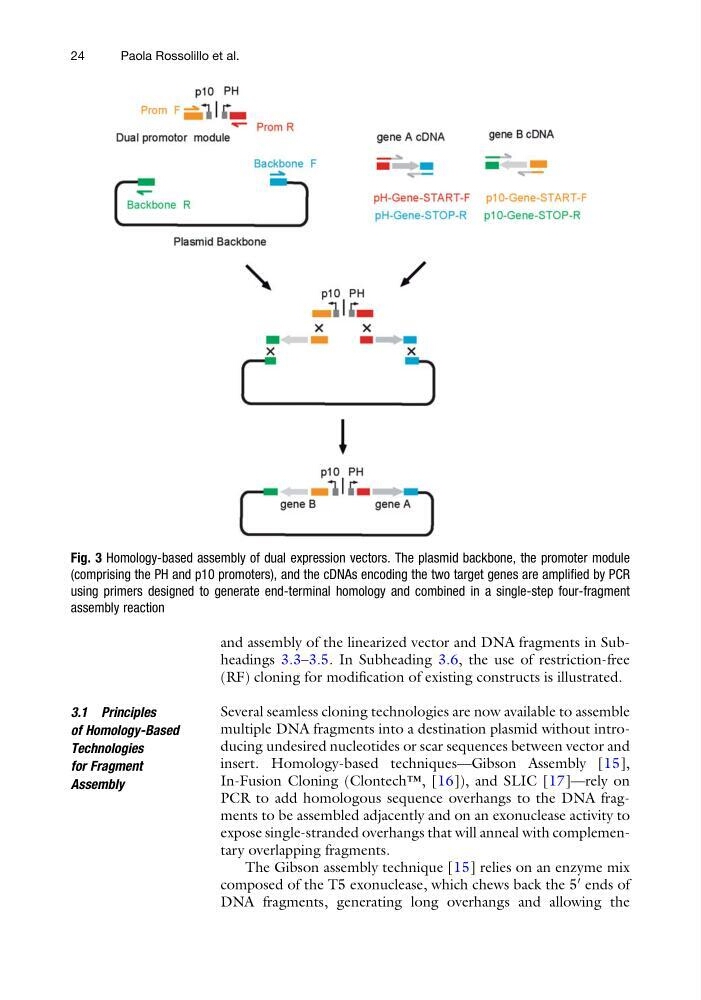
Fig. 3 Homology-based assembly of dual expression vectors. The plasmid backbone, the promoter module
(comprising the PH and p10 promoters), and the cDNAs encoding the two target genes are amplified by PCR
using primers designed to generate end-terminal homology and combined in a single-step four-fragment
assembly reaction
24
Paola Rossolillo et al.
(RF) cloning for modification of existing constructs is illustrated.
3.1 Principles
of Homology-Based
Technologies
for Fragment
Assembly
Several seamless cloning technologies are now available to assemble
multiple DNA fragments into a destination plasmid without introducing undesired nucleotides or scar sequences between vector and
insert. Homology-based techniques—Gibson Assembly [15],
In-Fusion Cloning (Clontech™, [16]), and SLIC [17]—rely on
PCR to add homologous sequence overhangs to the DNA fragments to be assembled adjacently and on an exonuclease activity to
expose single-stranded overhangs that will anneal with complementary overlapping fragments.
The Gibson assembly technique [15] relies on an enzyme mix
composed of the T5 exonuclease, which chews back the 5
0 ends of
DNA fragments, generating long overhangs and allowing the
Fig. 3 Homology-based assembly of dual expression vectors. The plasmid backbone, the promoter module
(comprising the PH and p10 promoters), and the cDNAs encoding the two target genes are amplified by PCR
using primers designed to generate end-terminal homology and combined in a single-step four-fragment
assembly reaction
24
Paola Rossolillo et al.