

strongly suggested. Try in particular to eliminate PmeI, AvrII,
BstZ17I, NruI, and SpeI recognition sequences from your
starting plasmids or cDNAs as these sites are essentials for the
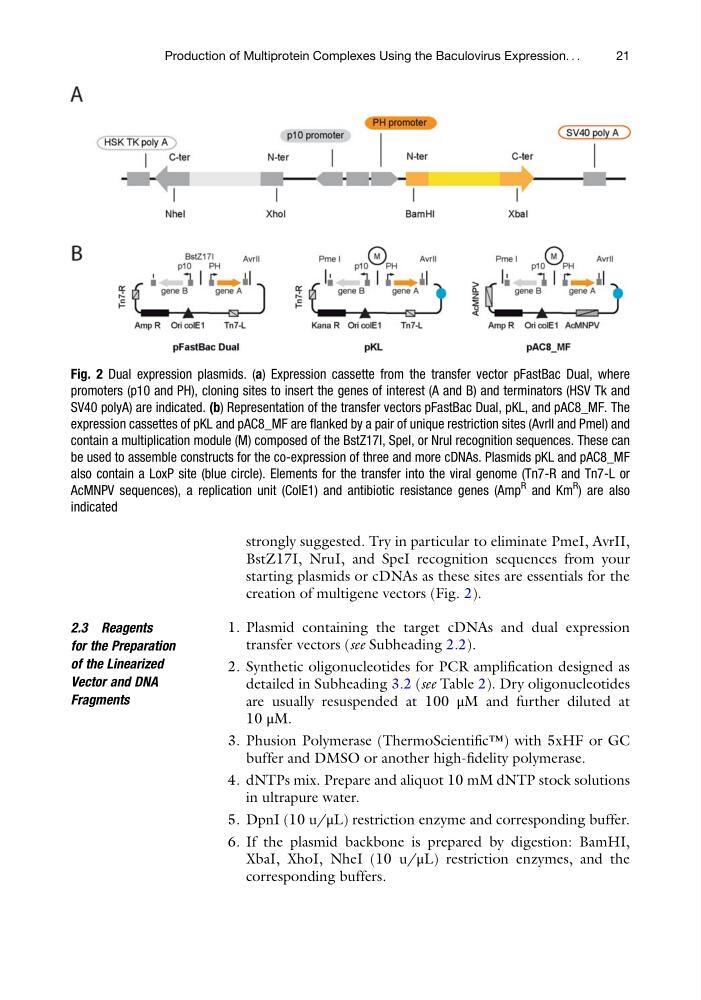
creation of multigene vectors (Fig. 2).
2.3 Reagents
for the Preparation
of the Linearized
Vector and DNA
Fragments
1. Plasmid containing the target cDNAs and dual expression
transfer vectors (see Subheading 2.2).
2. Synthetic oligonucleotides for PCR amplification designed as
detailed in Subheading 3.2 (see Table 2). Dry oligonucleotides
are usually resuspended at 100 μM and further diluted at
10 μM.
3. Phusion Polymerase (ThermoScientific™) with 5xHF or GC
buffer and DMSO or another high-fidelity polymerase.
4. dNTPs mix. Prepare and aliquot 10 mM dNTP stock solutions
in ultrapure water.
5. DpnI (10 u/μL) restriction enzyme and corresponding buffer.
6. If the plasmid backbone is prepared by digestion: BamHI,
XbaI, XhoI, NheI (10 u/μL) restriction enzymes, and the
corresponding buffers.
Fig. 2 Dual expression plasmids. (a) Expression cassette from the transfer vector pFastBac Dual, where
promoters (p10 and PH), cloning sites to insert the genes of interest (A and B) and terminators (HSV Tk and
SV40 polyA) are indicated. (b) Representation of the transfer vectors pFastBac Dual, pKL, and pAC8_MF. The
expression cassettes of pKL and pAC8_MF are flanked by a pair of unique restriction sites (AvrII and PmeI) and
contain a multiplication module (M) composed of the BstZ17I, SpeI, or NruI recognition sequences. These can
be used to assemble constructs for the co-expression of three and more cDNAs. Plasmids pKL and pAC8_MF
also contain a LoxP site (blue circle). Elements for the transfer into the viral genome (Tn7-R and Tn7-L or
AcMNPV sequences), a replication unit (ColE1) and antibiotic resistance genes (Amp
R
and Km
R
) are also
indicated
Production of Multiprotein Complexes Using the Baculovirus Expression. . .
21
BstZ17I, NruI, and SpeI recognition sequences from your
starting plasmids or cDNAs as these sites are essentials for the
creation of multigene vectors (Fig. 2).
2.3 Reagents
for the Preparation
of the Linearized
Vector and DNA
Fragments
1. Plasmid containing the target cDNAs and dual expression
transfer vectors (see Subheading 2.2).
2. Synthetic oligonucleotides for PCR amplification designed as
detailed in Subheading 3.2 (see Table 2). Dry oligonucleotides
are usually resuspended at 100 μM and further diluted at
10 μM.
3. Phusion Polymerase (ThermoScientific™) with 5xHF or GC
buffer and DMSO or another high-fidelity polymerase.
4. dNTPs mix. Prepare and aliquot 10 mM dNTP stock solutions
in ultrapure water.
5. DpnI (10 u/μL) restriction enzyme and corresponding buffer.
6. If the plasmid backbone is prepared by digestion: BamHI,
XbaI, XhoI, NheI (10 u/μL) restriction enzymes, and the
corresponding buffers.
Fig. 2 Dual expression plasmids. (a) Expression cassette from the transfer vector pFastBac Dual, where
promoters (p10 and PH), cloning sites to insert the genes of interest (A and B) and terminators (HSV Tk and
SV40 polyA) are indicated. (b) Representation of the transfer vectors pFastBac Dual, pKL, and pAC8_MF. The
expression cassettes of pKL and pAC8_MF are flanked by a pair of unique restriction sites (AvrII and PmeI) and
contain a multiplication module (M) composed of the BstZ17I, SpeI, or NruI recognition sequences. These can
be used to assemble constructs for the co-expression of three and more cDNAs. Plasmids pKL and pAC8_MF
also contain a LoxP site (blue circle). Elements for the transfer into the viral genome (Tn7-R and Tn7-L or
AcMNPV sequences), a replication unit (ColE1) and antibiotic resistance genes (Amp
R
and Km
R
) are also
indicated
Production of Multiprotein Complexes Using the Baculovirus Expression. . .
21