

place of the codon for an essential lysine in its active site (K93)
[31]. Suppression of this codon with an acylated lysine by genetic
code expansion [26] produces an enzyme that can be activated by
co-expression of a KDAC. This allows for positive (in the absence of
uracil) and negative (in the presence of 5-fluoroorotic acid [32] and
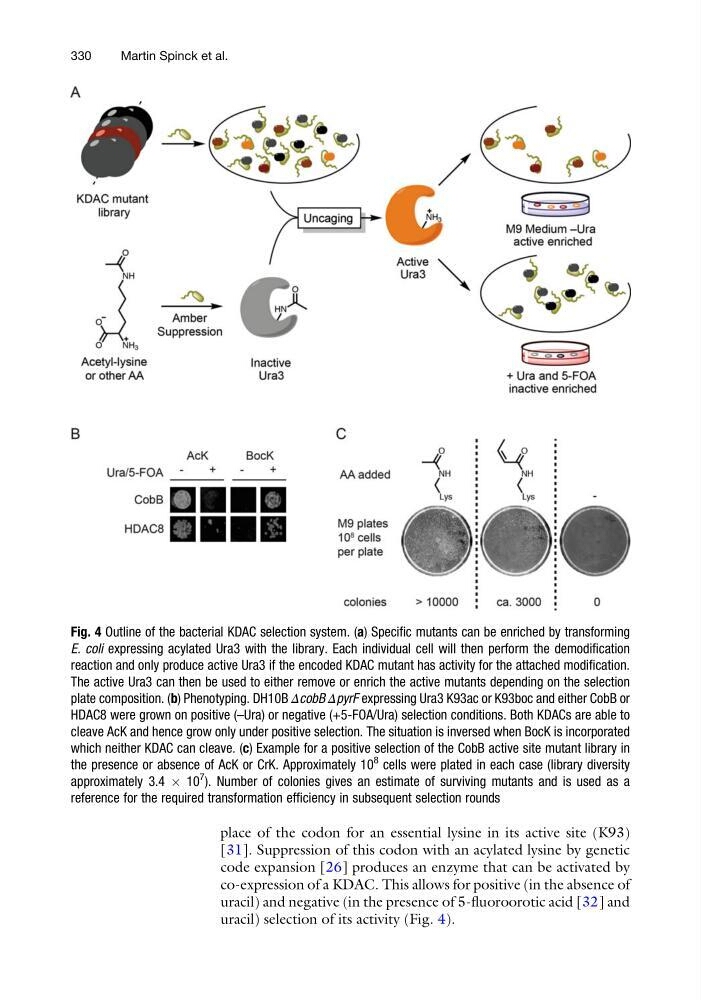
uracil) selection of its activity (Fig. 4).
Fig. 4 Outline of the bacterial KDAC selection system. (a) Specific mutants can be enriched by transforming
E. coli expressing acylated Ura3 with the library. Each individual cell will then perform the demodification
reaction and only produce active Ura3 if the encoded KDAC mutant has activity for the attached modification.
The active Ura3 can then be used to either remove or enrich the active mutants depending on the selection
plate composition. (b) Phenotyping. DH10B ΔcobB ΔpyrF expressing Ura3 K93ac or K93boc and either CobB or
HDAC8 were grown on positive (–Ura) or negative (+5-FOA/Ura) selection conditions. Both KDACs are able to
cleave AcK and hence grow only under positive selection. The situation is inversed when BocK is incorporated
which neither KDAC can cleave. (c) Example for a positive selection of the CobB active site mutant library in
the presence or absence of AcK or CrK. Approximately 10
8
cells were plated in each case (library diversity
approximately 3.4 Â 10
7
). Number of colonies gives an estimate of surviving mutants and is used as a
reference for the required transformation efficiency in subsequent selection rounds
330
Martin Spinck et al.
[31]. Suppression of this codon with an acylated lysine by genetic
code expansion [26] produces an enzyme that can be activated by
co-expression of a KDAC. This allows for positive (in the absence of
uracil) and negative (in the presence of 5-fluoroorotic acid [32] and
uracil) selection of its activity (Fig. 4).
Fig. 4 Outline of the bacterial KDAC selection system. (a) Specific mutants can be enriched by transforming
E. coli expressing acylated Ura3 with the library. Each individual cell will then perform the demodification
reaction and only produce active Ura3 if the encoded KDAC mutant has activity for the attached modification.
The active Ura3 can then be used to either remove or enrich the active mutants depending on the selection
plate composition. (b) Phenotyping. DH10B ΔcobB ΔpyrF expressing Ura3 K93ac or K93boc and either CobB or
HDAC8 were grown on positive (–Ura) or negative (+5-FOA/Ura) selection conditions. Both KDACs are able to
cleave AcK and hence grow only under positive selection. The situation is inversed when BocK is incorporated
which neither KDAC can cleave. (c) Example for a positive selection of the CobB active site mutant library in
the presence or absence of AcK or CrK. Approximately 10
8
cells were plated in each case (library diversity
approximately 3.4 Â 10
7
). Number of colonies gives an estimate of surviving mutants and is used as a
reference for the required transformation efficiency in subsequent selection rounds
330
Martin Spinck et al.