

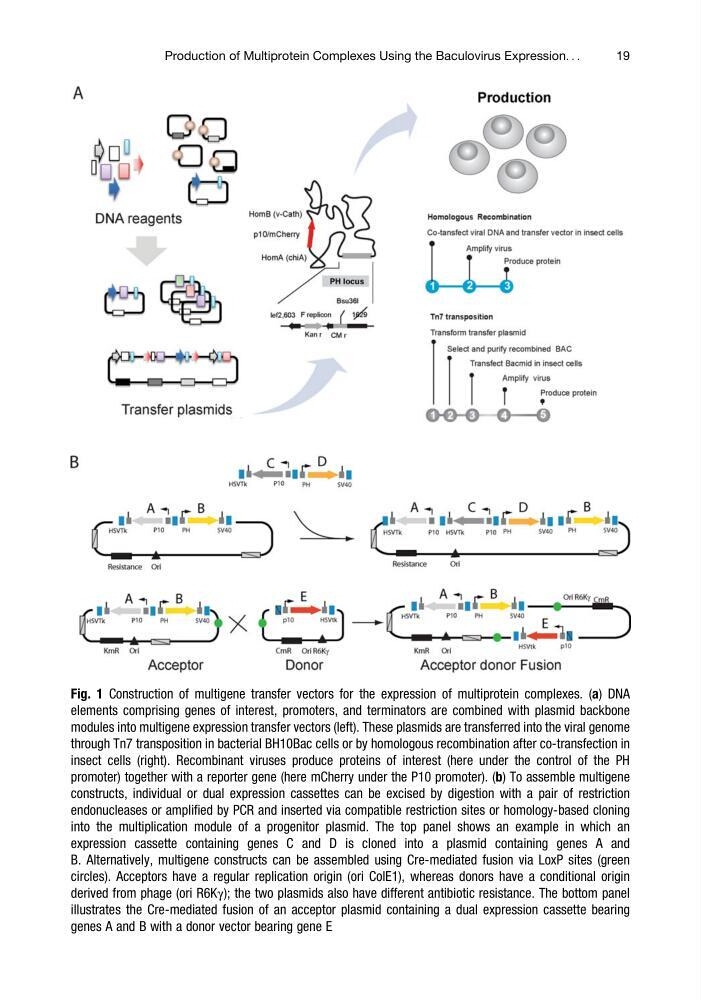
Fig. 1 Construction of multigene transfer vectors for the expression of multiprotein complexes. (a) DNA
elements comprising genes of interest, promoters, and terminators are combined with plasmid backbone
modules into multigene expression transfer vectors (left). These plasmids are transferred into the viral genome
through Tn7 transposition in bacterial BH10Bac cells or by homologous recombination after co-transfection in
insect cells (right). Recombinant viruses produce proteins of interest (here under the control of the PH
promoter) together with a reporter gene (here mCherry under the P10 promoter). (b) To assemble multigene
constructs, individual or dual expression cassettes can be excised by digestion with a pair of restriction
endonucleases or amplified by PCR and inserted via compatible restriction sites or homology-based cloning
into the multiplication module of a progenitor plasmid. The top panel shows an example in which an
expression cassette containing genes C and D is cloned into a plasmid containing genes A and
B. Alternatively, multigene constructs can be assembled using Cre-mediated fusion via LoxP sites (green
circles). Acceptors have a regular replication origin (ori ColE1), whereas donors have a conditional origin
derived from phage (ori R6Kγ); the two plasmids also have different antibiotic resistance. The bottom panel
illustrates the Cre-mediated fusion of an acceptor plasmid containing a dual expression cassette bearing
genes A and B with a donor vector bearing gene E
Production of Multiprotein Complexes Using the Baculovirus Expression. . .
19
elements comprising genes of interest, promoters, and terminators are combined with plasmid backbone
modules into multigene expression transfer vectors (left). These plasmids are transferred into the viral genome
through Tn7 transposition in bacterial BH10Bac cells or by homologous recombination after co-transfection in
insect cells (right). Recombinant viruses produce proteins of interest (here under the control of the PH
promoter) together with a reporter gene (here mCherry under the P10 promoter). (b) To assemble multigene
constructs, individual or dual expression cassettes can be excised by digestion with a pair of restriction
endonucleases or amplified by PCR and inserted via compatible restriction sites or homology-based cloning
into the multiplication module of a progenitor plasmid. The top panel shows an example in which an
expression cassette containing genes C and D is cloned into a plasmid containing genes A and
B. Alternatively, multigene constructs can be assembled using Cre-mediated fusion via LoxP sites (green
circles). Acceptors have a regular replication origin (ori ColE1), whereas donors have a conditional origin
derived from phage (ori R6Kγ); the two plasmids also have different antibiotic resistance. The bottom panel
illustrates the Cre-mediated fusion of an acceptor plasmid containing a dual expression cassette bearing
genes A and B with a donor vector bearing gene E
Production of Multiprotein Complexes Using the Baculovirus Expression. . .
19