

the number of events per frame at a nearly constant value, until
most of the molecules become bleached and the acquisition is
finished.
4. Post-processing. Although real-time super-resolution image
reconstruction is possible depending on the installed software,
a post-processing step is usually required to improve the result
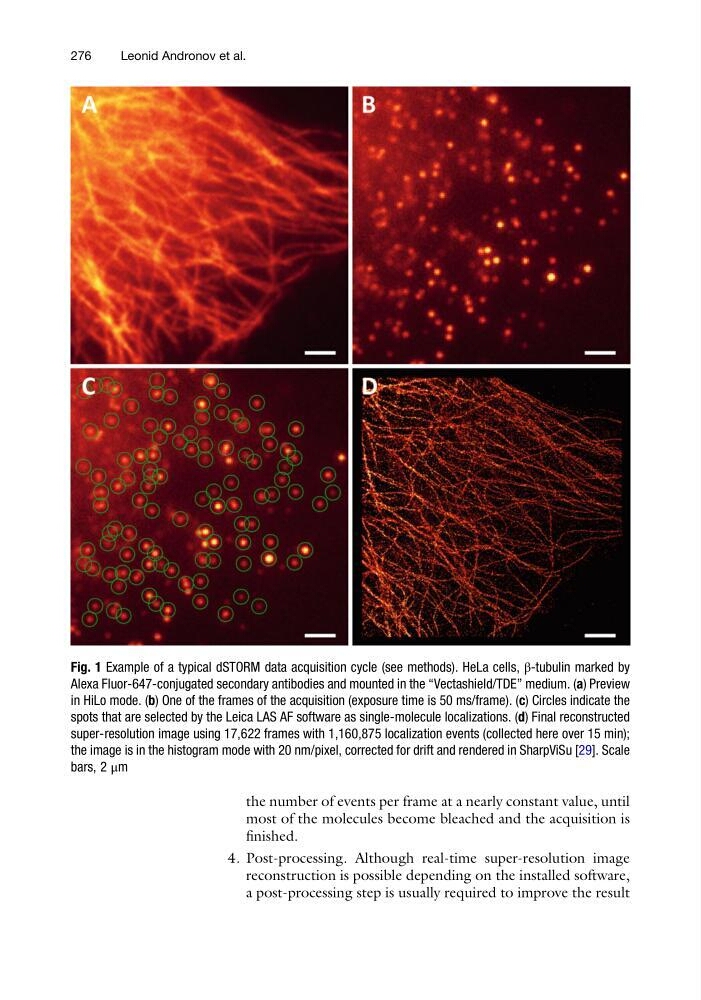
Fig. 1 Example of a typical dSTORM data acquisition cycle (see methods). HeLa cells, β-tubulin marked by
Alexa Fluor-647-conjugated secondary antibodies and mounted in the “Vectashield/TDE” medium. (a) Preview
in HiLo mode. (b) One of the frames of the acquisition (exposure time is 50 ms/frame). (c) Circles indicate the
spots that are selected by the Leica LAS AF software as single-molecule localizations. (d) Final reconstructed
super-resolution image using 17,622 frames with 1,160,875 localization events (collected here over 15 min);
the image is in the histogram mode with 20 nm/pixel, corrected for drift and rendered in SharpViSu [29]. Scale
bars, 2 μm
276
Leonid Andronov et al.
most of the molecules become bleached and the acquisition is
finished.
4. Post-processing. Although real-time super-resolution image
reconstruction is possible depending on the installed software,
a post-processing step is usually required to improve the result
Fig. 1 Example of a typical dSTORM data acquisition cycle (see methods). HeLa cells, β-tubulin marked by
Alexa Fluor-647-conjugated secondary antibodies and mounted in the “Vectashield/TDE” medium. (a) Preview
in HiLo mode. (b) One of the frames of the acquisition (exposure time is 50 ms/frame). (c) Circles indicate the
spots that are selected by the Leica LAS AF software as single-molecule localizations. (d) Final reconstructed
super-resolution image using 17,622 frames with 1,160,875 localization events (collected here over 15 min);
the image is in the histogram mode with 20 nm/pixel, corrected for drift and rendered in SharpViSu [29]. Scale
bars, 2 μm
276
Leonid Andronov et al.