

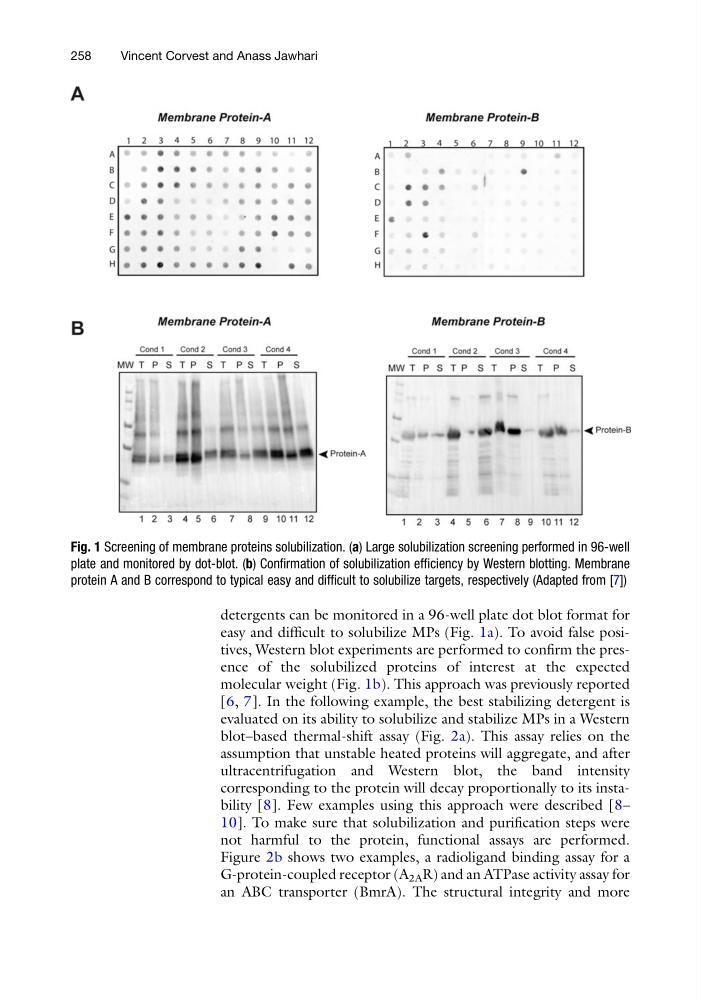
detergents can be monitored in a 96-well plate dot blot format for
easy and difficult to solubilize MPs (Fig. 1a). To avoid false positives, Western blot experiments are performed to confirm the presence of the solubilized proteins of interest at the expected
molecular weight (Fig. 1b). This approach was previously reported
[6, 7]. In the following example, the best stabilizing detergent is
evaluated on its ability to solubilize and stabilize MPs in a Western
blot–based thermal-shift assay (Fig. 2a). This assay relies on the
assumption that unstable heated proteins will aggregate, and after
ultracentrifugation and Western blot, the band intensity
corresponding to the protein will decay proportionally to its instability [8]. Few examples using this approach were described [8–
10]. To make sure that solubilization and purification steps were
not harmful to the protein, functional assays are performed.
Figure 2b shows two examples, a radioligand binding assay for a
G-protein-coupled receptor (A 2A R) and an ATPase activity assay for
an ABC transporter (BmrA). The structural integrity and more
Fig. 1 Screening of membrane proteins solubilization. (a) Large solubilization screening performed in 96-well
plate and monitored by dot-blot. (b) Confirmation of solubilization efficiency by Western blotting. Membrane
protein A and B correspond to typical easy and difficult to solubilize targets, respectively (Adapted from [7])
258
Vincent Corvest and Anass Jawhari
easy and difficult to solubilize MPs (Fig. 1a). To avoid false positives, Western blot experiments are performed to confirm the presence of the solubilized proteins of interest at the expected
molecular weight (Fig. 1b). This approach was previously reported
[6, 7]. In the following example, the best stabilizing detergent is
evaluated on its ability to solubilize and stabilize MPs in a Western
blot–based thermal-shift assay (Fig. 2a). This assay relies on the
assumption that unstable heated proteins will aggregate, and after
ultracentrifugation and Western blot, the band intensity
corresponding to the protein will decay proportionally to its instability [8]. Few examples using this approach were described [8–
10]. To make sure that solubilization and purification steps were
not harmful to the protein, functional assays are performed.
Figure 2b shows two examples, a radioligand binding assay for a
G-protein-coupled receptor (A 2A R) and an ATPase activity assay for
an ABC transporter (BmrA). The structural integrity and more
Fig. 1 Screening of membrane proteins solubilization. (a) Large solubilization screening performed in 96-well
plate and monitored by dot-blot. (b) Confirmation of solubilization efficiency by Western blotting. Membrane
protein A and B correspond to typical easy and difficult to solubilize targets, respectively (Adapted from [7])
258
Vincent Corvest and Anass Jawhari