

be gently removed under liquid nitrogen with tweezers. Storage for a few days in liquid nitrogen may detach the solid
ethane from the grid.
4. Crystalline ice. During freezing, parts of the water layer may
not have cooled down fast enough, thus forming hexagonal ice.
This should be restricted to the thicker parts of the suspension
layer. If this problem persists, the plunging speed or depth may
need to be adjusted. Alternatively if the grid heats up during its
manipulation, the vitreous ice will transform into cubic ice and
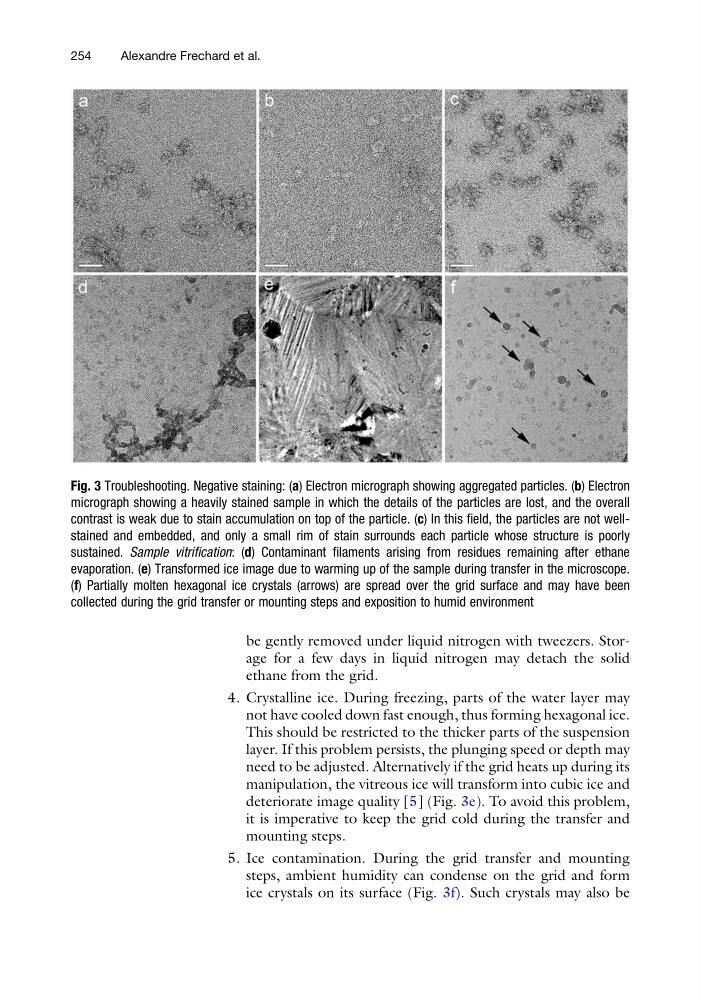
deteriorate image quality [5] (Fig. 3e). To avoid this problem,
it is imperative to keep the grid cold during the transfer and
mounting steps.
5. Ice contamination. During the grid transfer and mounting
steps, ambient humidity can condense on the grid and form
ice crystals on its surface (Fig. 3f). Such crystals may also be
Fig. 3 Troubleshooting. Negative staining: (a) Electron micrograph showing aggregated particles. (b) Electron
micrograph showing a heavily stained sample in which the details of the particles are lost, and the overall
contrast is weak due to stain accumulation on top of the particle. (c) In this field, the particles are not wellstained and embedded, and only a small rim of stain surrounds each particle whose structure is poorly
sustained. Sample vitrification: (d) Contaminant filaments arising from residues remaining after ethane
evaporation. (e) Transformed ice image due to warming up of the sample during transfer in the microscope.
(f) Partially molten hexagonal ice crystals (arrows) are spread over the grid surface and may have been
collected during the grid transfer or mounting steps and exposition to humid environment
254
Alexandre Frechard et al.
ethane from the grid.
4. Crystalline ice. During freezing, parts of the water layer may
not have cooled down fast enough, thus forming hexagonal ice.
This should be restricted to the thicker parts of the suspension
layer. If this problem persists, the plunging speed or depth may
need to be adjusted. Alternatively if the grid heats up during its
manipulation, the vitreous ice will transform into cubic ice and
deteriorate image quality [5] (Fig. 3e). To avoid this problem,
it is imperative to keep the grid cold during the transfer and
mounting steps.
5. Ice contamination. During the grid transfer and mounting
steps, ambient humidity can condense on the grid and form
ice crystals on its surface (Fig. 3f). Such crystals may also be
Fig. 3 Troubleshooting. Negative staining: (a) Electron micrograph showing aggregated particles. (b) Electron
micrograph showing a heavily stained sample in which the details of the particles are lost, and the overall
contrast is weak due to stain accumulation on top of the particle. (c) In this field, the particles are not wellstained and embedded, and only a small rim of stain surrounds each particle whose structure is poorly
sustained. Sample vitrification: (d) Contaminant filaments arising from residues remaining after ethane
evaporation. (e) Transformed ice image due to warming up of the sample during transfer in the microscope.
(f) Partially molten hexagonal ice crystals (arrows) are spread over the grid surface and may have been
collected during the grid transfer or mounting steps and exposition to humid environment
254
Alexandre Frechard et al.