

11. Calculate the CCS % error between the model (CCSmodel)
and experimental CCS (CCSexp) for all tryptophan synthase
models using:
% error ¼
CCS model À CCS exp
CCS exp
 100
12. The best-fit models will show the lowest % error. This conformation will have been generated using stoichiometry, crosslinking, and EM restraints and have been filtered using CCS.
13. Finally, evaluate the accuracy of your model against the crystal
structure of the full tetrameric tryptophan synthase complex.
Open PyMOL and use the “fetch 1WBJ, type¼pdb1, multiplex¼1” command to automatically download the “biological
assembly” of 1WBJ.
14. 1WBJ will download as two objects in PyMOL, 1WBJ_0001
and 1WBJ_0002 which will each be half of the complex. Both
alpha chains will be labeled as Chain A, and both beta as
Chain B.
15. To align our best-fit model to this complex, we will first need to
combine the two halves of 1WBJ into a single object, with the
same Chain ABCD arrangement.
16. Use the command “alter 1WBJ_0002 & chain A, chain¼‘C’”
and “alter 1WBJ_0002 & chain B, chain¼‘D’” to rename to
chains C and D.
17. Next, use “create 1WBJ_assembled, 1WBJ_*” to create a new
object with all chains of the tryptophan synthase biological
assembly.
18. Align your best fit model to this 1WBJ_assembled object using
either “align 1WBJ_assembled” or by
clicking on screen in the PyMOL GUI.
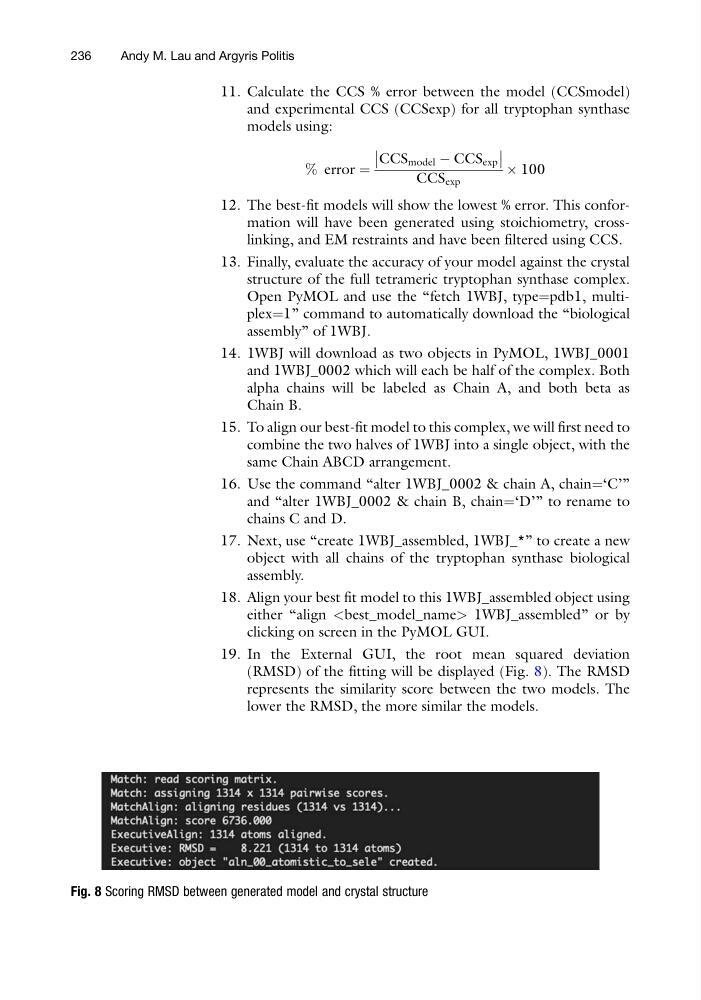
19. In the External GUI, the root mean squared deviation
(RMSD) of the fitting will be displayed (Fig. 8). The RMSD
represents the similarity score between the two models. The
lower the RMSD, the more similar the models.
Fig. 8 Scoring RMSD between generated model and crystal structure
236
Andy M. Lau and Argyris Politis
and experimental CCS (CCSexp) for all tryptophan synthase
models using:
% error ¼
CCS model À CCS exp
CCS exp
 100
12. The best-fit models will show the lowest % error. This conformation will have been generated using stoichiometry, crosslinking, and EM restraints and have been filtered using CCS.
13. Finally, evaluate the accuracy of your model against the crystal
structure of the full tetrameric tryptophan synthase complex.
Open PyMOL and use the “fetch 1WBJ, type¼pdb1, multiplex¼1” command to automatically download the “biological
assembly” of 1WBJ.
14. 1WBJ will download as two objects in PyMOL, 1WBJ_0001
and 1WBJ_0002 which will each be half of the complex. Both
alpha chains will be labeled as Chain A, and both beta as
Chain B.
15. To align our best-fit model to this complex, we will first need to
combine the two halves of 1WBJ into a single object, with the
same Chain ABCD arrangement.
16. Use the command “alter 1WBJ_0002 & chain A, chain¼‘C’”
and “alter 1WBJ_0002 & chain B, chain¼‘D’” to rename to
chains C and D.
17. Next, use “create 1WBJ_assembled, 1WBJ_*” to create a new
object with all chains of the tryptophan synthase biological
assembly.
18. Align your best fit model to this 1WBJ_assembled object using
either “align
clicking on screen in the PyMOL GUI.
19. In the External GUI, the root mean squared deviation
(RMSD) of the fitting will be displayed (Fig. 8). The RMSD
represents the similarity score between the two models. The
lower the RMSD, the more similar the models.
Fig. 8 Scoring RMSD between generated model and crystal structure
236
Andy M. Lau and Argyris Politis