

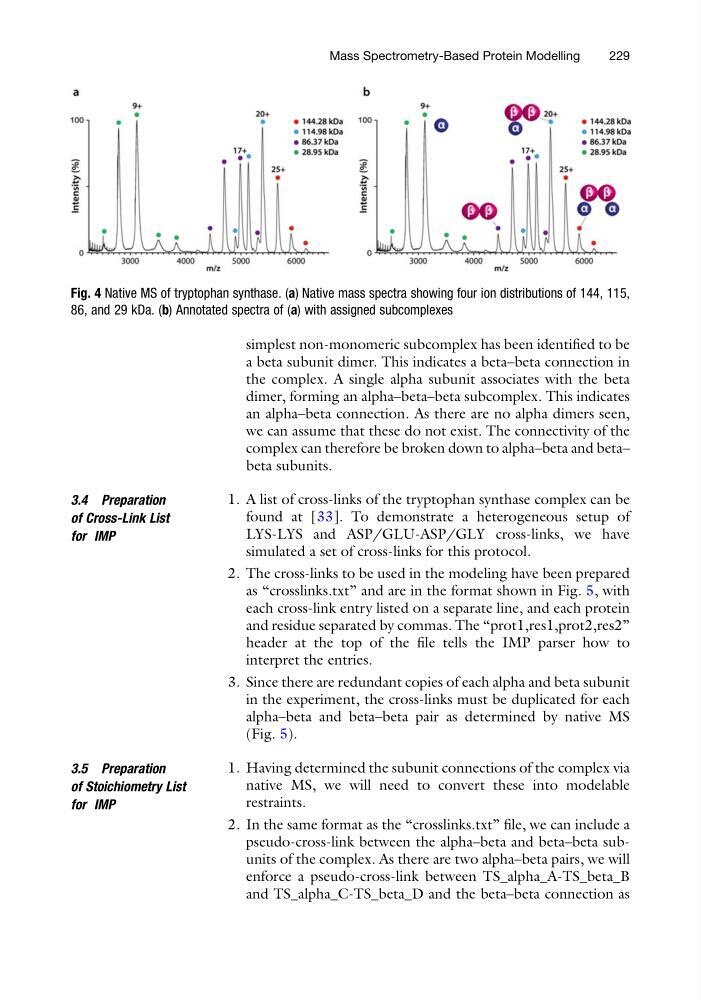
simplest non-monomeric subcomplex has been identified to be
a beta subunit dimer. This indicates a beta–beta connection in
the complex. A single alpha subunit associates with the beta
dimer, forming an alpha–beta–beta subcomplex. This indicates
an alpha–beta connection. As there are no alpha dimers seen,
we can assume that these do not exist. The connectivity of the
complex can therefore be broken down to alpha–beta and beta–
beta subunits.
3.4 Preparation
of Cross-Link List
for IMP
1. A list of cross-links of the tryptophan synthase complex can be
found at [33]. To demonstrate a heterogeneous setup of
LYS-LYS and ASP/GLU-ASP/GLY cross-links, we have
simulated a set of cross-links for this protocol.
2. The cross-links to be used in the modeling have been prepared
as “crosslinks.txt” and are in the format shown in Fig. 5, with
each cross-link entry listed on a separate line, and each protein
and residue separated by commas. The “prot1,res1,prot2,res2”
header at the top of the file tells the IMP parser how to
interpret the entries.
3. Since there are redundant copies of each alpha and beta subunit
in the experiment, the cross-links must be duplicated for each
alpha–beta and beta–beta pair as determined by native MS
(Fig. 5).
3.5 Preparation
of Stoichiometry List
for IMP
1. Having determined the subunit connections of the complex via
native MS, we will need to convert these into modelable
restraints.
2. In the same format as the “crosslinks.txt” file, we can include a
pseudo-cross-link between the alpha–beta and beta–beta subunits of the complex. As there are two alpha–beta pairs, we will
enforce a pseudo-cross-link between TS_alpha_A-TS_beta_B
and TS_alpha_C-TS_beta_D and the beta–beta connection as
Fig. 4 Native MS of tryptophan synthase. (a) Native mass spectra showing four ion distributions of 144, 115,
86, and 29 kDa. (b) Annotated spectra of (a) with assigned subcomplexes
Mass Spectrometry-Based Protein Modelling
229
a beta subunit dimer. This indicates a beta–beta connection in
the complex. A single alpha subunit associates with the beta
dimer, forming an alpha–beta–beta subcomplex. This indicates
an alpha–beta connection. As there are no alpha dimers seen,
we can assume that these do not exist. The connectivity of the
complex can therefore be broken down to alpha–beta and beta–
beta subunits.
3.4 Preparation
of Cross-Link List
for IMP
1. A list of cross-links of the tryptophan synthase complex can be
found at [33]. To demonstrate a heterogeneous setup of
LYS-LYS and ASP/GLU-ASP/GLY cross-links, we have
simulated a set of cross-links for this protocol.
2. The cross-links to be used in the modeling have been prepared
as “crosslinks.txt” and are in the format shown in Fig. 5, with
each cross-link entry listed on a separate line, and each protein
and residue separated by commas. The “prot1,res1,prot2,res2”
header at the top of the file tells the IMP parser how to
interpret the entries.
3. Since there are redundant copies of each alpha and beta subunit
in the experiment, the cross-links must be duplicated for each
alpha–beta and beta–beta pair as determined by native MS
(Fig. 5).
3.5 Preparation
of Stoichiometry List
for IMP
1. Having determined the subunit connections of the complex via
native MS, we will need to convert these into modelable
restraints.
2. In the same format as the “crosslinks.txt” file, we can include a
pseudo-cross-link between the alpha–beta and beta–beta subunits of the complex. As there are two alpha–beta pairs, we will
enforce a pseudo-cross-link between TS_alpha_A-TS_beta_B
and TS_alpha_C-TS_beta_D and the beta–beta connection as
Fig. 4 Native MS of tryptophan synthase. (a) Native mass spectra showing four ion distributions of 144, 115,
86, and 29 kDa. (b) Annotated spectra of (a) with assigned subcomplexes
Mass Spectrometry-Based Protein Modelling
229