

1.1 Native MS
Native MS is a powerful technique for interrogating key structural
aspects of proteins and their complexes. It allows examination of
the specificity and selectivity of ligands binding to a protein in
addition to identifying protein stoichiometry and their oligomeric
states [14–16]. The main strengths of native MS are that it can
rapidly provide information on the native state of large proteins and
their complexes, it does not require high concentrations of pure
material, and it can typically deal with heterogeneous samples. As
such, native MS has become an integral component of the structural biology toolkit complementing traditional structural methods. Information derived from native MS can be used to model
protein complexes [9] and also integrated with data sets from other
related methods [1, 2].
1.2 Ion Mobility MS
Native MS is often hyphenated with ion mobility (IM)-MS. IM-MS
provides information about protein topologies and dynamics in the
gas phase [17, 18]. It is expressed using the collisional cross section
(CCS) which reflects the orientationally average cross section of
proteins as they tumble through the IM cell in the mass spectrometer [19]. CCS from IM-MS is obtained by measuring the arrival
time distributions (ATDs) of different ions [20] and can in turn be
used as shape restraints for interrogating structural models generated by computational methods [7, 21, 22]. Structural dynamics
and conformational heterogeneity can be inferred from the distribution of mobilities measured by IM-MS [23–25]. Typically, ions
with multiple conformations will result in broad, Gaussian
ATDs [12].
1.3 Chemical
Cross-Linking
and Covalent
Labelling MS
Chemical cross-linking (CX)-MS allows covalent linkage of reactive
amino acid residues enabling information about the protein topology and their fold [6, 26–29]. CX-MS defines protein subunit
proximities which can be expressed as distance restraints for downstream modeling analysis [27, 30]. The information can
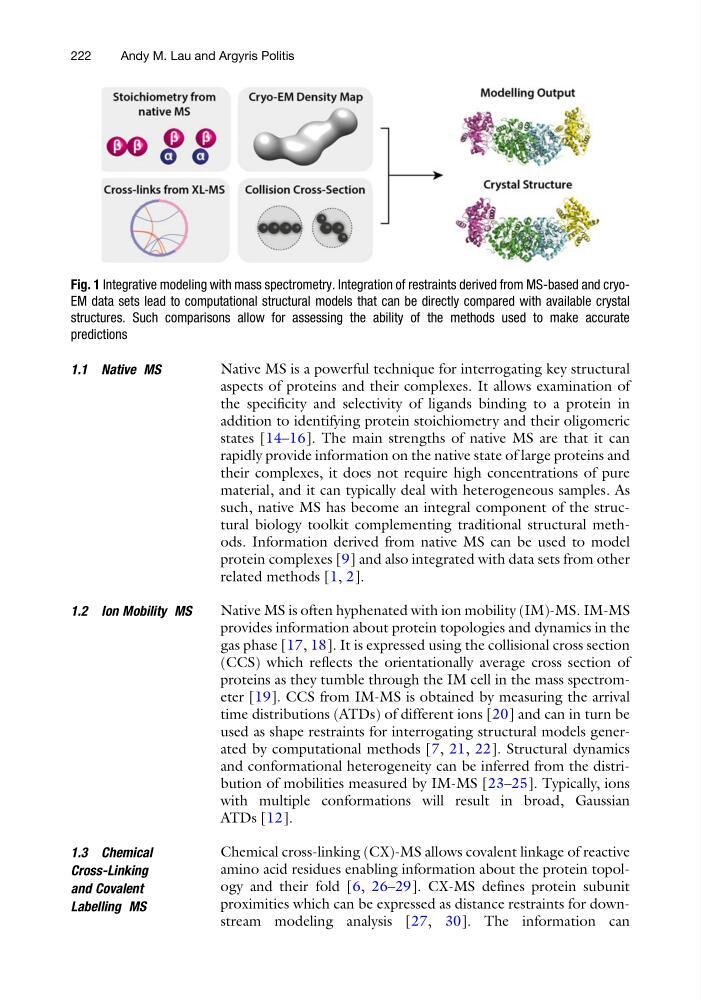
Fig. 1 Integrative modeling with mass spectrometry. Integration of restraints derived from MS-based and cryoEM data sets lead to computational structural models that can be directly compared with available crystal
structures. Such comparisons allow for assessing the ability of the methods used to make accurate
predictions
222
Andy M. Lau and Argyris Politis
Native MS is a powerful technique for interrogating key structural
aspects of proteins and their complexes. It allows examination of
the specificity and selectivity of ligands binding to a protein in
addition to identifying protein stoichiometry and their oligomeric
states [14–16]. The main strengths of native MS are that it can
rapidly provide information on the native state of large proteins and
their complexes, it does not require high concentrations of pure
material, and it can typically deal with heterogeneous samples. As
such, native MS has become an integral component of the structural biology toolkit complementing traditional structural methods. Information derived from native MS can be used to model
protein complexes [9] and also integrated with data sets from other
related methods [1, 2].
1.2 Ion Mobility MS
Native MS is often hyphenated with ion mobility (IM)-MS. IM-MS
provides information about protein topologies and dynamics in the
gas phase [17, 18]. It is expressed using the collisional cross section
(CCS) which reflects the orientationally average cross section of
proteins as they tumble through the IM cell in the mass spectrometer [19]. CCS from IM-MS is obtained by measuring the arrival
time distributions (ATDs) of different ions [20] and can in turn be
used as shape restraints for interrogating structural models generated by computational methods [7, 21, 22]. Structural dynamics
and conformational heterogeneity can be inferred from the distribution of mobilities measured by IM-MS [23–25]. Typically, ions
with multiple conformations will result in broad, Gaussian
ATDs [12].
1.3 Chemical
Cross-Linking
and Covalent
Labelling MS
Chemical cross-linking (CX)-MS allows covalent linkage of reactive
amino acid residues enabling information about the protein topology and their fold [6, 26–29]. CX-MS defines protein subunit
proximities which can be expressed as distance restraints for downstream modeling analysis [27, 30]. The information can
Fig. 1 Integrative modeling with mass spectrometry. Integration of restraints derived from MS-based and cryoEM data sets lead to computational structural models that can be directly compared with available crystal
structures. Such comparisons allow for assessing the ability of the methods used to make accurate
predictions
222
Andy M. Lau and Argyris Politis