

4. In MassLynx, set up an MS file with the following parameters:
Start Time: 0 min; End Time: 10 min; Polarity: Positive;
Analyser Mode: Sensitivity; Dynamic Range: Normal; Sensitivity: Normal; Low Mass: 1,000 Da; High Mass: 10,000 Da;
Scan Time: 1 s (Continuum); No Trap or Transfer CE.
5. In MassLynx, set up an Inlet file with the following parameters:
Flow rate 200 μL/min with 100% solvent A (200 mM ammonium acetate) for 10 min.
6. In MassLynx MS Tune windows, manually set the following
parameters:
Nanoflow+ panel: Capillary: 3 kV; Sampling Cone: 150 V.
Source Offset: 80 V. Source Temperature: 100
C. Cone Gas:
50 L/h; Nano Flow Gas: 0 Bar; Purge Gas: 100 L/h.
Instrument: Trap and Transfer Collision Energy are turned
off (4 V and 2 V, respectively by default).
Save these parameters as an MS tune file (.ipr file).
7. In MassLynx, create a sample list with the corresponding MS
file, Inlet file, and MS tune file. Specify the sample position
(Bottle) and the volume to be injected (10 μL).
8. Start the acquisition.
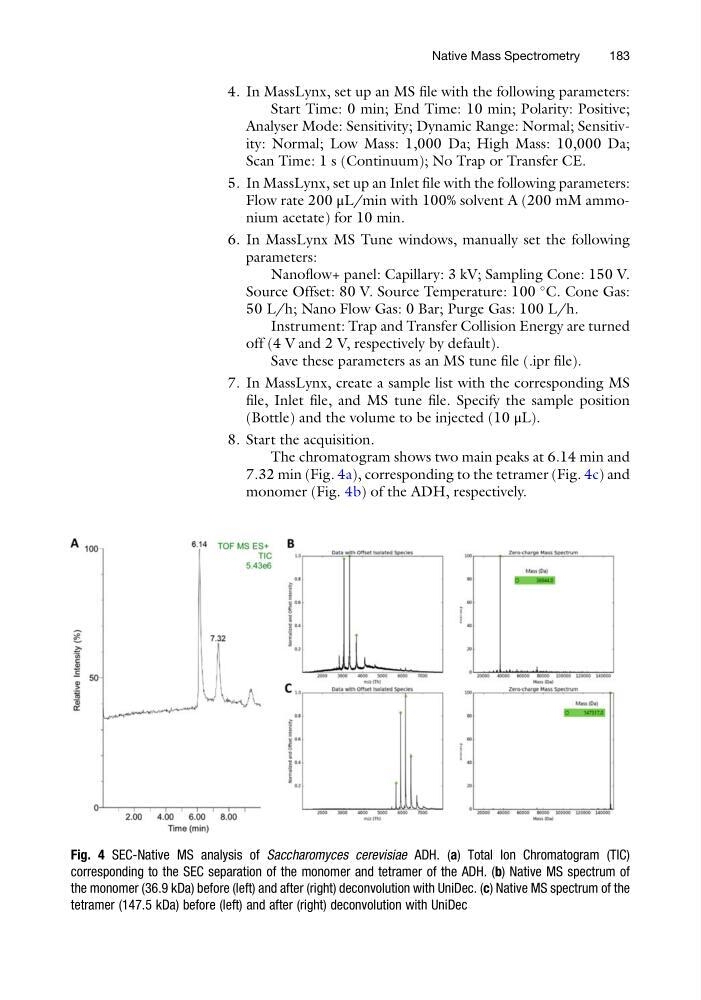
The chromatogram shows two main peaks at 6.14 min and
7.32 min (Fig. 4a), corresponding to the tetramer (Fig. 4c) and
monomer (Fig. 4b) of the ADH, respectively.
Fig. 4 SEC-Native MS analysis of Saccharomyces cerevisiae ADH. (a) Total Ion Chromatogram (TIC)
corresponding to the SEC separation of the monomer and tetramer of the ADH. (b) Native MS spectrum of
the monomer (36.9 kDa) before (left) and after (right) deconvolution with UniDec. (c) Native MS spectrum of the
tetramer (147.5 kDa) before (left) and after (right) deconvolution with UniDec
Native Mass Spectrometry
183
Start Time: 0 min; End Time: 10 min; Polarity: Positive;
Analyser Mode: Sensitivity; Dynamic Range: Normal; Sensitivity: Normal; Low Mass: 1,000 Da; High Mass: 10,000 Da;
Scan Time: 1 s (Continuum); No Trap or Transfer CE.
5. In MassLynx, set up an Inlet file with the following parameters:
Flow rate 200 μL/min with 100% solvent A (200 mM ammonium acetate) for 10 min.
6. In MassLynx MS Tune windows, manually set the following
parameters:
Nanoflow+ panel: Capillary: 3 kV; Sampling Cone: 150 V.
Source Offset: 80 V. Source Temperature: 100
C. Cone Gas:
50 L/h; Nano Flow Gas: 0 Bar; Purge Gas: 100 L/h.
Instrument: Trap and Transfer Collision Energy are turned
off (4 V and 2 V, respectively by default).
Save these parameters as an MS tune file (.ipr file).
7. In MassLynx, create a sample list with the corresponding MS
file, Inlet file, and MS tune file. Specify the sample position
(Bottle) and the volume to be injected (10 μL).
8. Start the acquisition.
The chromatogram shows two main peaks at 6.14 min and
7.32 min (Fig. 4a), corresponding to the tetramer (Fig. 4c) and
monomer (Fig. 4b) of the ADH, respectively.
Fig. 4 SEC-Native MS analysis of Saccharomyces cerevisiae ADH. (a) Total Ion Chromatogram (TIC)
corresponding to the SEC separation of the monomer and tetramer of the ADH. (b) Native MS spectrum of
the monomer (36.9 kDa) before (left) and after (right) deconvolution with UniDec. (c) Native MS spectrum of the
tetramer (147.5 kDa) before (left) and after (right) deconvolution with UniDec
Native Mass Spectrometry
183