

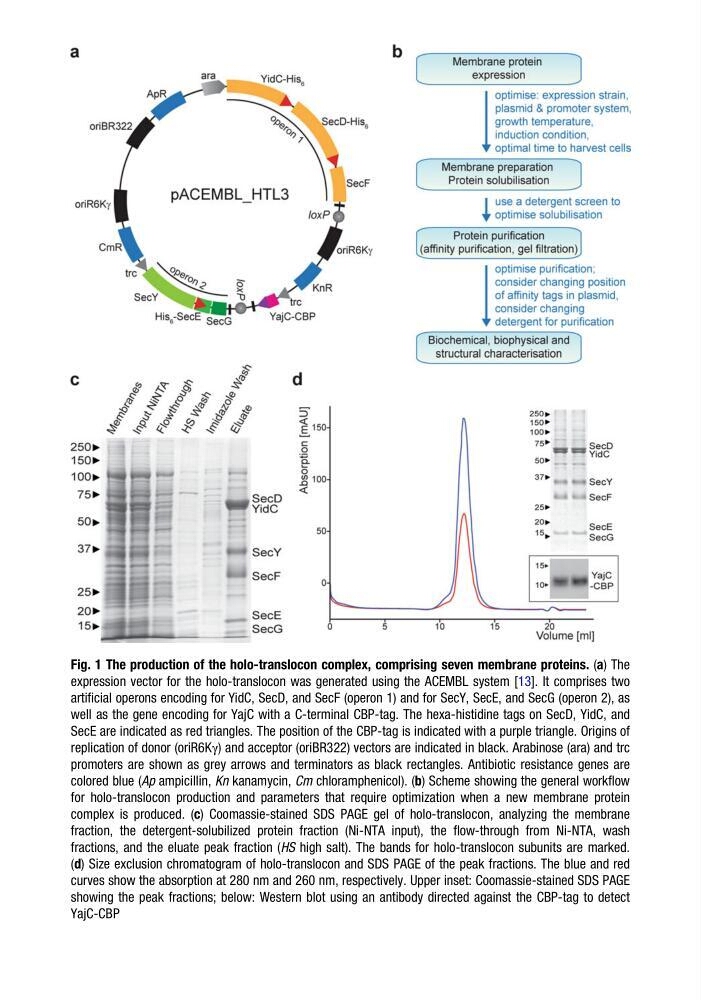
Fig. 1 The production of the holo-translocon complex, comprising seven membrane proteins. (a) The
expression vector for the holo-translocon was generated using the ACEMBL system [13]. It comprises two
artificial operons encoding for YidC, SecD, and SecF (operon 1) and for SecY, SecE, and SecG (operon 2), as
well as the gene encoding for YajC with a C-terminal CBP-tag. The hexa-histidine tags on SecD, YidC, and
SecE are indicated as red triangles. The position of the CBP-tag is indicated with a purple triangle. Origins of
replication of donor (oriR6Kγ) and acceptor (oriBR322) vectors are indicated in black. Arabinose (ara) and trc
promoters are shown as grey arrows and terminators as black rectangles. Antibiotic resistance genes are
colored blue (Ap ampicillin, Kn kanamycin, Cm chloramphenicol). (b) Scheme showing the general workflow
for holo-translocon production and parameters that require optimization when a new membrane protein
complex is produced. (c) Coomassie-stained SDS PAGE gel of holo-translocon, analyzing the membrane
fraction, the detergent-solubilized protein fraction (Ni-NTA input), the flow-through from Ni-NTA, wash
fractions, and the eluate peak fraction (HS high salt). The bands for holo-translocon subunits are marked.
(d) Size exclusion chromatogram of holo-translocon and SDS PAGE of the peak fractions. The blue and red
curves show the absorption at 280 nm and 260 nm, respectively. Upper inset: Coomassie-stained SDS PAGE
showing the peak fractions; below: Western blot using an antibody directed against the CBP-tag to detect
YajC-CBP
expression vector for the holo-translocon was generated using the ACEMBL system [13]. It comprises two
artificial operons encoding for YidC, SecD, and SecF (operon 1) and for SecY, SecE, and SecG (operon 2), as
well as the gene encoding for YajC with a C-terminal CBP-tag. The hexa-histidine tags on SecD, YidC, and
SecE are indicated as red triangles. The position of the CBP-tag is indicated with a purple triangle. Origins of
replication of donor (oriR6Kγ) and acceptor (oriBR322) vectors are indicated in black. Arabinose (ara) and trc
promoters are shown as grey arrows and terminators as black rectangles. Antibiotic resistance genes are
colored blue (Ap ampicillin, Kn kanamycin, Cm chloramphenicol). (b) Scheme showing the general workflow
for holo-translocon production and parameters that require optimization when a new membrane protein
complex is produced. (c) Coomassie-stained SDS PAGE gel of holo-translocon, analyzing the membrane
fraction, the detergent-solubilized protein fraction (Ni-NTA input), the flow-through from Ni-NTA, wash
fractions, and the eluate peak fraction (HS high salt). The bands for holo-translocon subunits are marked.
(d) Size exclusion chromatogram of holo-translocon and SDS PAGE of the peak fractions. The blue and red
curves show the absorption at 280 nm and 260 nm, respectively. Upper inset: Coomassie-stained SDS PAGE
showing the peak fractions; below: Western blot using an antibody directed against the CBP-tag to detect
YajC-CBP