

7 Synergetic Interpretation of Patterned Vasomotion Activity …
131
pulsations of perfusion patterns are a mere passive response, but slower activity bands
easily identifiable by the comparative frequency chromatograms make it possible to
distinguish them from other types of flow or blood content fluctuations. There is
nothing “chaotic” in these measurements of obviously pathological microcirculation, instead there is a remarkable “order” (more appropriately referred to as “synergetic stereotypes”) which is associated with a situation where vasoconstrictor control
mechanisms no longer prevails.
This situation, of course, is most characteristic of perfusion patterns associated
with degenerative neural diseases: physiological “attractors” disappear, pathological ones become prominent in the cutaneous microcirculation. In the latter disease
states, we corroborated an earlier finding, namely a frequent dissociation between the
LDA and the rPPG patterns, thereby providing a posteriori justification to institute
the somewhat complex measurement scenario we have constructed in our group.
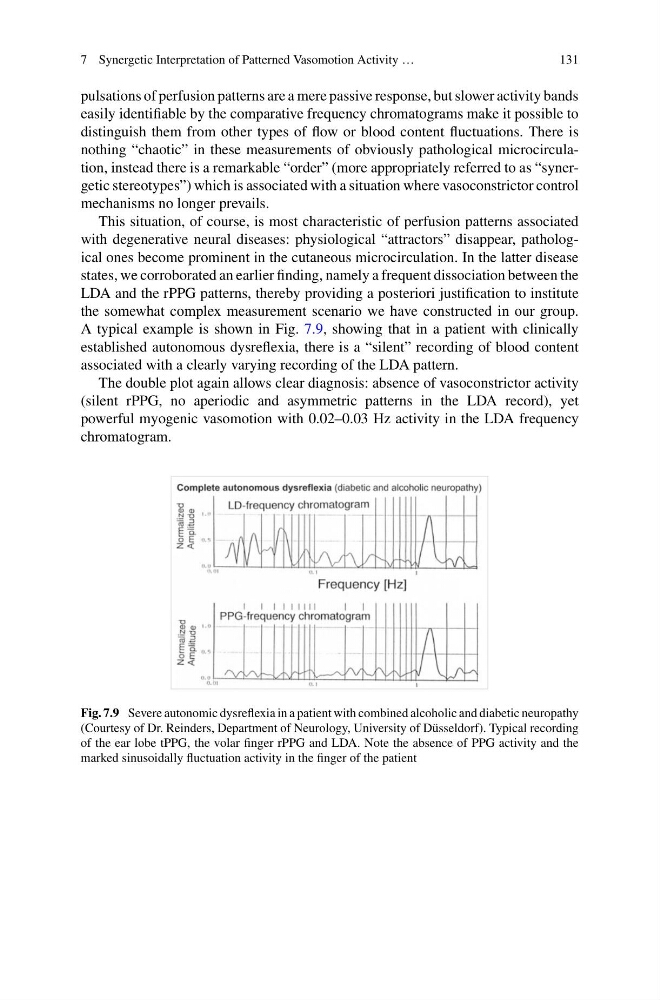
A typical example is shown in Fig. 7.9, showing that in a patient with clinically
established autonomous dysreflexia, there is a “silent” recording of blood content
associated with a clearly varying recording of the LDA pattern.
The double plot again allows clear diagnosis: absence of vasoconstrictor activity
(silent rPPG, no aperiodic and asymmetric patterns in the LDA record), yet
powerful myogenic vasomotion with 0.02–0.03 Hz activity in the LDA frequency
chromatogram.
Fig. 7.9 Severe autonomic dysreflexia in a patient with combined alcoholic and diabetic neuropathy
(Courtesy of Dr. Reinders, Department of Neurology, University of Düsseldorf). Typical recording
of the ear lobe tPPG, the volar finger rPPG and LDA. Note the absence of PPG activity and the
marked sinusoidally fluctuation activity in the finger of the patient
131
pulsations of perfusion patterns are a mere passive response, but slower activity bands
easily identifiable by the comparative frequency chromatograms make it possible to
distinguish them from other types of flow or blood content fluctuations. There is
nothing “chaotic” in these measurements of obviously pathological microcirculation, instead there is a remarkable “order” (more appropriately referred to as “synergetic stereotypes”) which is associated with a situation where vasoconstrictor control
mechanisms no longer prevails.
This situation, of course, is most characteristic of perfusion patterns associated
with degenerative neural diseases: physiological “attractors” disappear, pathological ones become prominent in the cutaneous microcirculation. In the latter disease
states, we corroborated an earlier finding, namely a frequent dissociation between the
LDA and the rPPG patterns, thereby providing a posteriori justification to institute
the somewhat complex measurement scenario we have constructed in our group.
A typical example is shown in Fig. 7.9, showing that in a patient with clinically
established autonomous dysreflexia, there is a “silent” recording of blood content
associated with a clearly varying recording of the LDA pattern.
The double plot again allows clear diagnosis: absence of vasoconstrictor activity
(silent rPPG, no aperiodic and asymmetric patterns in the LDA record), yet
powerful myogenic vasomotion with 0.02–0.03 Hz activity in the LDA frequency
chromatogram.
Fig. 7.9 Severe autonomic dysreflexia in a patient with combined alcoholic and diabetic neuropathy
(Courtesy of Dr. Reinders, Department of Neurology, University of Düsseldorf). Typical recording
of the ear lobe tPPG, the volar finger rPPG and LDA. Note the absence of PPG activity and the
marked sinusoidally fluctuation activity in the finger of the patient