

7 Synergetic Interpretation of Patterned Vasomotion Activity …
127
namely remarkably regular sinusoidal (“periodic”) and symmetric fluctuations in the
LDA records, but “silent” rPPG records. More importantly, since it could be easily
seen that a similar rhythm regularly prevails in patients with autonomic nervous
system diseases (without nutritional deficits), for example, in patients afflicted by
combined diabetic and alcoholic neuropathy also showing other signs of this disorder
(see Fig. 7.5). Therefore, the assumption seems to be warranted that the sinusoidal
activity we have attributed to myogenic vasomotion is detectable by the same combination of data: regularly timed sinusoidal fluctuations of the LDA record in the
range of 0.02 Hz–0.03 Hz. As will be demonstrated elsewhere (Schmid-Schönbein,
Blazek, Scheffler and Perlitz), we have now established that under the premis that
there is true vasoparalysis in the cutaneous microvessels (by pharmacological intervention or by local heating the skin), there is a high degree of coherency in the
patterns found in the arterial blood pressure, measured by means of FINAPRESS
®
or directly by intravascular manometry and the pattern of the perfusion of either
the hyperemic ear lobe or the hyperemic glabella area (Fig. 7.6). From this, it is
concluded that our original assumption concerning blood content fluctuation as an
indirect method of detecting the patterns of higher-order arterial blood pressure waves
(Hering-Mayer-type fluctuations) is indeed borne out by direct comparison.
This has important practical significance: it means that the inexpensive and
completely non-invasive rPPG assessment of the glabellar perfusion pattern provides
sufficient information concerning discrete activity bands of microvascular perfusion
that can be either related to neuronally controlled vasoconstriction or (under conditions where the neurogenic vasoconstriction is set to rest in warm environments) as
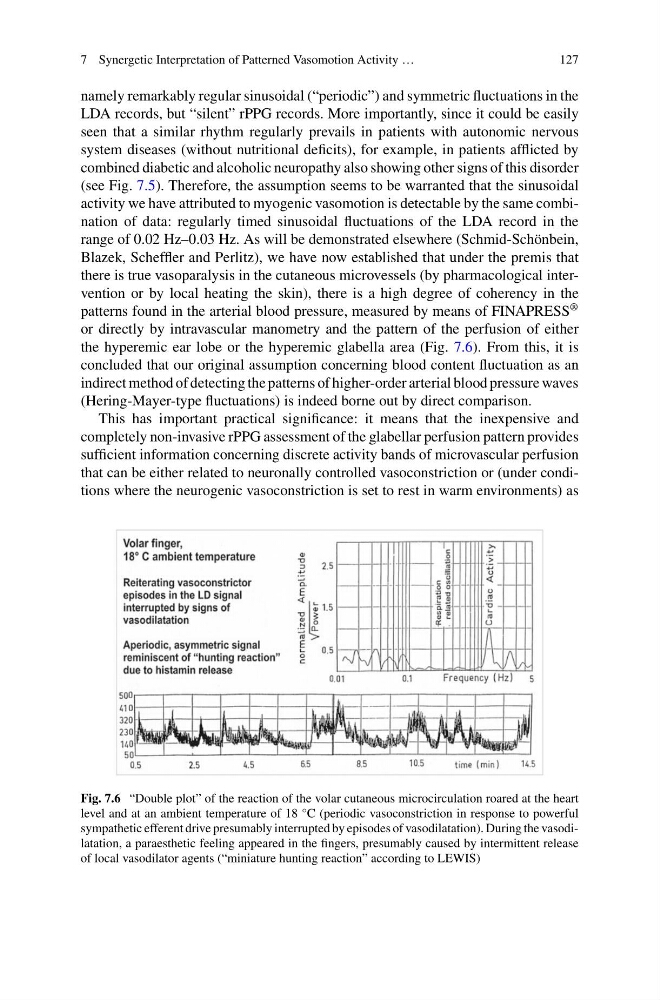
Fig. 7.6 “Double plot” of the reaction of the volar cutaneous microcirculation roared at the heart
level and at an ambient temperature of 18 °C (periodic vasoconstriction in response to powerful
sympathetic efferent drive presumably interrupted by episodes of vasodilatation). During the vasodilatation, a paraesthetic feeling appeared in the fingers, presumably caused by intermittent release
of local vasodilator agents (“miniature hunting reaction” according to LEWIS)
127
namely remarkably regular sinusoidal (“periodic”) and symmetric fluctuations in the
LDA records, but “silent” rPPG records. More importantly, since it could be easily
seen that a similar rhythm regularly prevails in patients with autonomic nervous
system diseases (without nutritional deficits), for example, in patients afflicted by
combined diabetic and alcoholic neuropathy also showing other signs of this disorder
(see Fig. 7.5). Therefore, the assumption seems to be warranted that the sinusoidal
activity we have attributed to myogenic vasomotion is detectable by the same combination of data: regularly timed sinusoidal fluctuations of the LDA record in the
range of 0.02 Hz–0.03 Hz. As will be demonstrated elsewhere (Schmid-Schönbein,
Blazek, Scheffler and Perlitz), we have now established that under the premis that
there is true vasoparalysis in the cutaneous microvessels (by pharmacological intervention or by local heating the skin), there is a high degree of coherency in the
patterns found in the arterial blood pressure, measured by means of FINAPRESS
®
or directly by intravascular manometry and the pattern of the perfusion of either
the hyperemic ear lobe or the hyperemic glabella area (Fig. 7.6). From this, it is
concluded that our original assumption concerning blood content fluctuation as an
indirect method of detecting the patterns of higher-order arterial blood pressure waves
(Hering-Mayer-type fluctuations) is indeed borne out by direct comparison.
This has important practical significance: it means that the inexpensive and
completely non-invasive rPPG assessment of the glabellar perfusion pattern provides
sufficient information concerning discrete activity bands of microvascular perfusion
that can be either related to neuronally controlled vasoconstriction or (under conditions where the neurogenic vasoconstriction is set to rest in warm environments) as
Fig. 7.6 “Double plot” of the reaction of the volar cutaneous microcirculation roared at the heart
level and at an ambient temperature of 18 °C (periodic vasoconstriction in response to powerful
sympathetic efferent drive presumably interrupted by episodes of vasodilatation). During the vasodilatation, a paraesthetic feeling appeared in the fingers, presumably caused by intermittent release
of local vasodilator agents (“miniature hunting reaction” according to LEWIS)