

7 Synergetic Interpretation of Patterned Vasomotion Activity …
121
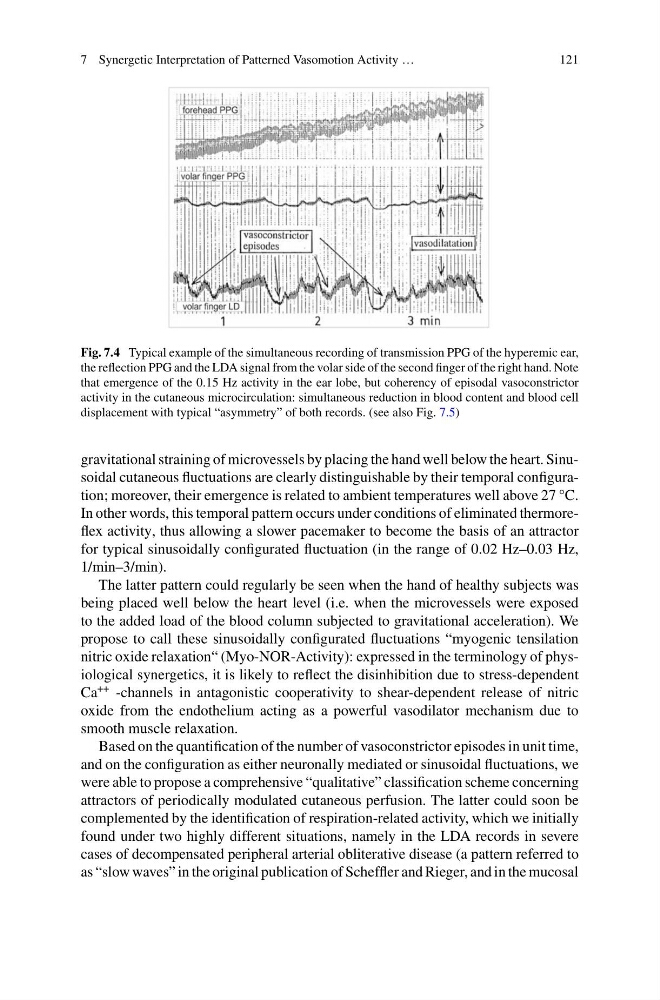
Fig. 7.4 Typical example of the simultaneous recording of transmission PPG of the hyperemic ear,
the reflection PPG and the LDA signal from the volar side of the second finger of the right hand. Note
that emergence of the 0.15 Hz activity in the ear lobe, but coherency of episodal vasoconstrictor
activity in the cutaneous microcirculation: simultaneous reduction in blood content and blood cell
displacement with typical “asymmetry” of both records. (see also Fig. 7.5)
gravitational straining of microvessels by placing the hand well below the heart. Sinusoidal cutaneous fluctuations are clearly distinguishable by their temporal configuration; moreover, their emergence is related to ambient temperatures well above 27 °C.
In other words, this temporal pattern occurs under conditions of eliminated thermoreflex activity, thus allowing a slower pacemaker to become the basis of an attractor
for typical sinusoidally configurated fluctuation (in the range of 0.02 Hz–0.03 Hz,
1/min–3/min).
The latter pattern could regularly be seen when the hand of healthy subjects was
being placed well below the heart level (i.e. when the microvessels were exposed
to the added load of the blood column subjected to gravitational acceleration). We
propose to call these sinusoidally configurated fluctuations “myogenic tensilation
nitric oxide relaxation“ (Myo-NOR-Activity): expressed in the terminology of physiological synergetics, it is likely to reflect the disinhibition due to stress-dependent
Ca
++ -channels in antagonistic cooperativity to shear-dependent release of nitric
oxide from the endothelium acting as a powerful vasodilator mechanism due to
smooth muscle relaxation.
Based on the quantification of the number of vasoconstrictor episodes in unit time,
and on the configuration as either neuronally mediated or sinusoidal fluctuations, we
were able to propose a comprehensive “qualitative” classification scheme concerning
attractors of periodically modulated cutaneous perfusion. The latter could soon be
complemented by the identification of respiration-related activity, which we initially
found under two highly different situations, namely in the LDA records in severe
cases of decompensated peripheral arterial obliterative disease (a pattern referred to
as “slow waves” in the original publication of Scheffler and Rieger, and in the mucosal
121
Fig. 7.4 Typical example of the simultaneous recording of transmission PPG of the hyperemic ear,
the reflection PPG and the LDA signal from the volar side of the second finger of the right hand. Note
that emergence of the 0.15 Hz activity in the ear lobe, but coherency of episodal vasoconstrictor
activity in the cutaneous microcirculation: simultaneous reduction in blood content and blood cell
displacement with typical “asymmetry” of both records. (see also Fig. 7.5)
gravitational straining of microvessels by placing the hand well below the heart. Sinusoidal cutaneous fluctuations are clearly distinguishable by their temporal configuration; moreover, their emergence is related to ambient temperatures well above 27 °C.
In other words, this temporal pattern occurs under conditions of eliminated thermoreflex activity, thus allowing a slower pacemaker to become the basis of an attractor
for typical sinusoidally configurated fluctuation (in the range of 0.02 Hz–0.03 Hz,
1/min–3/min).
The latter pattern could regularly be seen when the hand of healthy subjects was
being placed well below the heart level (i.e. when the microvessels were exposed
to the added load of the blood column subjected to gravitational acceleration). We
propose to call these sinusoidally configurated fluctuations “myogenic tensilation
nitric oxide relaxation“ (Myo-NOR-Activity): expressed in the terminology of physiological synergetics, it is likely to reflect the disinhibition due to stress-dependent
Ca
++ -channels in antagonistic cooperativity to shear-dependent release of nitric
oxide from the endothelium acting as a powerful vasodilator mechanism due to
smooth muscle relaxation.
Based on the quantification of the number of vasoconstrictor episodes in unit time,
and on the configuration as either neuronally mediated or sinusoidal fluctuations, we
were able to propose a comprehensive “qualitative” classification scheme concerning
attractors of periodically modulated cutaneous perfusion. The latter could soon be
complemented by the identification of respiration-related activity, which we initially
found under two highly different situations, namely in the LDA records in severe
cases of decompensated peripheral arterial obliterative disease (a pattern referred to
as “slow waves” in the original publication of Scheffler and Rieger, and in the mucosal