

110
H. J. Schmitt
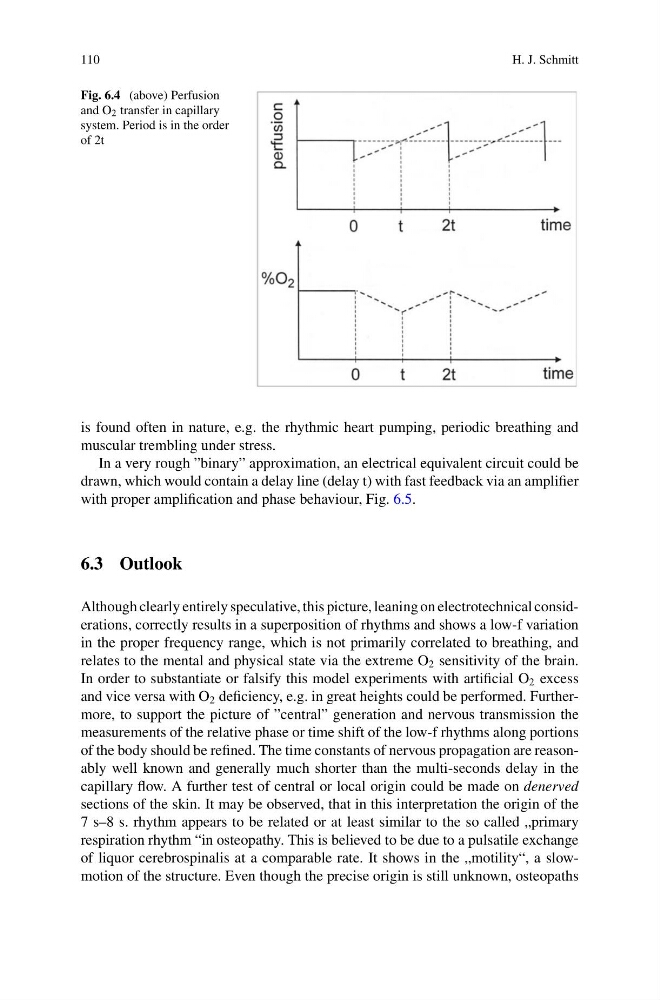
Fig. 6.4 (above) Perfusion
and O 2 transfer in capillary
system. Period is in the order
of 2t
is found often in nature, e.g. the rhythmic heart pumping, periodic breathing and
muscular trembling under stress.
In a very rough ”binary” approximation, an electrical equivalent circuit could be
drawn, which would contain a delay line (delay t) with fast feedback via an amplifier
with proper amplification and phase behaviour, Fig. 6.5.
6.3 Outlook
Although clearly entirely speculative, this picture, leaning on electrotechnical considerations, correctly results in a superposition of rhythms and shows a low-f variation
in the proper frequency range, which is not primarily correlated to breathing, and
relates to the mental and physical state via the extreme O 2 sensitivity of the brain.
In order to substantiate or falsify this model experiments with artificial O 2 excess
and vice versa with O 2 deficiency, e.g. in great heights could be performed. Furthermore, to support the picture of ”central” generation and nervous transmission the
measurements of the relative phase or time shift of the low-f rhythms along portions
of the body should be refined. The time constants of nervous propagation are reasonably well known and generally much shorter than the multi-seconds delay in the
capillary flow. A further test of central or local origin could be made on denerved
sections of the skin. It may be observed, that in this interpretation the origin of the
7 s–8 s. rhythm appears to be related or at least similar to the so called „primary
respiration rhythm “in osteopathy. This is believed to be due to a pulsatile exchange
of liquor cerebrospinalis at a comparable rate. It shows in the „motility“, a slowmotion of the structure. Even though the precise origin is still unknown, osteopaths
H. J. Schmitt
Fig. 6.4 (above) Perfusion
and O 2 transfer in capillary
system. Period is in the order
of 2t
is found often in nature, e.g. the rhythmic heart pumping, periodic breathing and
muscular trembling under stress.
In a very rough ”binary” approximation, an electrical equivalent circuit could be
drawn, which would contain a delay line (delay t) with fast feedback via an amplifier
with proper amplification and phase behaviour, Fig. 6.5.
6.3 Outlook
Although clearly entirely speculative, this picture, leaning on electrotechnical considerations, correctly results in a superposition of rhythms and shows a low-f variation
in the proper frequency range, which is not primarily correlated to breathing, and
relates to the mental and physical state via the extreme O 2 sensitivity of the brain.
In order to substantiate or falsify this model experiments with artificial O 2 excess
and vice versa with O 2 deficiency, e.g. in great heights could be performed. Furthermore, to support the picture of ”central” generation and nervous transmission the
measurements of the relative phase or time shift of the low-f rhythms along portions
of the body should be refined. The time constants of nervous propagation are reasonably well known and generally much shorter than the multi-seconds delay in the
capillary flow. A further test of central or local origin could be made on denerved
sections of the skin. It may be observed, that in this interpretation the origin of the
7 s–8 s. rhythm appears to be related or at least similar to the so called „primary
respiration rhythm “in osteopathy. This is believed to be due to a pulsatile exchange
of liquor cerebrospinalis at a comparable rate. It shows in the „motility“, a slowmotion of the structure. Even though the precise origin is still unknown, osteopaths