

94
V. Blazek and C. Blazek
task. Apart from the arterial oxygen saturation, a knowledge of oxygen saturation
in the veins will aid in analyzing the physiological functioning of the human cardio
pulmonary system in the maintenance of cellular oxygen usage [1]. Such a task would
be very beneficial, especially to patients suffering from cardio-pulmonary disorders,
if carried out noninvasively.
5.2 Some Physiological and Experimental Remarks
One of the substances transported with our blood is oxygen. On its way from the right
to the left heart, namely the pulmonary circulation, the deoxygenated blood flows
through oxygen-filled alveoli in the lung. The active red blood cells (with hemoglobin
as a very important component) absorb the oxygen and transport it to the farthest
tissue structure in the body. The oxygen is mainly carried by hemoglobin to which it
is chemically bound and exploited by different cells of the body. This process leads
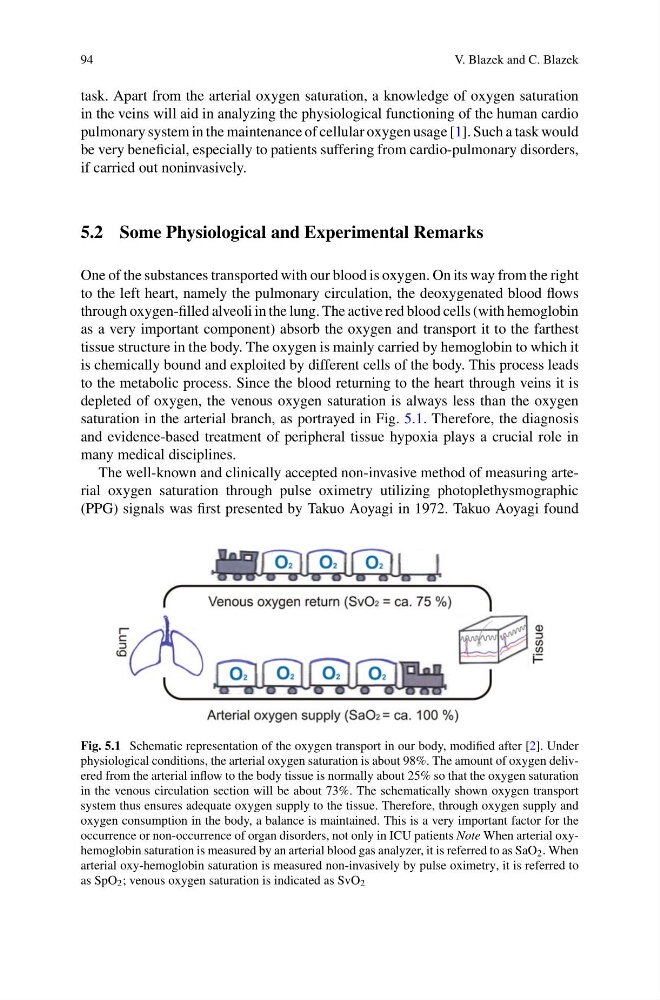
to the metabolic process. Since the blood returning to the heart through veins it is
depleted of oxygen, the venous oxygen saturation is always less than the oxygen
saturation in the arterial branch, as portrayed in Fig. 5.1. Therefore, the diagnosis
and evidence-based treatment of peripheral tissue hypoxia plays a crucial role in
many medical disciplines.
The well-known and clinically accepted non-invasive method of measuring arterial oxygen saturation through pulse oximetry utilizing photoplethysmographic
(PPG) signals was first presented by Takuo Aoyagi in 1972. Takuo Aoyagi found
Fig. 5.1 Schematic representation of the oxygen transport in our body, modified after [2]. Under
physiological conditions, the arterial oxygen saturation is about 98%. The amount of oxygen delivered from the arterial inflow to the body tissue is normally about 25% so that the oxygen saturation
in the venous circulation section will be about 73%. The schematically shown oxygen transport
system thus ensures adequate oxygen supply to the tissue. Therefore, through oxygen supply and
oxygen consumption in the body, a balance is maintained. This is a very important factor for the
occurrence or non-occurrence of organ disorders, not only in ICU patients Note When arterial oxyhemoglobin saturation is measured by an arterial blood gas analyzer, it is referred to as SaO 2 . When
arterial oxy-hemoglobin saturation is measured non-invasively by pulse oximetry, it is referred to
as SpO 2 ; venous oxygen saturation is indicated as SvO 2
V. Blazek and C. Blazek
task. Apart from the arterial oxygen saturation, a knowledge of oxygen saturation
in the veins will aid in analyzing the physiological functioning of the human cardio
pulmonary system in the maintenance of cellular oxygen usage [1]. Such a task would
be very beneficial, especially to patients suffering from cardio-pulmonary disorders,
if carried out noninvasively.
5.2 Some Physiological and Experimental Remarks
One of the substances transported with our blood is oxygen. On its way from the right
to the left heart, namely the pulmonary circulation, the deoxygenated blood flows
through oxygen-filled alveoli in the lung. The active red blood cells (with hemoglobin
as a very important component) absorb the oxygen and transport it to the farthest
tissue structure in the body. The oxygen is mainly carried by hemoglobin to which it
is chemically bound and exploited by different cells of the body. This process leads
to the metabolic process. Since the blood returning to the heart through veins it is
depleted of oxygen, the venous oxygen saturation is always less than the oxygen
saturation in the arterial branch, as portrayed in Fig. 5.1. Therefore, the diagnosis
and evidence-based treatment of peripheral tissue hypoxia plays a crucial role in
many medical disciplines.
The well-known and clinically accepted non-invasive method of measuring arterial oxygen saturation through pulse oximetry utilizing photoplethysmographic
(PPG) signals was first presented by Takuo Aoyagi in 1972. Takuo Aoyagi found
Fig. 5.1 Schematic representation of the oxygen transport in our body, modified after [2]. Under
physiological conditions, the arterial oxygen saturation is about 98%. The amount of oxygen delivered from the arterial inflow to the body tissue is normally about 25% so that the oxygen saturation
in the venous circulation section will be about 73%. The schematically shown oxygen transport
system thus ensures adequate oxygen supply to the tissue. Therefore, through oxygen supply and
oxygen consumption in the body, a balance is maintained. This is a very important factor for the
occurrence or non-occurrence of organ disorders, not only in ICU patients Note When arterial oxyhemoglobin saturation is measured by an arterial blood gas analyzer, it is referred to as SaO 2 . When
arterial oxy-hemoglobin saturation is measured non-invasively by pulse oximetry, it is referred to
as SpO 2 ; venous oxygen saturation is indicated as SvO 2