

S. polyrhiza is the most widely distributed
species and is suggested to be the most primitive
duckweed family member (Les et al. 2002) and is
therefore expected to have higher intra-specific
genetic diversity among the family. However, its
genetic diversity is very low as shown in the
samples collected in Hainan Province of China
(Xu et al. 2015), as well as in the samples of
Northeast China (Zhang et al. 2018) using two
chloroplast DNA marker sequences. Genetic
diversity analysis of global samples from the
genera Spirodela and Landoltia using three
plastidic sequences (rpL16, rpS16, atpF-atpH)
and AFLP fingerprinting also revealed low
genetic diversity in Spirodela (Bog et al. 2013).
The comparison of the two sequenced S. polyrhiza strains from the USA and Germany also
reveals few polymorphisms (Wang et al. 2014;
Michael et al. 2017) (Chap. 2). Recent studies on
duckweed accessions from China reveal that S.
polyrhiza has the lowest diversity, followed by
Lan. punctata and L. aequinoctialis. Meanwhile,
W. globosa has the highest diversity, which is not
in parallel with the evolutionary history of the
duckweed family. However, there is not enough
data available to illustrate the underlying
mechanism.
5.3 Species Identification
of Duckweed Based on DNA
Barcoding
Traditionally, taxonomists use taxonomic keys
based on morphological characters of vegetative
and floral parts to identify plant species. For
identification in this traditional way, one usually
needs to have both vegetative and floral parts,
and the missing of anyone can cause difficulties
and mistakes in identification. Due to its minute
size and rare flowering, duckweed is very difficult to properly identify at the species level using
morphological characters (Les et al. 1997).
DNA barcodes are used as molecular identifiers for living species in the same way as
machine-readable black and white barcodes
applied in the retail industry for identification of
commercial products. The application of DNA
barcodes needs the establishment of a comprehensive library that links organisms and their
barcodes, just as is done in the commercial barcodes (Ali et al. 2016). A strong barcode needs to
have appropriate threshold between inter- and
intra-specific genetic distances, i.e., the difference in sequences between species should be
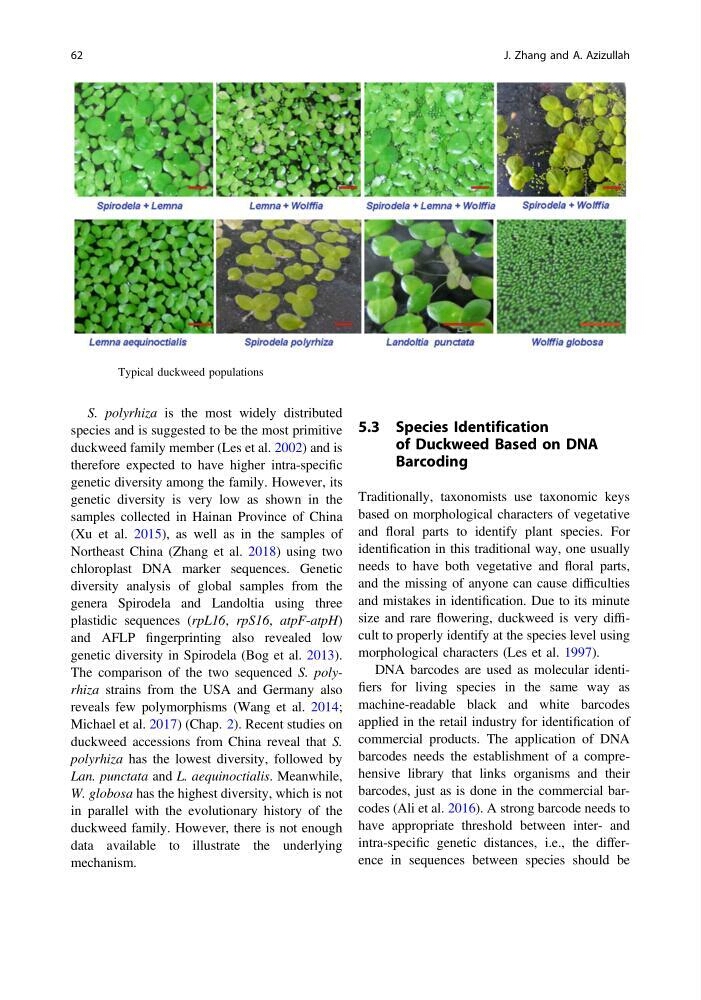
Fig. 5.1 Typical duckweed populations
62
J. Zhang and A. Azizullah
species and is suggested to be the most primitive
duckweed family member (Les et al. 2002) and is
therefore expected to have higher intra-specific
genetic diversity among the family. However, its
genetic diversity is very low as shown in the
samples collected in Hainan Province of China
(Xu et al. 2015), as well as in the samples of
Northeast China (Zhang et al. 2018) using two
chloroplast DNA marker sequences. Genetic
diversity analysis of global samples from the
genera Spirodela and Landoltia using three
plastidic sequences (rpL16, rpS16, atpF-atpH)
and AFLP fingerprinting also revealed low
genetic diversity in Spirodela (Bog et al. 2013).
The comparison of the two sequenced S. polyrhiza strains from the USA and Germany also
reveals few polymorphisms (Wang et al. 2014;
Michael et al. 2017) (Chap. 2). Recent studies on
duckweed accessions from China reveal that S.
polyrhiza has the lowest diversity, followed by
Lan. punctata and L. aequinoctialis. Meanwhile,
W. globosa has the highest diversity, which is not
in parallel with the evolutionary history of the
duckweed family. However, there is not enough
data available to illustrate the underlying
mechanism.
5.3 Species Identification
of Duckweed Based on DNA
Barcoding
Traditionally, taxonomists use taxonomic keys
based on morphological characters of vegetative
and floral parts to identify plant species. For
identification in this traditional way, one usually
needs to have both vegetative and floral parts,
and the missing of anyone can cause difficulties
and mistakes in identification. Due to its minute
size and rare flowering, duckweed is very difficult to properly identify at the species level using
morphological characters (Les et al. 1997).
DNA barcodes are used as molecular identifiers for living species in the same way as
machine-readable black and white barcodes
applied in the retail industry for identification of
commercial products. The application of DNA
barcodes needs the establishment of a comprehensive library that links organisms and their
barcodes, just as is done in the commercial barcodes (Ali et al. 2016). A strong barcode needs to
have appropriate threshold between inter- and
intra-specific genetic distances, i.e., the difference in sequences between species should be
Fig. 5.1 Typical duckweed populations
62
J. Zhang and A. Azizullah