

While a variety of plants have been used
effectively in constructed wetlands, we will focus
here on the 37 species of the Lemnaceae family
for their global distribution, tolerance of ammonia, heavy metals, other stresses, high yield of
biomass (especially at 20–30 °C), ease of harvest, high protein and starch content, and range
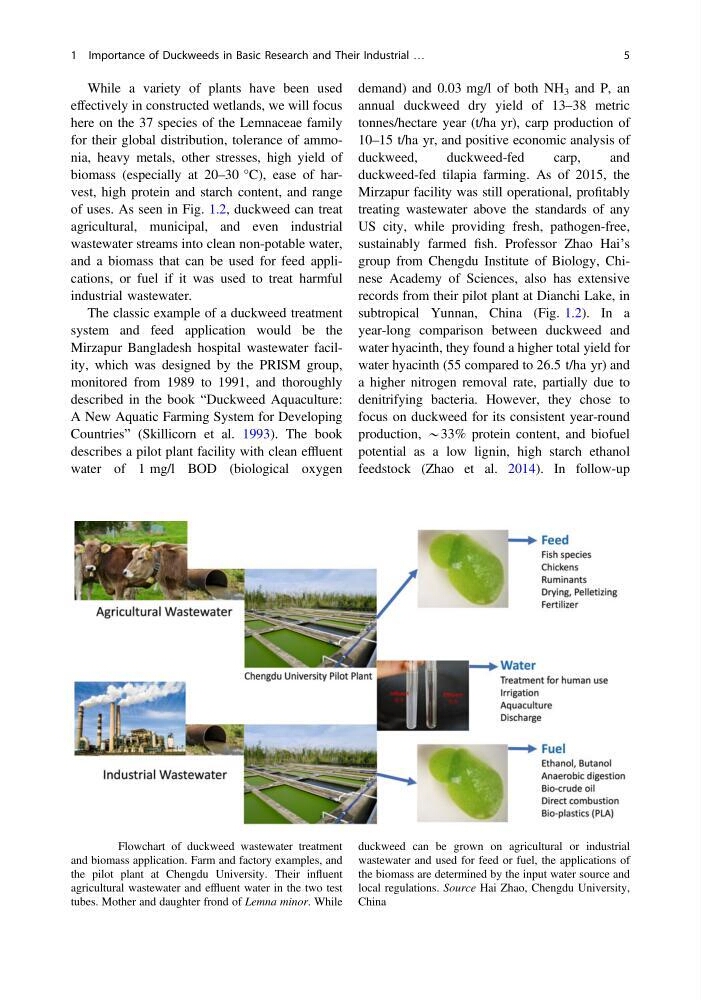
of uses. As seen in Fig. 1.2, duckweed can treat
agricultural, municipal, and even industrial
wastewater streams into clean non-potable water,
and a biomass that can be used for feed applications, or fuel if it was used to treat harmful
industrial wastewater.
The classic example of a duckweed treatment
system and feed application would be the
Mirzapur Bangladesh hospital wastewater facility, which was designed by the PRISM group,
monitored from 1989 to 1991, and thoroughly
described in the book “Duckweed Aquaculture:
A New Aquatic Farming System for Developing
Countries” (Skillicorn et al. 1993). The book
describes a pilot plant facility with clean effluent
water of 1 mg/l BOD (biological oxygen
demand) and 0.03 mg/l of both NH 3 and P, an
annual duckweed dry yield of 13–38 metric
tonnes/hectare year (t/ha yr), carp production of
10–15 t/ha yr, and positive economic analysis of
duckweed,
duckweed-fed
carp,
and
duckweed-fed tilapia farming. As of 2015, the
Mirzapur facility was still operational, profitably
treating wastewater above the standards of any
US city, while providing fresh, pathogen-free,
sustainably farmed fish. Professor Zhao Hai’s
group from Chengdu Institute of Biology, Chinese Academy of Sciences, also has extensive
records from their pilot plant at Dianchi Lake, in
subtropical Yunnan, China (Fig. 1.2). In a
year-long comparison between duckweed and
water hyacinth, they found a higher total yield for
water hyacinth (55 compared to 26.5 t/ha yr) and
a higher nitrogen removal rate, partially due to
denitrifying bacteria. However, they chose to
focus on duckweed for its consistent year-round
production, *33% protein content, and biofuel
potential as a low lignin, high starch ethanol
feedstock (Zhao et al. 2014). In follow-up
Fig. 1.2 Flowchart of duckweed wastewater treatment
and biomass application. Farm and factory examples, and
the pilot plant at Chengdu University. Their influent
agricultural wastewater and effluent water in the two test
tubes. Mother and daughter frond of Lemna minor. While
duckweed can be grown on agricultural or industrial
wastewater and used for feed or fuel, the applications of
the biomass are determined by the input water source and
local regulations. Source Hai Zhao, Chengdu University,
China
1 Importance of Duckweeds in Basic Research and Their Industrial …
5
effectively in constructed wetlands, we will focus
here on the 37 species of the Lemnaceae family
for their global distribution, tolerance of ammonia, heavy metals, other stresses, high yield of
biomass (especially at 20–30 °C), ease of harvest, high protein and starch content, and range
of uses. As seen in Fig. 1.2, duckweed can treat
agricultural, municipal, and even industrial
wastewater streams into clean non-potable water,
and a biomass that can be used for feed applications, or fuel if it was used to treat harmful
industrial wastewater.
The classic example of a duckweed treatment
system and feed application would be the
Mirzapur Bangladesh hospital wastewater facility, which was designed by the PRISM group,
monitored from 1989 to 1991, and thoroughly
described in the book “Duckweed Aquaculture:
A New Aquatic Farming System for Developing
Countries” (Skillicorn et al. 1993). The book
describes a pilot plant facility with clean effluent
water of 1 mg/l BOD (biological oxygen
demand) and 0.03 mg/l of both NH 3 and P, an
annual duckweed dry yield of 13–38 metric
tonnes/hectare year (t/ha yr), carp production of
10–15 t/ha yr, and positive economic analysis of
duckweed,
duckweed-fed
carp,
and
duckweed-fed tilapia farming. As of 2015, the
Mirzapur facility was still operational, profitably
treating wastewater above the standards of any
US city, while providing fresh, pathogen-free,
sustainably farmed fish. Professor Zhao Hai’s
group from Chengdu Institute of Biology, Chinese Academy of Sciences, also has extensive
records from their pilot plant at Dianchi Lake, in
subtropical Yunnan, China (Fig. 1.2). In a
year-long comparison between duckweed and
water hyacinth, they found a higher total yield for
water hyacinth (55 compared to 26.5 t/ha yr) and
a higher nitrogen removal rate, partially due to
denitrifying bacteria. However, they chose to
focus on duckweed for its consistent year-round
production, *33% protein content, and biofuel
potential as a low lignin, high starch ethanol
feedstock (Zhao et al. 2014). In follow-up
Fig. 1.2 Flowchart of duckweed wastewater treatment
and biomass application. Farm and factory examples, and
the pilot plant at Chengdu University. Their influent
agricultural wastewater and effluent water in the two test
tubes. Mother and daughter frond of Lemna minor. While
duckweed can be grown on agricultural or industrial
wastewater and used for feed or fuel, the applications of
the biomass are determined by the input water source and
local regulations. Source Hai Zhao, Chengdu University,
China
1 Importance of Duckweeds in Basic Research and Their Industrial …
5