

1.1 Introduction
Duckweed (known as monocotyledon family
Lemnaceae or recently classified as subfamily
Lemnoideae in the arum or aroid family Araceae)
is a small group of aquatic plants with only five
genera (Spirodela, Landoltia, Lemna, Wolffia,
and Wolffiella) and 37 species (see Landolt 1986;
Nauheimer et al. 2012; Sree et al. 2016). Except
for Wolffiella (commonly named as bogmat) that
is restricted to the Americas and Africa, species of
other duckweed genera occur around the whole
world. Although highly adaptable across a broad
range of climates, most diverse species of duckweed appear in the subtropical or tropical zones.
Duckweed species tend to be associated with
nutrient-rich or eutrophic freshwater environments with quiet or slow-moving flow. However,
they are extremely rare in deserts and are absent
in the cold polar regions (Arctic and Antarctica).
Duckweed species are the smallest flowering
plants with minute sizes from 0.5 mm to less
than two cm (Landolt 1986). Species of duckweed can be easily distinguished morphologically from species of any other flowering plants,
even closely related aquatic plants, due to their
highly reduced body structure. The leaflike body
of the duckweed species, sometimes called a
frond or thallus, is a modified stem with only few
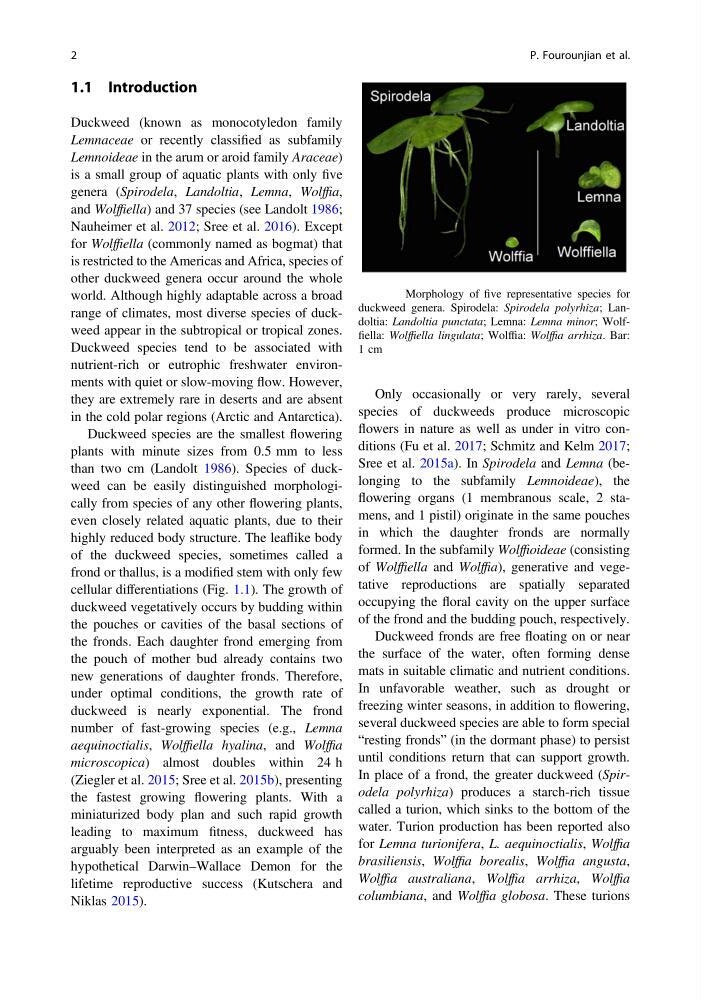
cellular differentiations (Fig. 1.1). The growth of
duckweed vegetatively occurs by budding within
the pouches or cavities of the basal sections of
the fronds. Each daughter frond emerging from
the pouch of mother bud already contains two
new generations of daughter fronds. Therefore,
under optimal conditions, the growth rate of
duckweed is nearly exponential. The frond
number of fast-growing species (e.g., Lemna
aequinoctialis, Wolffiella hyalina, and Wolffia
microscopica) almost doubles within 24 h
(Ziegler et al. 2015; Sree et al. 2015b), presenting
the fastest growing flowering plants. With a
miniaturized body plan and such rapid growth
leading to maximum fitness, duckweed has
arguably been interpreted as an example of the
hypothetical Darwin–Wallace Demon for the
lifetime reproductive success (Kutschera and
Niklas 2015).
Only occasionally or very rarely, several
species of duckweeds produce microscopic
flowers in nature as well as under in vitro conditions (Fu et al. 2017; Schmitz and Kelm 2017;
Sree et al. 2015a). In Spirodela and Lemna (belonging to the subfamily Lemnoideae), the
flowering organs (1 membranous scale, 2 stamens, and 1 pistil) originate in the same pouches
in which the daughter fronds are normally
formed. In the subfamily Wolffioideae (consisting
of Wolffiella and Wolffia), generative and vegetative reproductions are spatially separated
occupying the floral cavity on the upper surface
of the frond and the budding pouch, respectively.
Duckweed fronds are free floating on or near
the surface of the water, often forming dense
mats in suitable climatic and nutrient conditions.
In unfavorable weather, such as drought or
freezing winter seasons, in addition to flowering,
several duckweed species are able to form special
“resting fronds” (in the dormant phase) to persist
until conditions return that can support growth.
In place of a frond, the greater duckweed (Spirodela polyrhiza) produces a starch-rich tissue
called a turion, which sinks to the bottom of the
water. Turion production has been reported also
for Lemna turionifera, L. aequinoctialis, Wolffia
brasiliensis, Wolffia borealis, Wolffia angusta,
Wolffia australiana, Wolffia arrhiza, Wolffia
columbiana, and Wolffia globosa. These turions
Fig. 1.1 Morphology of five representative species for
duckweed genera. Spirodela: Spirodela polyrhiza; Landoltia: Landoltia punctata; Lemna: Lemna minor; Wolffiella: Wolffiella lingulata; Wolffia: Wolffia arrhiza. Bar:
1 cm
2
P. Fourounjian et al.
Duckweed (known as monocotyledon family
Lemnaceae or recently classified as subfamily
Lemnoideae in the arum or aroid family Araceae)
is a small group of aquatic plants with only five
genera (Spirodela, Landoltia, Lemna, Wolffia,
and Wolffiella) and 37 species (see Landolt 1986;
Nauheimer et al. 2012; Sree et al. 2016). Except
for Wolffiella (commonly named as bogmat) that
is restricted to the Americas and Africa, species of
other duckweed genera occur around the whole
world. Although highly adaptable across a broad
range of climates, most diverse species of duckweed appear in the subtropical or tropical zones.
Duckweed species tend to be associated with
nutrient-rich or eutrophic freshwater environments with quiet or slow-moving flow. However,
they are extremely rare in deserts and are absent
in the cold polar regions (Arctic and Antarctica).
Duckweed species are the smallest flowering
plants with minute sizes from 0.5 mm to less
than two cm (Landolt 1986). Species of duckweed can be easily distinguished morphologically from species of any other flowering plants,
even closely related aquatic plants, due to their
highly reduced body structure. The leaflike body
of the duckweed species, sometimes called a
frond or thallus, is a modified stem with only few
cellular differentiations (Fig. 1.1). The growth of
duckweed vegetatively occurs by budding within
the pouches or cavities of the basal sections of
the fronds. Each daughter frond emerging from
the pouch of mother bud already contains two
new generations of daughter fronds. Therefore,
under optimal conditions, the growth rate of
duckweed is nearly exponential. The frond
number of fast-growing species (e.g., Lemna
aequinoctialis, Wolffiella hyalina, and Wolffia
microscopica) almost doubles within 24 h
(Ziegler et al. 2015; Sree et al. 2015b), presenting
the fastest growing flowering plants. With a
miniaturized body plan and such rapid growth
leading to maximum fitness, duckweed has
arguably been interpreted as an example of the
hypothetical Darwin–Wallace Demon for the
lifetime reproductive success (Kutschera and
Niklas 2015).
Only occasionally or very rarely, several
species of duckweeds produce microscopic
flowers in nature as well as under in vitro conditions (Fu et al. 2017; Schmitz and Kelm 2017;
Sree et al. 2015a). In Spirodela and Lemna (belonging to the subfamily Lemnoideae), the
flowering organs (1 membranous scale, 2 stamens, and 1 pistil) originate in the same pouches
in which the daughter fronds are normally
formed. In the subfamily Wolffioideae (consisting
of Wolffiella and Wolffia), generative and vegetative reproductions are spatially separated
occupying the floral cavity on the upper surface
of the frond and the budding pouch, respectively.
Duckweed fronds are free floating on or near
the surface of the water, often forming dense
mats in suitable climatic and nutrient conditions.
In unfavorable weather, such as drought or
freezing winter seasons, in addition to flowering,
several duckweed species are able to form special
“resting fronds” (in the dormant phase) to persist
until conditions return that can support growth.
In place of a frond, the greater duckweed (Spirodela polyrhiza) produces a starch-rich tissue
called a turion, which sinks to the bottom of the
water. Turion production has been reported also
for Lemna turionifera, L. aequinoctialis, Wolffia
brasiliensis, Wolffia borealis, Wolffia angusta,
Wolffia australiana, Wolffia arrhiza, Wolffia
columbiana, and Wolffia globosa. These turions
Fig. 1.1 Morphology of five representative species for
duckweed genera. Spirodela: Spirodela polyrhiza; Landoltia: Landoltia punctata; Lemna: Lemna minor; Wolffiella: Wolffiella lingulata; Wolffia: Wolffia arrhiza. Bar:
1 cm
2
P. Fourounjian et al.