

targets sequenced in over half of the conditions,
71% of the cleaved targets were sequence
specific underscoring the importance of sampling
a variety of post-transcriptional responses.
Notably sucrose had the largest number of
condition-specific results including metabolic
and signaling proteins indicating a large shift in
the mixotrophic lifestyle. This included a complete reversal where miR172 went from cleaving
half as many targets as miR156 to twice as many
despite being 0.4% of its expression. This suggested that sucrose may be inducing a less
neotenous phenotype, and that highly expressed
miRNAs are not necessarily highly active. Of the
81 novel miRNAs predicted within the three
separate experiments of Spirodela, 24 were validated with 66 targets. This 30% validation rate,
evenly spread between the three experiments, is
consistent with similar surveys in other plant
genomes thanks to the low expression and
number of targets compared to conserved miRNAs, and the likelihood that novel miRNAs may
be false predictions (Song et al. 2010; Li et al.
2010; Yang et al. 2013). While degradome evidence is a great way to confirm miRNAs, it does
require co-expression and mRNA cleavage
meaning that non-supported miRNAs may be
found as active in later experiments with the right
conditions and sequencing depth.
In order to provide other scientists easy access
for further analysis, the raw data is available for
LT5a results at GSE55208, 9509 at
PRJNA308109, and 7498 at PRJNA473779
(SRP149336). As a second approach to increase
transparency, ease replication, and enable further
research, the data from the 2018 study and some
of its analysis can be viewed in the Galaxy server
as a history of the analysis, which includes the
option of extracting the workflow and adapting it
to analyze similar data Spirodela7498Galaxyhistory (Afgan et al. 2016). Then, as a third
method to make the data quick to review and
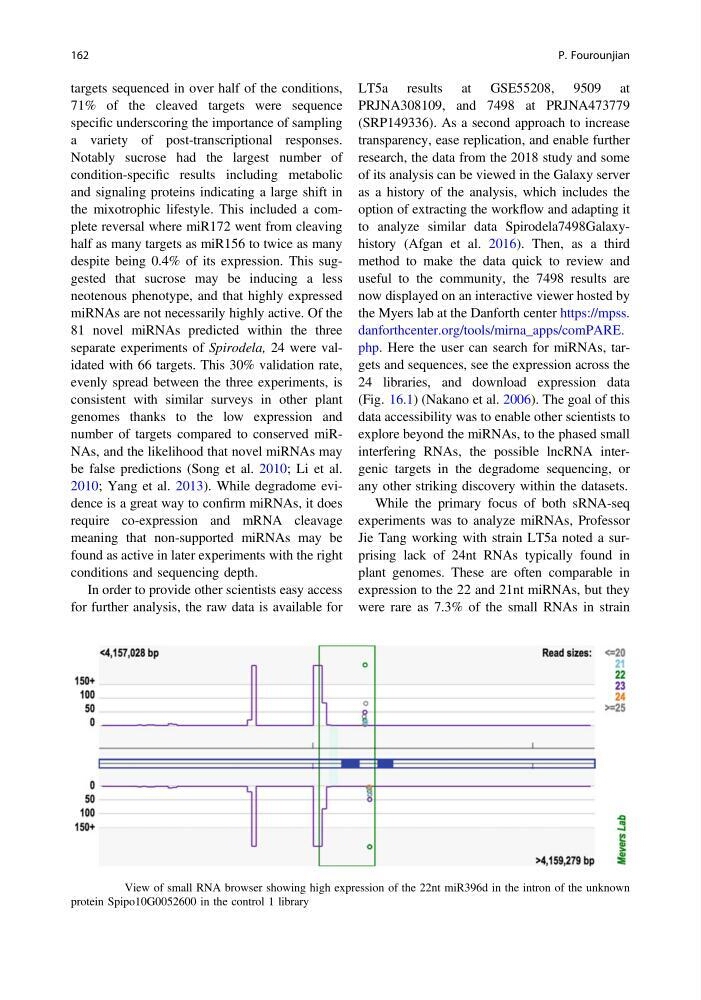
useful to the community, the 7498 results are
now displayed on an interactive viewer hosted by
the Myers lab at the Danforth center https://mpss.
danforthcenter.org/tools/mirna_apps/comPARE.
php. Here the user can search for miRNAs, targets and sequences, see the expression across the
24 libraries, and download expression data
(Fig. 16.1) (Nakano et al. 2006). The goal of this
data accessibility was to enable other scientists to
explore beyond the miRNAs, to the phased small
interfering RNAs, the possible lncRNA intergenic targets in the degradome sequencing, or
any other striking discovery within the datasets.
While the primary focus of both sRNA-seq
experiments was to analyze miRNAs, Professor
Jie Tang working with strain LT5a noted a surprising lack of 24nt RNAs typically found in
plant genomes. These are often comparable in
expression to the 22 and 21nt miRNAs, but they
were rare as 7.3% of the small RNAs in strain
Fig. 16.1 View of small RNA browser showing high expression of the 22nt miR396d in the intron of the unknown
protein Spipo10G0052600 in the control 1 library
162
P. Fourounjian
71% of the cleaved targets were sequence
specific underscoring the importance of sampling
a variety of post-transcriptional responses.
Notably sucrose had the largest number of
condition-specific results including metabolic
and signaling proteins indicating a large shift in
the mixotrophic lifestyle. This included a complete reversal where miR172 went from cleaving
half as many targets as miR156 to twice as many
despite being 0.4% of its expression. This suggested that sucrose may be inducing a less
neotenous phenotype, and that highly expressed
miRNAs are not necessarily highly active. Of the
81 novel miRNAs predicted within the three
separate experiments of Spirodela, 24 were validated with 66 targets. This 30% validation rate,
evenly spread between the three experiments, is
consistent with similar surveys in other plant
genomes thanks to the low expression and
number of targets compared to conserved miRNAs, and the likelihood that novel miRNAs may
be false predictions (Song et al. 2010; Li et al.
2010; Yang et al. 2013). While degradome evidence is a great way to confirm miRNAs, it does
require co-expression and mRNA cleavage
meaning that non-supported miRNAs may be
found as active in later experiments with the right
conditions and sequencing depth.
In order to provide other scientists easy access
for further analysis, the raw data is available for
LT5a results at GSE55208, 9509 at
PRJNA308109, and 7498 at PRJNA473779
(SRP149336). As a second approach to increase
transparency, ease replication, and enable further
research, the data from the 2018 study and some
of its analysis can be viewed in the Galaxy server
as a history of the analysis, which includes the
option of extracting the workflow and adapting it
to analyze similar data Spirodela7498Galaxyhistory (Afgan et al. 2016). Then, as a third
method to make the data quick to review and
useful to the community, the 7498 results are
now displayed on an interactive viewer hosted by
the Myers lab at the Danforth center https://mpss.
danforthcenter.org/tools/mirna_apps/comPARE.
php. Here the user can search for miRNAs, targets and sequences, see the expression across the
24 libraries, and download expression data
(Fig. 16.1) (Nakano et al. 2006). The goal of this
data accessibility was to enable other scientists to
explore beyond the miRNAs, to the phased small
interfering RNAs, the possible lncRNA intergenic targets in the degradome sequencing, or
any other striking discovery within the datasets.
While the primary focus of both sRNA-seq
experiments was to analyze miRNAs, Professor
Jie Tang working with strain LT5a noted a surprising lack of 24nt RNAs typically found in
plant genomes. These are often comparable in
expression to the 22 and 21nt miRNAs, but they
were rare as 7.3% of the small RNAs in strain
Fig. 16.1 View of small RNA browser showing high expression of the 22nt miR396d in the intron of the unknown
protein Spipo10G0052600 in the control 1 library
162
P. Fourounjian