

The starch content ranges from 3 to 75% (dry
weight) depended on duckweed species and
growing conditions (Cui et al. 2011). The starch
produced in duckweed is mainly native small
granular starch (with diameter lower than 10 lm)
presenting higher gelatinization temperature,
lower viscosity than large granular starch (with
diameter greater than 10 lm), and B-type starch,
which showing the potential utilization of starch
from duckweed in food and non-food industries
(Chen et al. 2016). Besides, duckweeds can be
used for animal feed or fertilizer supplement for
the high protein content varying from 15 to 45%
of the dry weight (Cui et al. 2011).
The founding that DNA contains all of the
genetic information that directs to construct an
organism led to the principal dogma of molecular
biology, which described a unidirectional flow of
information from DNA to RNA to proteins
(Crick 1970). The study of proteins, as key
molecular entities, and the cell proteome, as a
whole, is a challenging work, because of its
complexity. Mass spectrometry-based proteomics is a current most effective way to study
proteomes; because of high throughput, the raw
data of mass spectrometry (MS) can result in up
to 100,000-peptide spectra depended on the
samples. So, proteomics, different from other
omics, needs a dry lab, time-consuming in data
mining. Quantitative protein expression profiling
should identify the components of a proteome
and compare the altered expression levels of two
or more difference proteomes in response to a
given treatment. iTRAQ, for isobaric tags for
relative and absolute quantification, primary
amino groups (the N-terminus and lysine side
chains) of peptides are labeled chemically; there
are eight different labels can be used to allow
mixing of samples originating from different
conditions or treatments for simultaneous analysis in a mass spectrometer (Angel et al. 2012).
The iTRAQ technology had been used for proteome analysis during duckweed starch production recently (Huang et al. 2014, 2015).
Some transcriptome sequencing analysis had
been carried out to address underlying physiological mechanism of duckweed response to changing
environments. Although the protein concentrations
are represented by the corresponding mRNA
expression levels over a long period of time, a
large number of studies are changing our understanding of protein expression regulation. Proteomics can directly reflect what plants have done
responding to the external environment. There are
fewer studies on duckweed proteome analysis than
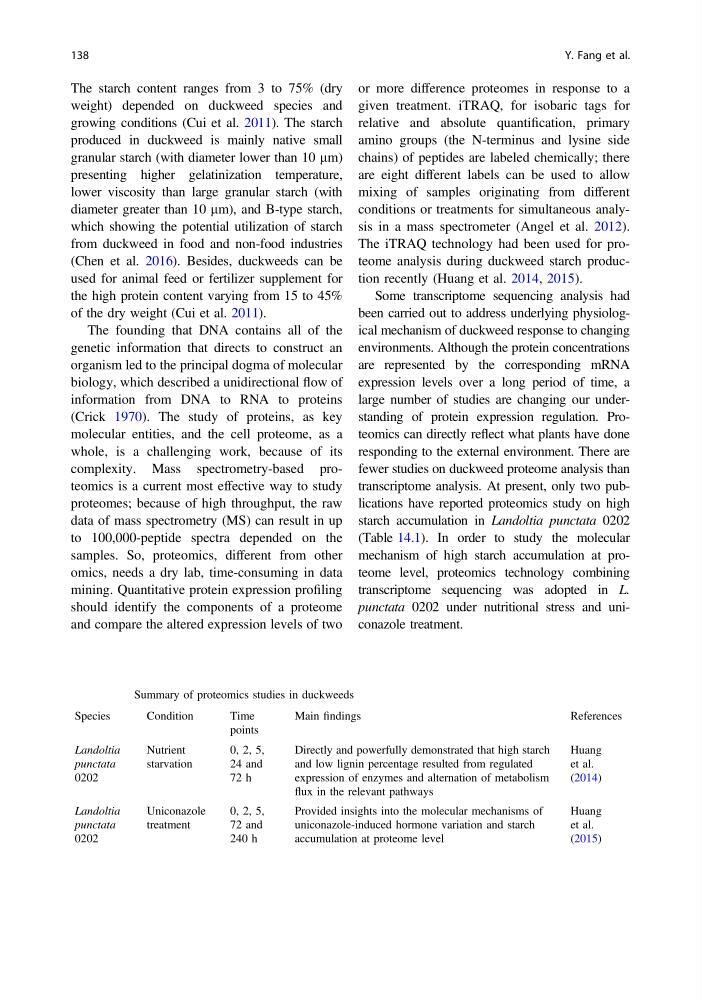
transcriptome analysis. At present, only two publications have reported proteomics study on high
starch accumulation in Landoltia punctata 0202
(Table 14.1). In order to study the molecular
mechanism of high starch accumulation at proteome level, proteomics technology combining
transcriptome sequencing was adopted in L.
punctata 0202 under nutritional stress and uniconazole treatment.
Table 14.1 Summary of proteomics studies in duckweeds
Species
Condition
Time
points
Main findings
References
Landoltia
punctata
0202
Nutrient
starvation
0, 2, 5,
24 and
72 h
Directly and powerfully demonstrated that high starch
and low lignin percentage resulted from regulated
expression of enzymes and alternation of metabolism
flux in the relevant pathways
Huang
et al.
(2014)
Landoltia
punctata
0202
Uniconazole
treatment
0, 2, 5,
72 and
240 h
Provided insights into the molecular mechanisms of
uniconazole-induced hormone variation and starch
accumulation at proteome level
Huang
et al.
(2015)
138
Y. Fang et al.
weight) depended on duckweed species and
growing conditions (Cui et al. 2011). The starch
produced in duckweed is mainly native small
granular starch (with diameter lower than 10 lm)
presenting higher gelatinization temperature,
lower viscosity than large granular starch (with
diameter greater than 10 lm), and B-type starch,
which showing the potential utilization of starch
from duckweed in food and non-food industries
(Chen et al. 2016). Besides, duckweeds can be
used for animal feed or fertilizer supplement for
the high protein content varying from 15 to 45%
of the dry weight (Cui et al. 2011).
The founding that DNA contains all of the
genetic information that directs to construct an
organism led to the principal dogma of molecular
biology, which described a unidirectional flow of
information from DNA to RNA to proteins
(Crick 1970). The study of proteins, as key
molecular entities, and the cell proteome, as a
whole, is a challenging work, because of its
complexity. Mass spectrometry-based proteomics is a current most effective way to study
proteomes; because of high throughput, the raw
data of mass spectrometry (MS) can result in up
to 100,000-peptide spectra depended on the
samples. So, proteomics, different from other
omics, needs a dry lab, time-consuming in data
mining. Quantitative protein expression profiling
should identify the components of a proteome
and compare the altered expression levels of two
or more difference proteomes in response to a
given treatment. iTRAQ, for isobaric tags for
relative and absolute quantification, primary
amino groups (the N-terminus and lysine side
chains) of peptides are labeled chemically; there
are eight different labels can be used to allow
mixing of samples originating from different
conditions or treatments for simultaneous analysis in a mass spectrometer (Angel et al. 2012).
The iTRAQ technology had been used for proteome analysis during duckweed starch production recently (Huang et al. 2014, 2015).
Some transcriptome sequencing analysis had
been carried out to address underlying physiological mechanism of duckweed response to changing
environments. Although the protein concentrations
are represented by the corresponding mRNA
expression levels over a long period of time, a
large number of studies are changing our understanding of protein expression regulation. Proteomics can directly reflect what plants have done
responding to the external environment. There are
fewer studies on duckweed proteome analysis than
transcriptome analysis. At present, only two publications have reported proteomics study on high
starch accumulation in Landoltia punctata 0202
(Table 14.1). In order to study the molecular
mechanism of high starch accumulation at proteome level, proteomics technology combining
transcriptome sequencing was adopted in L.
punctata 0202 under nutritional stress and uniconazole treatment.
Table 14.1 Summary of proteomics studies in duckweeds
Species
Condition
Time
points
Main findings
References
Landoltia
punctata
0202
Nutrient
starvation
0, 2, 5,
24 and
72 h
Directly and powerfully demonstrated that high starch
and low lignin percentage resulted from regulated
expression of enzymes and alternation of metabolism
flux in the relevant pathways
Huang
et al.
(2014)
Landoltia
punctata
0202
Uniconazole
treatment
0, 2, 5,
72 and
240 h
Provided insights into the molecular mechanisms of
uniconazole-induced hormone variation and starch
accumulation at proteome level
Huang
et al.
(2015)
138
Y. Fang et al.