

the transcripts of some transporters were
up-regulated within the first 2 h. Additionally,
the expression of most transcripts encoding key
enzymes involved in flavonoid biosynthesis was
up-regulated drastically regardless of starvation,
while the expression of the last rate-limiting
enzyme of lignification, laccase, presented very
low in all the three samples. Furthermore, the
expression of genes involved in starch biosynthesis was confirmed by quantitative reverse
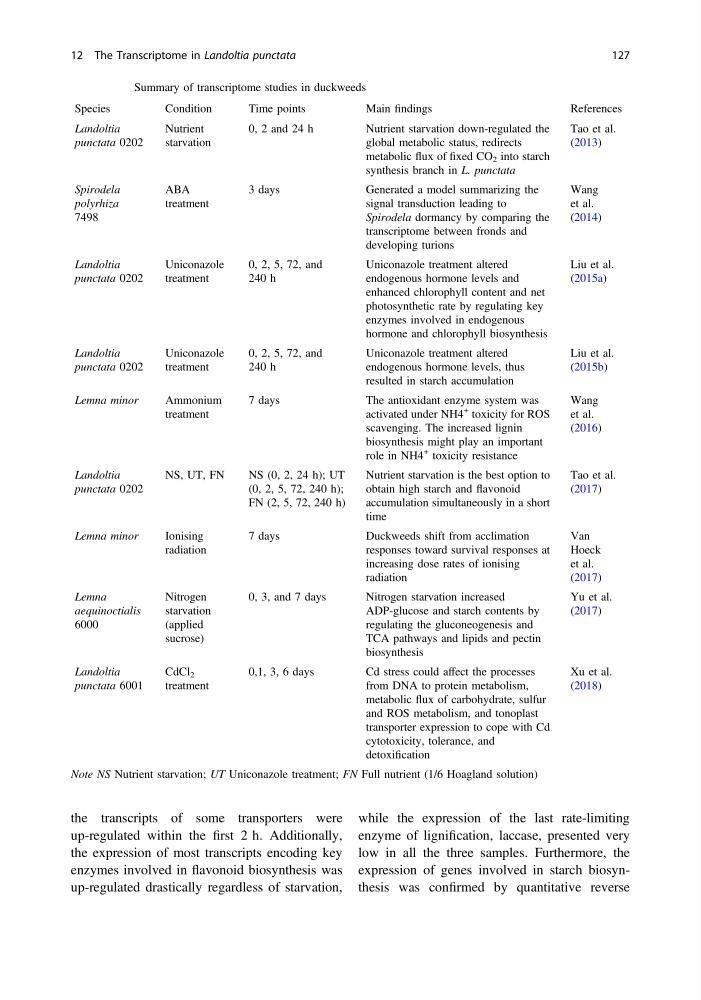
Table 12.1 Summary of transcriptome studies in duckweeds
Species
Condition
Time points
Main findings
References
Landoltia
punctata 0202
Nutrient
starvation
0, 2 and 24 h
Nutrient starvation down-regulated the
global metabolic status, redirects
metabolic flux of fixed CO 2 into starch
synthesis branch in L. punctata
Tao et al.
(2013)
Spirodela
polyrhiza
7498
ABA
treatment
3 days
Generated a model summarizing the
signal transduction leading to
Spirodela dormancy by comparing the
transcriptome between fronds and
developing turions
Wang
et al.
(2014)
Landoltia
punctata 0202
Uniconazole
treatment
0, 2, 5, 72, and
240 h
Uniconazole treatment altered
endogenous hormone levels and
enhanced chlorophyll content and net
photosynthetic rate by regulating key
enzymes involved in endogenous
hormone and chlorophyll biosynthesis
Liu et al.
(2015a)
Landoltia
punctata 0202
Uniconazole
treatment
0, 2, 5, 72, and
240 h
Uniconazole treatment altered
endogenous hormone levels, thus
resulted in starch accumulation
Liu et al.
(2015b)
Lemna minor
Ammonium
treatment
7 days
The antioxidant enzyme system was
activated under NH4
+ toxicity for ROS
scavenging. The increased lignin
biosynthesis might play an important
role in NH4
+ toxicity resistance
Wang
et al.
(2016)
Landoltia
punctata 0202
NS, UT, FN
NS (0, 2, 24 h); UT
(0, 2, 5, 72, 240 h);
FN (2, 5, 72, 240 h)
Nutrient starvation is the best option to
obtain high starch and flavonoid
accumulation simultaneously in a short
time
Tao et al.
(2017)
Lemna minor
Ionising
radiation
7 days
Duckweeds shift from acclimation
responses toward survival responses at
increasing dose rates of ionising
radiation
Van
Hoeck
et al.
(2017)
Lemna
aequinoctialis
6000
Nitrogen
starvation
(applied
sucrose)
0, 3, and 7 days
Nitrogen starvation increased
ADP-glucose and starch contents by
regulating the gluconeogenesis and
TCA pathways and lipids and pectin
biosynthesis
Yu et al.
(2017)
Landoltia
punctata 6001
CdCl 2
treatment
0,1, 3, 6 days
Cd stress could affect the processes
from DNA to protein metabolism,
metabolic flux of carbohydrate, sulfur
and ROS metabolism, and tonoplast
transporter expression to cope with Cd
cytotoxicity, tolerance, and
detoxification
Xu et al.
(2018)
Note NS Nutrient starvation; UT Uniconazole treatment; FN Full nutrient (1/6 Hoagland solution)
12 The Transcriptome in Landoltia punctata
127
up-regulated within the first 2 h. Additionally,
the expression of most transcripts encoding key
enzymes involved in flavonoid biosynthesis was
up-regulated drastically regardless of starvation,
while the expression of the last rate-limiting
enzyme of lignification, laccase, presented very
low in all the three samples. Furthermore, the
expression of genes involved in starch biosynthesis was confirmed by quantitative reverse
Table 12.1 Summary of transcriptome studies in duckweeds
Species
Condition
Time points
Main findings
References
Landoltia
punctata 0202
Nutrient
starvation
0, 2 and 24 h
Nutrient starvation down-regulated the
global metabolic status, redirects
metabolic flux of fixed CO 2 into starch
synthesis branch in L. punctata
Tao et al.
(2013)
Spirodela
polyrhiza
7498
ABA
treatment
3 days
Generated a model summarizing the
signal transduction leading to
Spirodela dormancy by comparing the
transcriptome between fronds and
developing turions
Wang
et al.
(2014)
Landoltia
punctata 0202
Uniconazole
treatment
0, 2, 5, 72, and
240 h
Uniconazole treatment altered
endogenous hormone levels and
enhanced chlorophyll content and net
photosynthetic rate by regulating key
enzymes involved in endogenous
hormone and chlorophyll biosynthesis
Liu et al.
(2015a)
Landoltia
punctata 0202
Uniconazole
treatment
0, 2, 5, 72, and
240 h
Uniconazole treatment altered
endogenous hormone levels, thus
resulted in starch accumulation
Liu et al.
(2015b)
Lemna minor
Ammonium
treatment
7 days
The antioxidant enzyme system was
activated under NH4
+ toxicity for ROS
scavenging. The increased lignin
biosynthesis might play an important
role in NH4
+ toxicity resistance
Wang
et al.
(2016)
Landoltia
punctata 0202
NS, UT, FN
NS (0, 2, 24 h); UT
(0, 2, 5, 72, 240 h);
FN (2, 5, 72, 240 h)
Nutrient starvation is the best option to
obtain high starch and flavonoid
accumulation simultaneously in a short
time
Tao et al.
(2017)
Lemna minor
Ionising
radiation
7 days
Duckweeds shift from acclimation
responses toward survival responses at
increasing dose rates of ionising
radiation
Van
Hoeck
et al.
(2017)
Lemna
aequinoctialis
6000
Nitrogen
starvation
(applied
sucrose)
0, 3, and 7 days
Nitrogen starvation increased
ADP-glucose and starch contents by
regulating the gluconeogenesis and
TCA pathways and lipids and pectin
biosynthesis
Yu et al.
(2017)
Landoltia
punctata 6001
CdCl 2
treatment
0,1, 3, 6 days
Cd stress could affect the processes
from DNA to protein metabolism,
metabolic flux of carbohydrate, sulfur
and ROS metabolism, and tonoplast
transporter expression to cope with Cd
cytotoxicity, tolerance, and
detoxification
Xu et al.
(2018)
Note NS Nutrient starvation; UT Uniconazole treatment; FN Full nutrient (1/6 Hoagland solution)
12 The Transcriptome in Landoltia punctata
127