

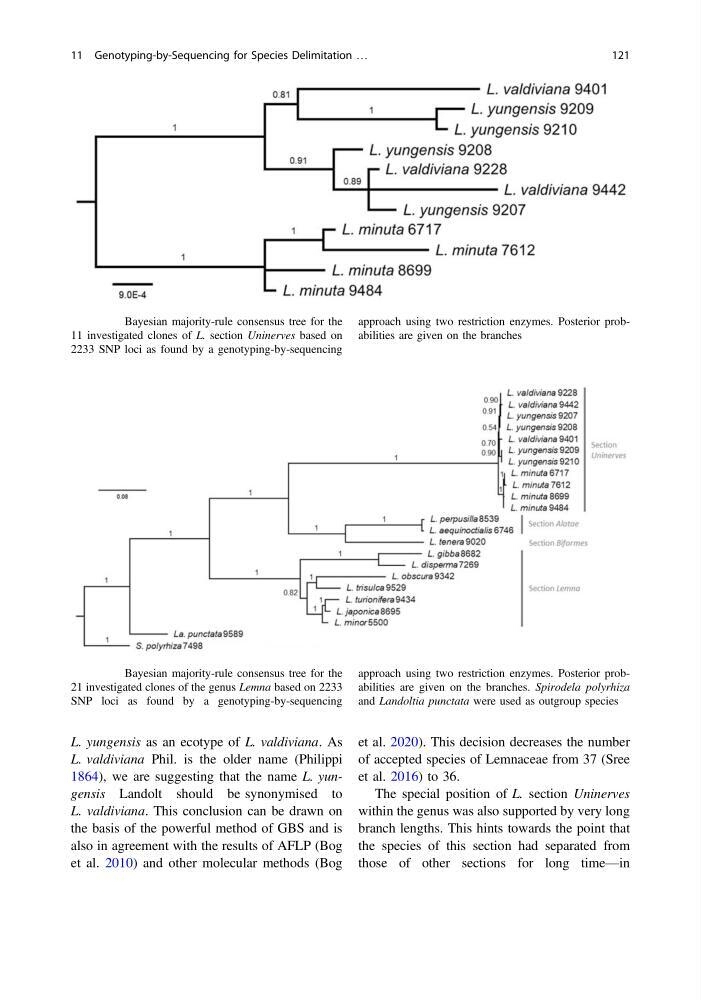
L. yungensis as an ecotype of L. valdiviana. As
L. valdiviana Phil. is the older name (Philippi
1864), we are suggesting that the name L. yungensis Landolt should be synonymised to
L. valdiviana. This conclusion can be drawn on
the basis of the powerful method of GBS and is
also in agreement with the results of AFLP (Bog
et al. 2010) and other molecular methods (Bog
et al. 2020). This decision decreases the number
of accepted species of Lemnaceae from 37 (Sree
et al. 2016) to 36.
The special position of L. section Uninerves
within the genus was also supported by very long
branch lengths. This hints towards the point that
the species of this section had separated from
those of other sections for long time—in
Fig. 11.1 Bayesian majority-rule consensus tree for the
11 investigated clones of L. section Uninerves based on
2233 SNP loci as found by a genotyping-by-sequencing
approach using two restriction enzymes. Posterior probabilities are given on the branches
Fig. 11.2 Bayesian majority-rule consensus tree for the
21 investigated clones of the genus Lemna based on 2233
SNP loci as found by a genotyping-by-sequencing
approach using two restriction enzymes. Posterior probabilities are given on the branches. Spirodela polyrhiza
and Landoltia punctata were used as outgroup species
11 Genotyping-by-Sequencing for Species Delimitation …
121
L. valdiviana Phil. is the older name (Philippi
1864), we are suggesting that the name L. yungensis Landolt should be synonymised to
L. valdiviana. This conclusion can be drawn on
the basis of the powerful method of GBS and is
also in agreement with the results of AFLP (Bog
et al. 2010) and other molecular methods (Bog
et al. 2020). This decision decreases the number
of accepted species of Lemnaceae from 37 (Sree
et al. 2016) to 36.
The special position of L. section Uninerves
within the genus was also supported by very long
branch lengths. This hints towards the point that
the species of this section had separated from
those of other sections for long time—in
Fig. 11.1 Bayesian majority-rule consensus tree for the
11 investigated clones of L. section Uninerves based on
2233 SNP loci as found by a genotyping-by-sequencing
approach using two restriction enzymes. Posterior probabilities are given on the branches
Fig. 11.2 Bayesian majority-rule consensus tree for the
21 investigated clones of the genus Lemna based on 2233
SNP loci as found by a genotyping-by-sequencing
approach using two restriction enzymes. Posterior probabilities are given on the branches. Spirodela polyrhiza
and Landoltia punctata were used as outgroup species
11 Genotyping-by-Sequencing for Species Delimitation …
121