

Musa acuminata; thus, they may have actually
been lost in the stem group that led to extant
monocots (Fig. 9.1). Furthermore, as already
mentioned above, depending on correct classification, FLC-like genes may have been lost in the
MRCA of Alismatales (Fig. 9.1).
9.5.3 Clades of MIKC
C -Group Genes
Lost in the Lineage
Leading to Duckweeds
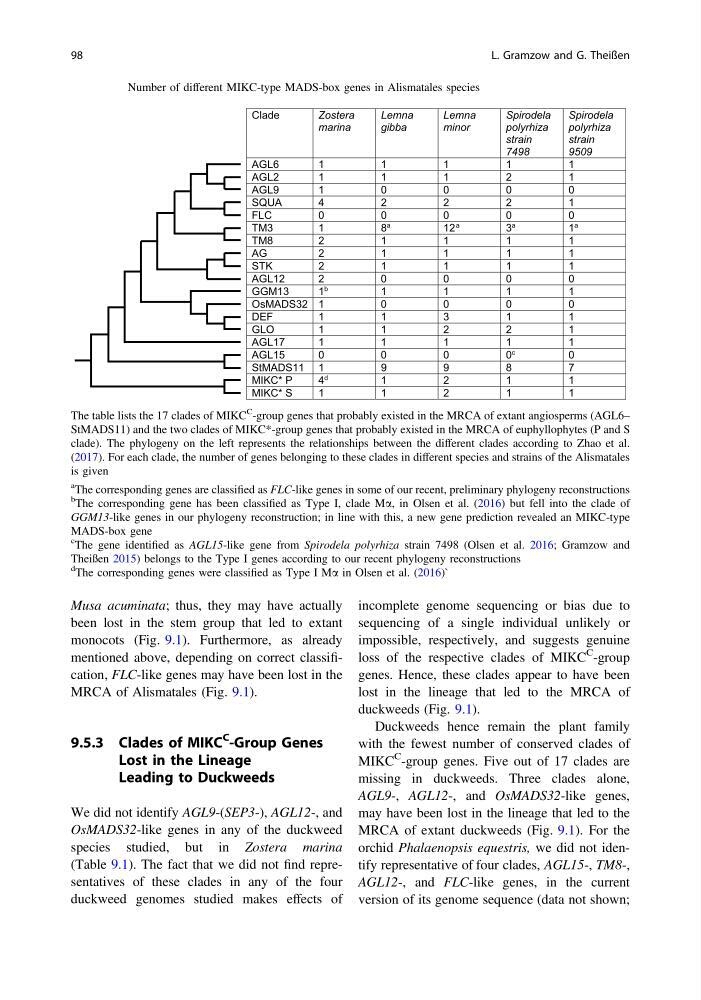
We did not identify AGL9-(SEP3-), AGL12-, and
OsMADS32-like genes in any of the duckweed
species studied, but in Zostera marina
(Table 9.1). The fact that we did not find representatives of these clades in any of the four
duckweed genomes studied makes effects of
incomplete genome sequencing or bias due to
sequencing of a single individual unlikely or
impossible, respectively, and suggests genuine
loss of the respective clades of MIKC
C -group
genes. Hence, these clades appear to have been
lost in the lineage that led to the MRCA of
duckweeds (Fig. 9.1).
Duckweeds hence remain the plant family
with the fewest number of conserved clades of
MIKC
C -group genes. Five out of 17 clades are
missing in duckweeds. Three clades alone,
AGL9-, AGL12-, and OsMADS32-like genes,
may have been lost in the lineage that led to the
MRCA of extant duckweeds (Fig. 9.1). For the
orchid Phalaenopsis equestris, we did not identify representative of four clades, AGL15-, TM8-,
AGL12-, and FLC-like genes, in the current
version of its genome sequence (data not shown;
Table 9.1 Number of different MIKC-type MADS-box genes in Alismatales species
Clade
Zostera
marina
Lemna
gibba
Lemna
minor
Spirodela
polyrhiza
strain
7498
Spirodela
polyrhiza
strain
9509
AGL6
1
1
1
1
1
AGL2
1
1
1
2
1
AGL9
1
0
0
0
0
SQUA
4
2
2
2
1
FLC
0
0
0
0
0
TM3
1
8
a
12
a
3
a
1
a
TM8
2
1
1
1
1
AG
2
1
1
1
1
STK
2
1
1
1
1
AGL12
2
0
0
0
0
GGM13
1
b
1
1
1
1
OsMADS32 1
0
0
0
0
DEF
1
1
3
1
1
GLO
1
1
2
2
1
AGL17
1
1
1
1
1
AGL15
0
0
0
0
c
0
StMADS11 1
9
9
8
7
MIKC* P
4
d
1
2
1
1
MIKC* S
1
1
2
1
1
The table lists the 17 clades of MIKC
C -group genes that probably existed in the MRCA of extant angiosperms (AGL6–
StMADS11) and the two clades of MIKC*-group genes that probably existed in the MRCA of euphyllophytes (P and S
clade). The phylogeny on the left represents the relationships between the different clades according to Zhao et al.
(2017). For each clade, the number of genes belonging to these clades in different species and strains of the Alismatales
is given
a The corresponding genes are classified as FLC-like genes in some of our recent, preliminary phylogeny reconstructions
b
The corresponding gene has been classified as Type I, clade Ma, in Olsen et al. (2016) but fell into the clade of
GGM13-like genes in our phylogeny reconstruction; in line with this, a new gene prediction revealed an MIKC-type
MADS-box gene
c The gene identified as AGL15-like gene from Spirodela polyrhiza strain 7498 (Olsen et al. 2016; Gramzow and
Theißen 2015) belongs to the Type I genes according to our recent phylogeny reconstructions
d
The corresponding genes were classified as Type I Ma in Olsen et al. (2016)`
98
L. Gramzow and G. Theißen
been lost in the stem group that led to extant
monocots (Fig. 9.1). Furthermore, as already
mentioned above, depending on correct classification, FLC-like genes may have been lost in the
MRCA of Alismatales (Fig. 9.1).
9.5.3 Clades of MIKC
C -Group Genes
Lost in the Lineage
Leading to Duckweeds
We did not identify AGL9-(SEP3-), AGL12-, and
OsMADS32-like genes in any of the duckweed
species studied, but in Zostera marina
(Table 9.1). The fact that we did not find representatives of these clades in any of the four
duckweed genomes studied makes effects of
incomplete genome sequencing or bias due to
sequencing of a single individual unlikely or
impossible, respectively, and suggests genuine
loss of the respective clades of MIKC
C -group
genes. Hence, these clades appear to have been
lost in the lineage that led to the MRCA of
duckweeds (Fig. 9.1).
Duckweeds hence remain the plant family
with the fewest number of conserved clades of
MIKC
C -group genes. Five out of 17 clades are
missing in duckweeds. Three clades alone,
AGL9-, AGL12-, and OsMADS32-like genes,
may have been lost in the lineage that led to the
MRCA of extant duckweeds (Fig. 9.1). For the
orchid Phalaenopsis equestris, we did not identify representative of four clades, AGL15-, TM8-,
AGL12-, and FLC-like genes, in the current
version of its genome sequence (data not shown;
Table 9.1 Number of different MIKC-type MADS-box genes in Alismatales species
Clade
Zostera
marina
Lemna
gibba
Lemna
minor
Spirodela
polyrhiza
strain
7498
Spirodela
polyrhiza
strain
9509
AGL6
1
1
1
1
1
AGL2
1
1
1
2
1
AGL9
1
0
0
0
0
SQUA
4
2
2
2
1
FLC
0
0
0
0
0
TM3
1
8
a
12
a
3
a
1
a
TM8
2
1
1
1
1
AG
2
1
1
1
1
STK
2
1
1
1
1
AGL12
2
0
0
0
0
GGM13
1
b
1
1
1
1
OsMADS32 1
0
0
0
0
DEF
1
1
3
1
1
GLO
1
1
2
2
1
AGL17
1
1
1
1
1
AGL15
0
0
0
0
c
0
StMADS11 1
9
9
8
7
MIKC* P
4
d
1
2
1
1
MIKC* S
1
1
2
1
1
The table lists the 17 clades of MIKC
C -group genes that probably existed in the MRCA of extant angiosperms (AGL6–
StMADS11) and the two clades of MIKC*-group genes that probably existed in the MRCA of euphyllophytes (P and S
clade). The phylogeny on the left represents the relationships between the different clades according to Zhao et al.
(2017). For each clade, the number of genes belonging to these clades in different species and strains of the Alismatales
is given
a The corresponding genes are classified as FLC-like genes in some of our recent, preliminary phylogeny reconstructions
b
The corresponding gene has been classified as Type I, clade Ma, in Olsen et al. (2016) but fell into the clade of
GGM13-like genes in our phylogeny reconstruction; in line with this, a new gene prediction revealed an MIKC-type
MADS-box gene
c The gene identified as AGL15-like gene from Spirodela polyrhiza strain 7498 (Olsen et al. 2016; Gramzow and
Theißen 2015) belongs to the Type I genes according to our recent phylogeny reconstructions
d
The corresponding genes were classified as Type I Ma in Olsen et al. (2016)`
98
L. Gramzow and G. Theißen