

Gene loss is the most frequent fate of young
paralogs after gene duplication, and that certainly
also applies to MADS-box genes in plants,
especially to Type I genes with their high death
rates (Gramzow and Theißen 2013). However,
MIKC-type MADS-box genes do not only show
the preferential retention after whole-genome
duplications typical for genes encoding transcription factors, but also the establishment and
strong conservation of some gene clades in stem
groups of plants that have been of utmost
importance for plant biodiversity on land, most
importantly seed and flowering plants. Nevertheless, phylogenomic analyses in recent years
revealed that even ancient and relatively strongly
conserved clades of genes can be completely lost
in some organismic lineages. The earlier that
happens during evolution, the more extant species are typically affected.
Closely related paralogs within one and the
same clade of MIKC
C -group genes have often
partially redundant functions and then may have
a high probability to get lost. On the other hand,
there is a considerable correlation between clade
membership and function (Theißen et al. 1996),
so that loss of a complete gene clade in a plant
has a quite high probability to be of functional
relevance (Gramzow and Theißen 2015).
Accordingly, most clades of MADS-box genes
appear to have never been lost completely during
angiosperm evolution in any lineage, at least as
far as this can be determined already based on a
quite limited sampling. For example, in a previous study involving 27 angiosperm genome
sequences, of the 17 clades of MIKC
C -group
genes that probably existed in the MRCA of
extant angiosperms, ten have not been wiped out
in any of the investigated species. Besides the
clades of floral organ identity genes (AGL2-,
AGL6-, SQUA-, DEF-, GLO-, and AG-like
genes), these include also TM3-like, StMADS11like, AGL17-like, and GGM13-like (B sister )
genes. This finding suggests that also the less
well-studied (non-homeotic) gene clades provide
functions that are more important than has been
recognized previously.
Eudicots
Sorghum bicolor
Oryza sativa
Musa acuminata
Phalaenopsis equestris
Lemna gibba
Lemna minor
Spirodela polyrhiza
Zostera marina
Amborella trichopoda
Gymnosperms
PEN
Permian
Triassic
Jurassic
Cretaceous
Paleogene
Ng
Periods
Paleozoic
Mesozoic
Cenozoic
Eras
Phanerozoic
Eons
Geologic Timescale
0
80
160
240
320
Time (MYA)
AGL6
AGL2
AGL9
SQUA
FLC
TM3
TM8
AG
STK
AGL12
GGM13
OsMADS32
DEF
GLO
AGL17
AGL15
StMADS11
-OsMADS32
-AGL15
-AGL9
-AGL12
-OsMADS32
-FLC
-TM8
-AGL12 -FLC
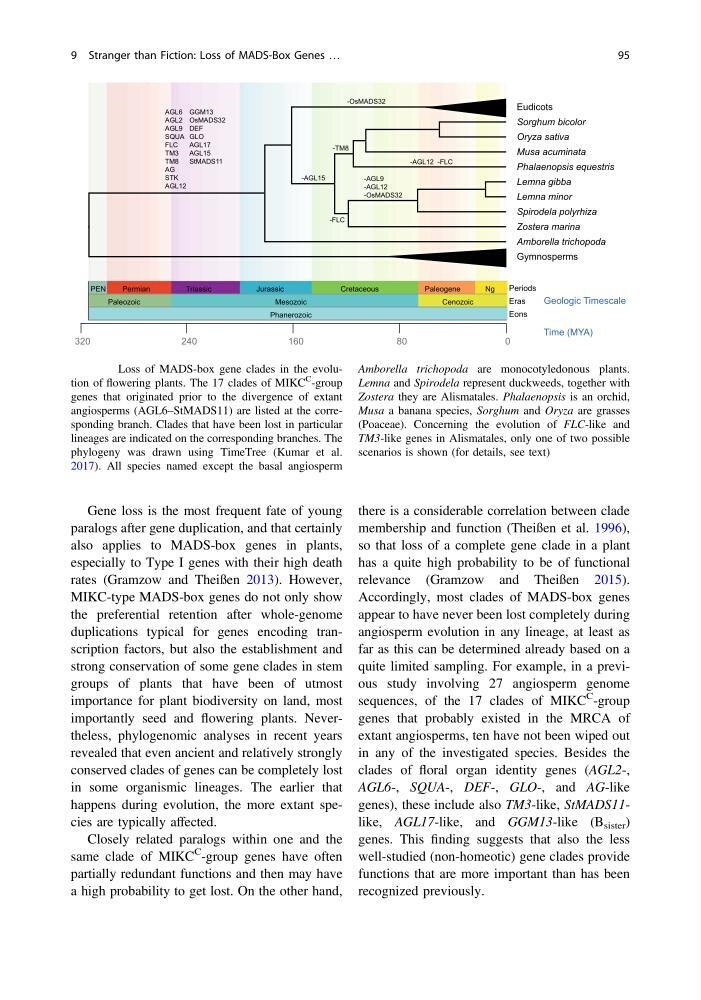
Fig. 9.1 Loss of MADS-box gene clades in the evolution of flowering plants. The 17 clades of MIKC
C -group
genes that originated prior to the divergence of extant
angiosperms (AGL6–StMADS11) are listed at the corresponding branch. Clades that have been lost in particular
lineages are indicated on the corresponding branches. The
phylogeny was drawn using TimeTree (Kumar et al.
2017). All species named except the basal angiosperm
Amborella trichopoda are monocotyledonous plants.
Lemna and Spirodela represent duckweeds, together with
Zostera they are Alismatales. Phalaenopsis is an orchid,
Musa a banana species, Sorghum and Oryza are grasses
(Poaceae). Concerning the evolution of FLC-like and
TM3-like genes in Alismatales, only one of two possible
scenarios is shown (for details, see text)
9 Stranger than Fiction: Loss of MADS-Box Genes …
95
paralogs after gene duplication, and that certainly
also applies to MADS-box genes in plants,
especially to Type I genes with their high death
rates (Gramzow and Theißen 2013). However,
MIKC-type MADS-box genes do not only show
the preferential retention after whole-genome
duplications typical for genes encoding transcription factors, but also the establishment and
strong conservation of some gene clades in stem
groups of plants that have been of utmost
importance for plant biodiversity on land, most
importantly seed and flowering plants. Nevertheless, phylogenomic analyses in recent years
revealed that even ancient and relatively strongly
conserved clades of genes can be completely lost
in some organismic lineages. The earlier that
happens during evolution, the more extant species are typically affected.
Closely related paralogs within one and the
same clade of MIKC
C -group genes have often
partially redundant functions and then may have
a high probability to get lost. On the other hand,
there is a considerable correlation between clade
membership and function (Theißen et al. 1996),
so that loss of a complete gene clade in a plant
has a quite high probability to be of functional
relevance (Gramzow and Theißen 2015).
Accordingly, most clades of MADS-box genes
appear to have never been lost completely during
angiosperm evolution in any lineage, at least as
far as this can be determined already based on a
quite limited sampling. For example, in a previous study involving 27 angiosperm genome
sequences, of the 17 clades of MIKC
C -group
genes that probably existed in the MRCA of
extant angiosperms, ten have not been wiped out
in any of the investigated species. Besides the
clades of floral organ identity genes (AGL2-,
AGL6-, SQUA-, DEF-, GLO-, and AG-like
genes), these include also TM3-like, StMADS11like, AGL17-like, and GGM13-like (B sister )
genes. This finding suggests that also the less
well-studied (non-homeotic) gene clades provide
functions that are more important than has been
recognized previously.
Eudicots
Sorghum bicolor
Oryza sativa
Musa acuminata
Phalaenopsis equestris
Lemna gibba
Lemna minor
Spirodela polyrhiza
Zostera marina
Amborella trichopoda
Gymnosperms
PEN
Permian
Triassic
Jurassic
Cretaceous
Paleogene
Ng
Periods
Paleozoic
Mesozoic
Cenozoic
Eras
Phanerozoic
Eons
Geologic Timescale
0
80
160
240
320
Time (MYA)
AGL6
AGL2
AGL9
SQUA
FLC
TM3
TM8
AG
STK
AGL12
GGM13
OsMADS32
DEF
GLO
AGL17
AGL15
StMADS11
-OsMADS32
-AGL15
-AGL9
-AGL12
-OsMADS32
-FLC
-TM8
-AGL12 -FLC
Fig. 9.1 Loss of MADS-box gene clades in the evolution of flowering plants. The 17 clades of MIKC
C -group
genes that originated prior to the divergence of extant
angiosperms (AGL6–StMADS11) are listed at the corresponding branch. Clades that have been lost in particular
lineages are indicated on the corresponding branches. The
phylogeny was drawn using TimeTree (Kumar et al.
2017). All species named except the basal angiosperm
Amborella trichopoda are monocotyledonous plants.
Lemna and Spirodela represent duckweeds, together with
Zostera they are Alismatales. Phalaenopsis is an orchid,
Musa a banana species, Sorghum and Oryza are grasses
(Poaceae). Concerning the evolution of FLC-like and
TM3-like genes in Alismatales, only one of two possible
scenarios is shown (for details, see text)
9 Stranger than Fiction: Loss of MADS-Box Genes …
95