

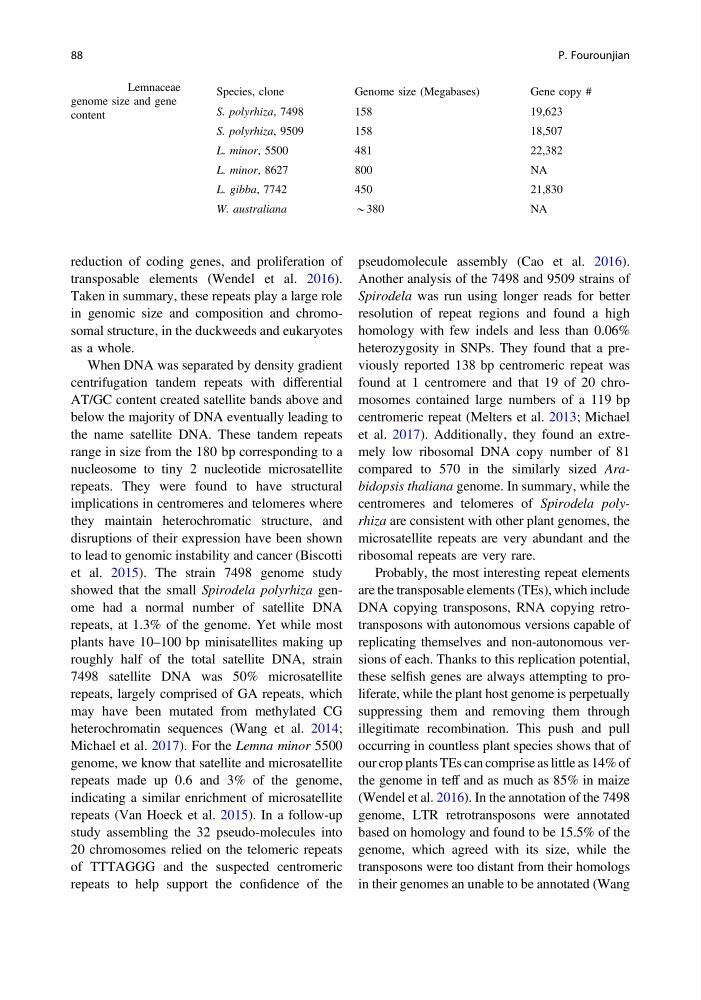
reduction of coding genes, and proliferation of
transposable elements (Wendel et al. 2016).
Taken in summary, these repeats play a large role
in genomic size and composition and chromosomal structure, in the duckweeds and eukaryotes
as a whole.
When DNA was separated by density gradient
centrifugation tandem repeats with differential
AT/GC content created satellite bands above and
below the majority of DNA eventually leading to
the name satellite DNA. These tandem repeats
range in size from the 180 bp corresponding to a
nucleosome to tiny 2 nucleotide microsatellite
repeats. They were found to have structural
implications in centromeres and telomeres where
they maintain heterochromatic structure, and
disruptions of their expression have been shown
to lead to genomic instability and cancer (Biscotti
et al. 2015). The strain 7498 genome study
showed that the small Spirodela polyrhiza genome had a normal number of satellite DNA
repeats, at 1.3% of the genome. Yet while most
plants have 10–100 bp minisatellites making up
roughly half of the total satellite DNA, strain
7498 satellite DNA was 50% microsatellite
repeats, largely comprised of GA repeats, which
may have been mutated from methylated CG
heterochromatin sequences (Wang et al. 2014;
Michael et al. 2017). For the Lemna minor 5500
genome, we know that satellite and microsatellite
repeats made up 0.6 and 3% of the genome,
indicating a similar enrichment of microsatellite
repeats (Van Hoeck et al. 2015). In a follow-up
study assembling the 32 pseudo-molecules into
20 chromosomes relied on the telomeric repeats
of TTTAGGG and the suspected centromeric
repeats to help support the confidence of the
pseudomolecule assembly (Cao et al. 2016).
Another analysis of the 7498 and 9509 strains of
Spirodela was run using longer reads for better
resolution of repeat regions and found a high
homology with few indels and less than 0.06%
heterozygosity in SNPs. They found that a previously reported 138 bp centromeric repeat was
found at 1 centromere and that 19 of 20 chromosomes contained large numbers of a 119 bp
centromeric repeat (Melters et al. 2013; Michael
et al. 2017). Additionally, they found an extremely low ribosomal DNA copy number of 81
compared to 570 in the similarly sized Arabidopsis thaliana genome. In summary, while the
centromeres and telomeres of Spirodela polyrhiza are consistent with other plant genomes, the
microsatellite repeats are very abundant and the
ribosomal repeats are very rare.
Probably, the most interesting repeat elements
are the transposable elements (TEs), which include
DNA copying transposons, RNA copying retrotransposons with autonomous versions capable of
replicating themselves and non-autonomous versions of each. Thanks to this replication potential,
these selfish genes are always attempting to proliferate, while the plant host genome is perpetually
suppressing them and removing them through
illegitimate recombination. This push and pull
occurring in countless plant species shows that of
our crop plants TEs can comprise as little as 14% of
the genome in teff and as much as 85% in maize
(Wendel et al. 2016). In the annotation of the 7498
genome, LTR retrotransposons were annotated
based on homology and found to be 15.5% of the
genome, which agreed with its size, while the
transposons were too distant from their homologs
in their genomes an unable to be annotated (Wang
Table 8.1 Lemnaceae
genome size and gene
content
Species, clone
Genome size (Megabases)
Gene copy #
S. polyrhiza, 7498
158
19,623
S. polyrhiza, 9509
158
18,507
L. minor, 5500
481
22,382
L. minor, 8627
800
NA
L. gibba, 7742
450
21,830
W. australiana
*380
NA
88
P. Fourounjian
transposable elements (Wendel et al. 2016).
Taken in summary, these repeats play a large role
in genomic size and composition and chromosomal structure, in the duckweeds and eukaryotes
as a whole.
When DNA was separated by density gradient
centrifugation tandem repeats with differential
AT/GC content created satellite bands above and
below the majority of DNA eventually leading to
the name satellite DNA. These tandem repeats
range in size from the 180 bp corresponding to a
nucleosome to tiny 2 nucleotide microsatellite
repeats. They were found to have structural
implications in centromeres and telomeres where
they maintain heterochromatic structure, and
disruptions of their expression have been shown
to lead to genomic instability and cancer (Biscotti
et al. 2015). The strain 7498 genome study
showed that the small Spirodela polyrhiza genome had a normal number of satellite DNA
repeats, at 1.3% of the genome. Yet while most
plants have 10–100 bp minisatellites making up
roughly half of the total satellite DNA, strain
7498 satellite DNA was 50% microsatellite
repeats, largely comprised of GA repeats, which
may have been mutated from methylated CG
heterochromatin sequences (Wang et al. 2014;
Michael et al. 2017). For the Lemna minor 5500
genome, we know that satellite and microsatellite
repeats made up 0.6 and 3% of the genome,
indicating a similar enrichment of microsatellite
repeats (Van Hoeck et al. 2015). In a follow-up
study assembling the 32 pseudo-molecules into
20 chromosomes relied on the telomeric repeats
of TTTAGGG and the suspected centromeric
repeats to help support the confidence of the
pseudomolecule assembly (Cao et al. 2016).
Another analysis of the 7498 and 9509 strains of
Spirodela was run using longer reads for better
resolution of repeat regions and found a high
homology with few indels and less than 0.06%
heterozygosity in SNPs. They found that a previously reported 138 bp centromeric repeat was
found at 1 centromere and that 19 of 20 chromosomes contained large numbers of a 119 bp
centromeric repeat (Melters et al. 2013; Michael
et al. 2017). Additionally, they found an extremely low ribosomal DNA copy number of 81
compared to 570 in the similarly sized Arabidopsis thaliana genome. In summary, while the
centromeres and telomeres of Spirodela polyrhiza are consistent with other plant genomes, the
microsatellite repeats are very abundant and the
ribosomal repeats are very rare.
Probably, the most interesting repeat elements
are the transposable elements (TEs), which include
DNA copying transposons, RNA copying retrotransposons with autonomous versions capable of
replicating themselves and non-autonomous versions of each. Thanks to this replication potential,
these selfish genes are always attempting to proliferate, while the plant host genome is perpetually
suppressing them and removing them through
illegitimate recombination. This push and pull
occurring in countless plant species shows that of
our crop plants TEs can comprise as little as 14% of
the genome in teff and as much as 85% in maize
(Wendel et al. 2016). In the annotation of the 7498
genome, LTR retrotransposons were annotated
based on homology and found to be 15.5% of the
genome, which agreed with its size, while the
transposons were too distant from their homologs
in their genomes an unable to be annotated (Wang
Table 8.1 Lemnaceae
genome size and gene
content
Species, clone
Genome size (Megabases)
Gene copy #
S. polyrhiza, 7498
158
19,623
S. polyrhiza, 9509
158
18,507
L. minor, 5500
481
22,382
L. minor, 8627
800
NA
L. gibba, 7742
450
21,830
W. australiana
*380
NA
88
P. Fourounjian