

cf. Fig. 1.2). One example is the gravitropic behavior of lateral roots in Arabidopsis
thaliana. These bud from the main root orthogonal to the gravitational vector
(diatropism) and upon reorientation to either a more upright or downward facing
direction, the tip of the lateral root will display a rapid curvature that brings it back
towards the original orientation (Mullen and Hangarter 2003; Guyomarc’h et al.
2012).
Research on gravity sensing and gravitropic responses has greatly benefitted
from the advancement in molecular and cellular methods as well as from experiment platforms providing the almost stimulus-free environment of microgravity.
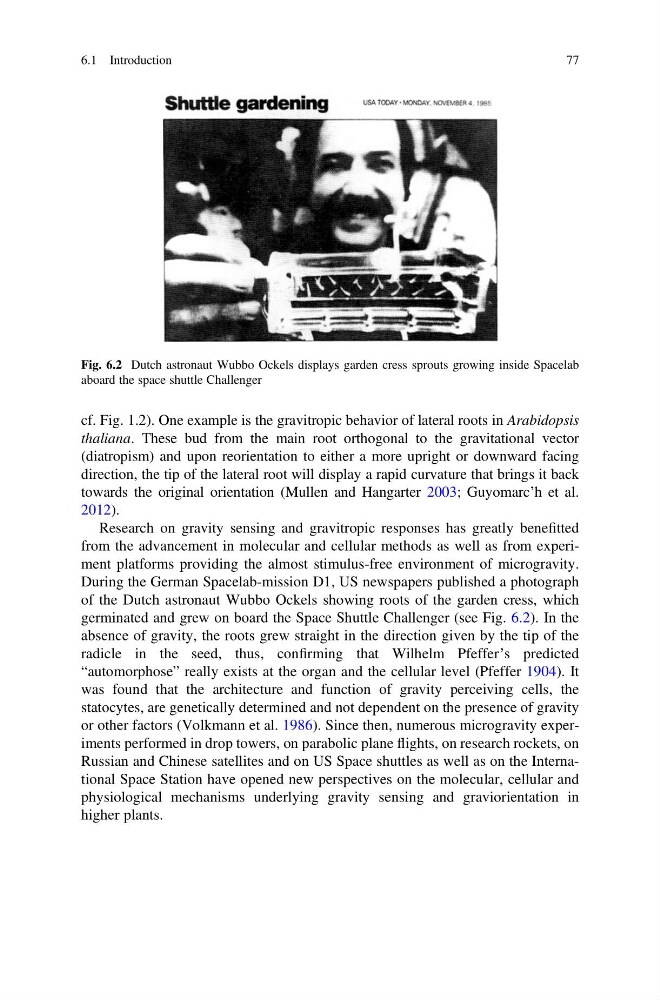
During the German Spacelab-mission D1, US newspapers published a photograph
of the Dutch astronaut Wubbo Ockels showing roots of the garden cress, which
germinated and grew on board the Space Shuttle Challenger (see Fig. 6.2). In the
absence of gravity, the roots grew straight in the direction given by the tip of the
radicle in the seed, thus, confirming that Wilhelm Pfeffer’s predicted
“automorphose” really exists at the organ and the cellular level (Pfeffer 1904). It
was found that the architecture and function of gravity perceiving cells, the
statocytes, are genetically determined and not dependent on the presence of gravity
or other factors (Volkmann et al. 1986). Since then, numerous microgravity experiments performed in drop towers, on parabolic plane flights, on research rockets, on
Russian and Chinese satellites and on US Space shuttles as well as on the International Space Station have opened new perspectives on the molecular, cellular and
physiological mechanisms underlying gravity sensing and graviorientation in
higher plants.
Fig. 6.2 Dutch astronaut Wubbo Ockels displays garden cress sprouts growing inside Spacelab
aboard the space shuttle Challenger
6.1 Introduction
77
thaliana. These bud from the main root orthogonal to the gravitational vector
(diatropism) and upon reorientation to either a more upright or downward facing
direction, the tip of the lateral root will display a rapid curvature that brings it back
towards the original orientation (Mullen and Hangarter 2003; Guyomarc’h et al.
2012).
Research on gravity sensing and gravitropic responses has greatly benefitted
from the advancement in molecular and cellular methods as well as from experiment platforms providing the almost stimulus-free environment of microgravity.
During the German Spacelab-mission D1, US newspapers published a photograph
of the Dutch astronaut Wubbo Ockels showing roots of the garden cress, which
germinated and grew on board the Space Shuttle Challenger (see Fig. 6.2). In the
absence of gravity, the roots grew straight in the direction given by the tip of the
radicle in the seed, thus, confirming that Wilhelm Pfeffer’s predicted
“automorphose” really exists at the organ and the cellular level (Pfeffer 1904). It
was found that the architecture and function of gravity perceiving cells, the
statocytes, are genetically determined and not dependent on the presence of gravity
or other factors (Volkmann et al. 1986). Since then, numerous microgravity experiments performed in drop towers, on parabolic plane flights, on research rockets, on
Russian and Chinese satellites and on US Space shuttles as well as on the International Space Station have opened new perspectives on the molecular, cellular and
physiological mechanisms underlying gravity sensing and graviorientation in
higher plants.
Fig. 6.2 Dutch astronaut Wubbo Ockels displays garden cress sprouts growing inside Spacelab
aboard the space shuttle Challenger
6.1 Introduction
77