

suppressed. When Coprinus cinereus was grown on a clinostat, it produced normal
fruit body primordials but failed to produce spores. Even though the research on
gravitropism in higher fungi (mushrooms) has been carried out for more than
125 years, the underlying mechanism still has to be revealed.
The fruiting bodies of the basidiomycete Flammulina velutipes show a clear
negative gravitropic response. When oriented horizontally within 2 h the stems of
the fruiting body respond with an increased elongation of the lower side, while
it decreased by 40% in the upper side (Monzer et al. 1994; Kern et al. 1997). This
growth response results in an overshoot, which is subsequently regulated. Under real
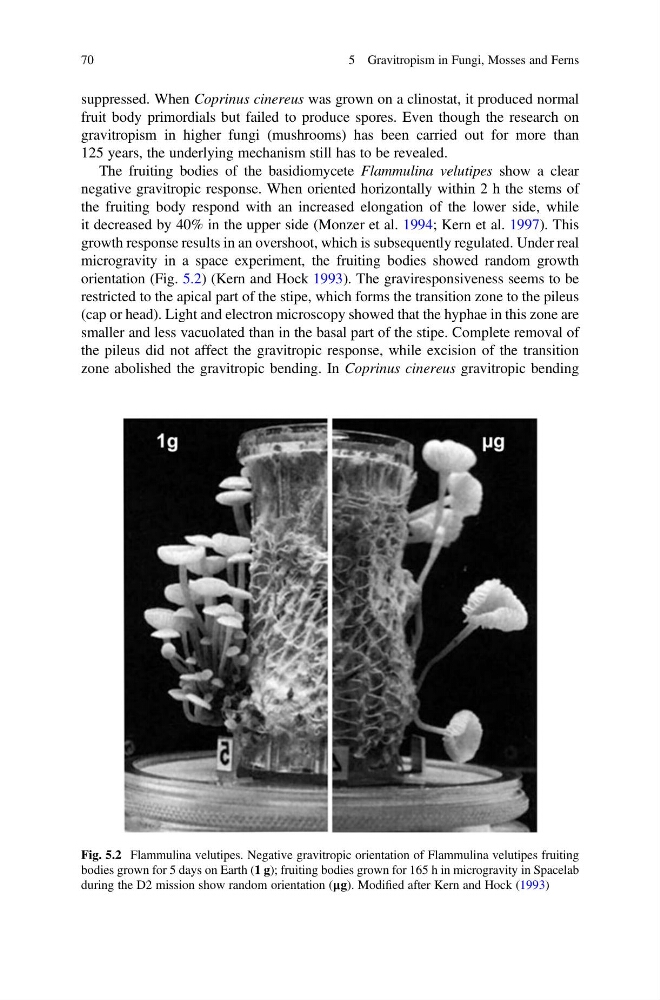
microgravity in a space experiment, the fruiting bodies showed random growth
orientation (Fig. 5.2) (Kern and Hock 1993). The graviresponsiveness seems to be
restricted to the apical part of the stipe, which forms the transition zone to the pileus
(cap or head). Light and electron microscopy showed that the hyphae in this zone are
smaller and less vacuolated than in the basal part of the stipe. Complete removal of
the pileus did not affect the gravitropic response, while excision of the transition
zone abolished the gravitropic bending. In Coprinus cinereus gravitropic bending
Fig. 5.2 Flammulina velutipes. Negative gravitropic orientation of Flammulina velutipes fruiting
bodies grown for 5 days on Earth (1 g); fruiting bodies grown for 165 h in microgravity in Spacelab
during the D2 mission show random orientation (μg). Modified after Kern and Hock (1993)
70
5 Gravitropism in Fungi, Mosses and Ferns
fruit body primordials but failed to produce spores. Even though the research on
gravitropism in higher fungi (mushrooms) has been carried out for more than
125 years, the underlying mechanism still has to be revealed.
The fruiting bodies of the basidiomycete Flammulina velutipes show a clear
negative gravitropic response. When oriented horizontally within 2 h the stems of
the fruiting body respond with an increased elongation of the lower side, while
it decreased by 40% in the upper side (Monzer et al. 1994; Kern et al. 1997). This
growth response results in an overshoot, which is subsequently regulated. Under real
microgravity in a space experiment, the fruiting bodies showed random growth
orientation (Fig. 5.2) (Kern and Hock 1993). The graviresponsiveness seems to be
restricted to the apical part of the stipe, which forms the transition zone to the pileus
(cap or head). Light and electron microscopy showed that the hyphae in this zone are
smaller and less vacuolated than in the basal part of the stipe. Complete removal of
the pileus did not affect the gravitropic response, while excision of the transition
zone abolished the gravitropic bending. In Coprinus cinereus gravitropic bending
Fig. 5.2 Flammulina velutipes. Negative gravitropic orientation of Flammulina velutipes fruiting
bodies grown for 5 days on Earth (1 g); fruiting bodies grown for 165 h in microgravity in Spacelab
during the D2 mission show random orientation (μg). Modified after Kern and Hock (1993)
70
5 Gravitropism in Fungi, Mosses and Ferns