

can exert pressure to an underlying membrane system. In some cases,
mechanosensitive ion channels have been identified as gravisensors, while in other
systems, the structural and biochemical identity still has to be provided.
Probably all organisms have developed the ability to sense the direction of the
gravity vector of the Earth. Most are capable to respond to it with the exception of
very small bacteria and viruses, which are subject to Brownian movement. However,
the molecular mechanisms of graviperception may have been evolved several times.
5.2 Slime Molds and Fungi
The cellular slime mold Dictyostelium discoideum undergoes a life cycle, which
includes a unicellular phase that consists of motile amoebae feeding on soil bacteria
(Devreotes 1989). Under starved conditions some amoebae send out a cAMP signal,
which is relayed through the population and results in a migration towards the signal
center (Henderson 1975). There, 10
3
–10
5 amoebae aggregate to form a multicellular
pseudoplasmodium (also called slug), which is about 0.5–2 mm long and 0.1 mm in
diameter (Loomis 2012). The slugs are also motile and respond to a number of
external stimuli including chemical clues, temperature gradients, light and gravity
(Poff and Häder 1984; Häder and Hansel 1991; Maree et al. 1999; Song et al. 2006).
They move for a few days until they culminate and form a sporangiophore with
unicellular spores. Under optimal environmental conditions these spores are shed
and form new motile amoebae.
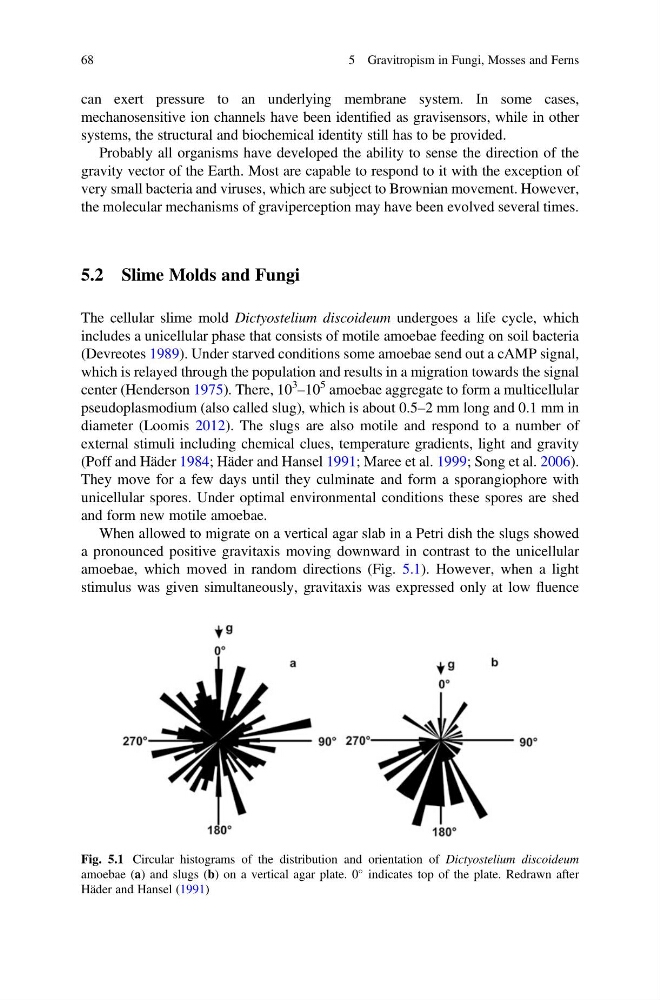
When allowed to migrate on a vertical agar slab in a Petri dish the slugs showed
a pronounced positive gravitaxis moving downward in contrast to the unicellular
amoebae, which moved in random directions (Fig. 5.1). However, when a light
stimulus was given simultaneously, gravitaxis was expressed only at low fluence
Fig. 5.1 Circular histograms of the distribution and orientation of Dictyostelium discoideum
amoebae (a) and slugs (b) on a vertical agar plate. 0
indicates top of the plate. Redrawn after
Häder and Hansel (1991)
68
5 Gravitropism in Fungi, Mosses and Ferns
mechanosensitive ion channels have been identified as gravisensors, while in other
systems, the structural and biochemical identity still has to be provided.
Probably all organisms have developed the ability to sense the direction of the
gravity vector of the Earth. Most are capable to respond to it with the exception of
very small bacteria and viruses, which are subject to Brownian movement. However,
the molecular mechanisms of graviperception may have been evolved several times.
5.2 Slime Molds and Fungi
The cellular slime mold Dictyostelium discoideum undergoes a life cycle, which
includes a unicellular phase that consists of motile amoebae feeding on soil bacteria
(Devreotes 1989). Under starved conditions some amoebae send out a cAMP signal,
which is relayed through the population and results in a migration towards the signal
center (Henderson 1975). There, 10
3
–10
5 amoebae aggregate to form a multicellular
pseudoplasmodium (also called slug), which is about 0.5–2 mm long and 0.1 mm in
diameter (Loomis 2012). The slugs are also motile and respond to a number of
external stimuli including chemical clues, temperature gradients, light and gravity
(Poff and Häder 1984; Häder and Hansel 1991; Maree et al. 1999; Song et al. 2006).
They move for a few days until they culminate and form a sporangiophore with
unicellular spores. Under optimal environmental conditions these spores are shed
and form new motile amoebae.
When allowed to migrate on a vertical agar slab in a Petri dish the slugs showed
a pronounced positive gravitaxis moving downward in contrast to the unicellular
amoebae, which moved in random directions (Fig. 5.1). However, when a light
stimulus was given simultaneously, gravitaxis was expressed only at low fluence
Fig. 5.1 Circular histograms of the distribution and orientation of Dictyostelium discoideum
amoebae (a) and slugs (b) on a vertical agar plate. 0
indicates top of the plate. Redrawn after
Häder and Hansel (1991)
68
5 Gravitropism in Fungi, Mosses and Ferns