

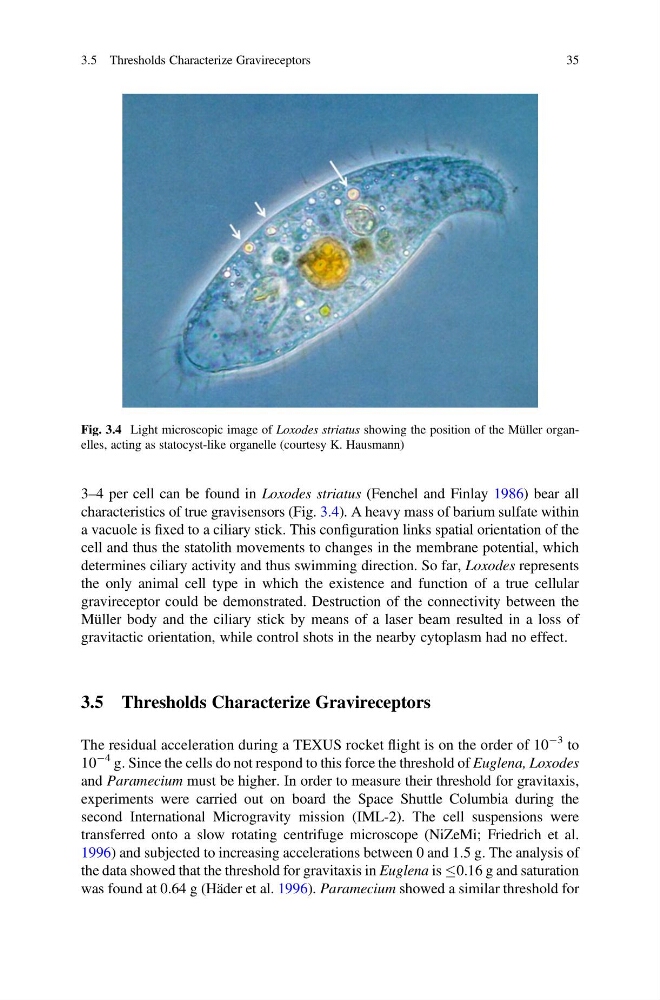
3–4 per cell can be found in Loxodes striatus (Fenchel and Finlay 1986) bear all
characteristics of true gravisensors (Fig. 3.4). A heavy mass of barium sulfate within
a vacuole is fixed to a ciliary stick. This configuration links spatial orientation of the
cell and thus the statolith movements to changes in the membrane potential, which
determines ciliary activity and thus swimming direction. So far, Loxodes represents
the only animal cell type in which the existence and function of a true cellular
gravireceptor could be demonstrated. Destruction of the connectivity between the
Müller body and the ciliary stick by means of a laser beam resulted in a loss of
gravitactic orientation, while control shots in the nearby cytoplasm had no effect.
3.5 Thresholds Characterize Gravireceptors
The residual acceleration during a TEXUS rocket flight is on the order of 10
À3 to
10
À4 g. Since the cells do not respond to this force the threshold of Euglena, Loxodes
and Paramecium must be higher. In order to measure their threshold for gravitaxis,
experiments were carried out on board the Space Shuttle Columbia during the
second International Microgravity mission (IML-2). The cell suspensions were
transferred onto a slow rotating centrifuge microscope (NiZeMi; Friedrich et al.
1996) and subjected to increasing accelerations between 0 and 1.5 g. The analysis of
the data showed that the threshold for gravitaxis in Euglena is 0.16 g and saturation
was found at 0.64 g (Häder et al. 1996). Paramecium showed a similar threshold for
Fig. 3.4 Light microscopic image of Loxodes striatus showing the position of the Müller organelles, acting as statocyst-like organelle (courtesy K. Hausmann)
3.5 Thresholds Characterize Gravireceptors
35
characteristics of true gravisensors (Fig. 3.4). A heavy mass of barium sulfate within
a vacuole is fixed to a ciliary stick. This configuration links spatial orientation of the
cell and thus the statolith movements to changes in the membrane potential, which
determines ciliary activity and thus swimming direction. So far, Loxodes represents
the only animal cell type in which the existence and function of a true cellular
gravireceptor could be demonstrated. Destruction of the connectivity between the
Müller body and the ciliary stick by means of a laser beam resulted in a loss of
gravitactic orientation, while control shots in the nearby cytoplasm had no effect.
3.5 Thresholds Characterize Gravireceptors
The residual acceleration during a TEXUS rocket flight is on the order of 10
À3 to
10
À4 g. Since the cells do not respond to this force the threshold of Euglena, Loxodes
and Paramecium must be higher. In order to measure their threshold for gravitaxis,
experiments were carried out on board the Space Shuttle Columbia during the
second International Microgravity mission (IML-2). The cell suspensions were
transferred onto a slow rotating centrifuge microscope (NiZeMi; Friedrich et al.
1996) and subjected to increasing accelerations between 0 and 1.5 g. The analysis of
the data showed that the threshold for gravitaxis in Euglena is 0.16 g and saturation
was found at 0.64 g (Häder et al. 1996). Paramecium showed a similar threshold for
Fig. 3.4 Light microscopic image of Loxodes striatus showing the position of the Müller organelles, acting as statocyst-like organelle (courtesy K. Hausmann)
3.5 Thresholds Characterize Gravireceptors
35