

2.4.1 Drop Tower
A high quality of microgravity of about 10
À6 g is achieved during the 110 m
free fall in the vacuum tube of the drop tower at the Zentrum für Angewandte
Raumfahrttechnologie und Mikrogravitation (ZARM) in Bremen, Germany. Favorable features are the daily accessibility, multiple launches and drops per week,
thereby, guaranteeing a sufficient amount of replicates and a flexible experiment
adaptation. Microgravity period of 4.74 s or even 9.3 s, the latter by using a catapult
system, provide ample time for a surprisingly great number of fast cell biological and
physiological processes (Könemann et al. 2015). Although an experiment time of
4.74 s is rather short, the fact that no hypergravity phase is involved is of great
advantage especially for sensitive and quickly responding processes.
Using the catapult, however, unavoidably comes with an initial phase of high
accelerations of up to 30 g for 0.26 s, to propel the drop capsule up into the evacuated
tower shaft. These boundary conditions have to be taken into account and their effects
on the biological sample have to be carefully assessed by control experiments.
Biologists are frequently using the drop tower e.g. to study fast molecular, cellular
and physiological responses of cells and organisms after the offset of gravity.
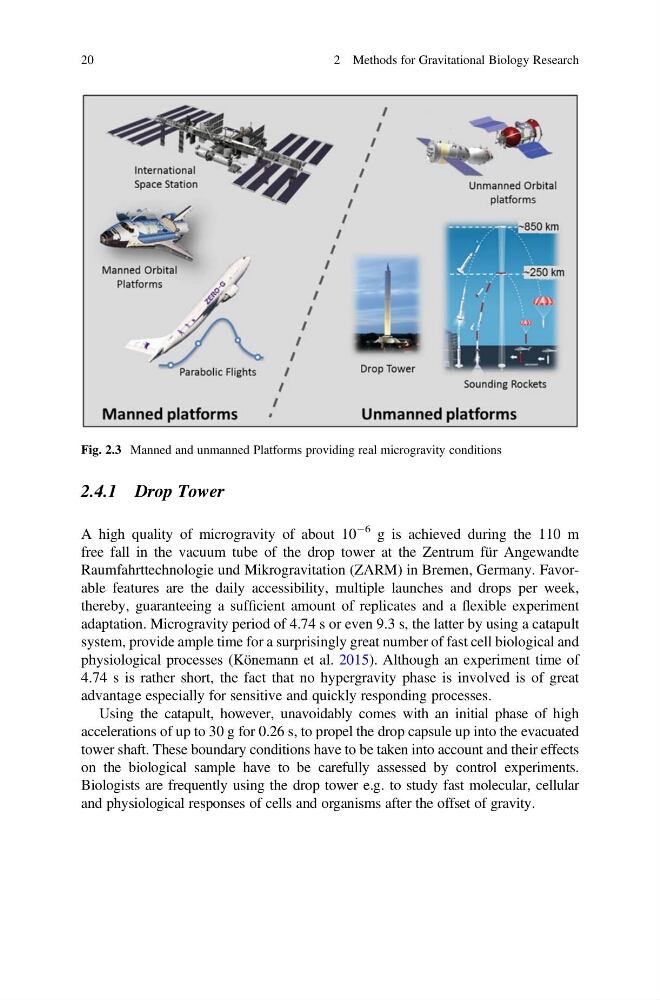
Fig. 2.3 Manned and unmanned Platforms providing real microgravity conditions
20
2 Methods for Gravitational Biology Research
A high quality of microgravity of about 10
À6 g is achieved during the 110 m
free fall in the vacuum tube of the drop tower at the Zentrum für Angewandte
Raumfahrttechnologie und Mikrogravitation (ZARM) in Bremen, Germany. Favorable features are the daily accessibility, multiple launches and drops per week,
thereby, guaranteeing a sufficient amount of replicates and a flexible experiment
adaptation. Microgravity period of 4.74 s or even 9.3 s, the latter by using a catapult
system, provide ample time for a surprisingly great number of fast cell biological and
physiological processes (Könemann et al. 2015). Although an experiment time of
4.74 s is rather short, the fact that no hypergravity phase is involved is of great
advantage especially for sensitive and quickly responding processes.
Using the catapult, however, unavoidably comes with an initial phase of high
accelerations of up to 30 g for 0.26 s, to propel the drop capsule up into the evacuated
tower shaft. These boundary conditions have to be taken into account and their effects
on the biological sample have to be carefully assessed by control experiments.
Biologists are frequently using the drop tower e.g. to study fast molecular, cellular
and physiological responses of cells and organisms after the offset of gravity.
Fig. 2.3 Manned and unmanned Platforms providing real microgravity conditions
20
2 Methods for Gravitational Biology Research