

1995). Since these responses are so obvious they have been studied in depth for a
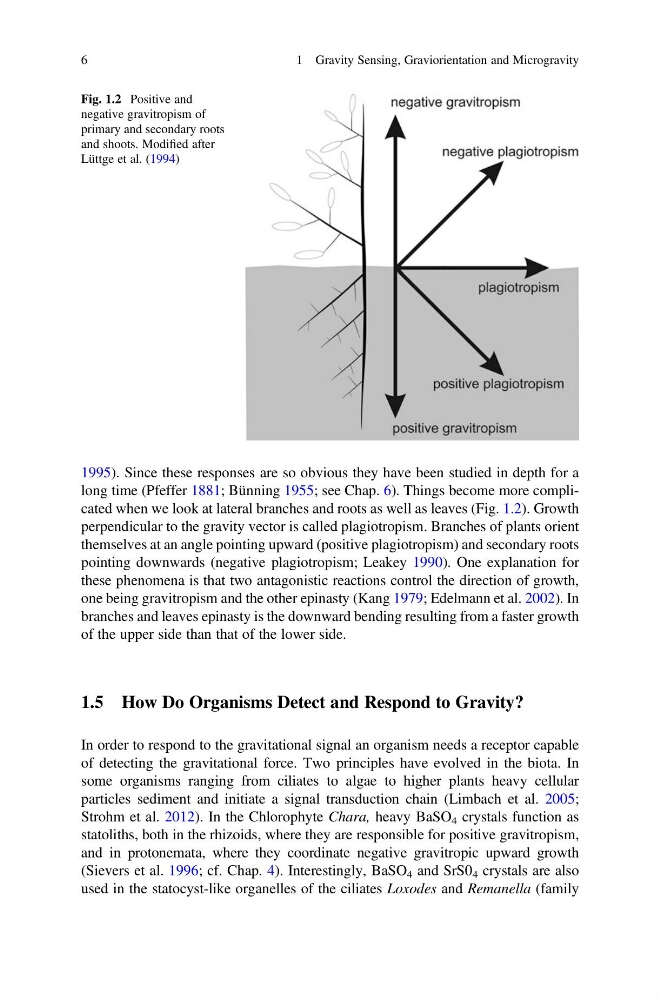
long time (Pfeffer 1881; Bünning 1955; see Chap. 6). Things become more complicated when we look at lateral branches and roots as well as leaves (Fig. 1.2). Growth
perpendicular to the gravity vector is called plagiotropism. Branches of plants orient
themselves at an angle pointing upward (positive plagiotropism) and secondary roots
pointing downwards (negative plagiotropism; Leakey 1990). One explanation for
these phenomena is that two antagonistic reactions control the direction of growth,
one being gravitropism and the other epinasty (Kang 1979; Edelmann et al. 2002). In
branches and leaves epinasty is the downward bending resulting from a faster growth
of the upper side than that of the lower side.
1.5 How Do Organisms Detect and Respond to Gravity?
In order to respond to the gravitational signal an organism needs a receptor capable
of detecting the gravitational force. Two principles have evolved in the biota. In
some organisms ranging from ciliates to algae to higher plants heavy cellular
particles sediment and initiate a signal transduction chain (Limbach et al. 2005;
Strohm et al. 2012). In the Chlorophyte Chara, heavy BaSO 4 crystals function as
statoliths, both in the rhizoids, where they are responsible for positive gravitropism,
and in protonemata, where they coordinate negative gravitropic upward growth
(Sievers et al. 1996; cf. Chap. 4). Interestingly, BaSO 4 and SrS0 4 crystals are also
used in the statocyst-like organelles of the ciliates Loxodes and Remanella (family
Fig. 1.2 Positive and
negative gravitropism of
primary and secondary roots
and shoots. Modified after
Lüttge et al. (1994)
6
1 Gravity Sensing, Graviorientation and Microgravity
long time (Pfeffer 1881; Bünning 1955; see Chap. 6). Things become more complicated when we look at lateral branches and roots as well as leaves (Fig. 1.2). Growth
perpendicular to the gravity vector is called plagiotropism. Branches of plants orient
themselves at an angle pointing upward (positive plagiotropism) and secondary roots
pointing downwards (negative plagiotropism; Leakey 1990). One explanation for
these phenomena is that two antagonistic reactions control the direction of growth,
one being gravitropism and the other epinasty (Kang 1979; Edelmann et al. 2002). In
branches and leaves epinasty is the downward bending resulting from a faster growth
of the upper side than that of the lower side.
1.5 How Do Organisms Detect and Respond to Gravity?
In order to respond to the gravitational signal an organism needs a receptor capable
of detecting the gravitational force. Two principles have evolved in the biota. In
some organisms ranging from ciliates to algae to higher plants heavy cellular
particles sediment and initiate a signal transduction chain (Limbach et al. 2005;
Strohm et al. 2012). In the Chlorophyte Chara, heavy BaSO 4 crystals function as
statoliths, both in the rhizoids, where they are responsible for positive gravitropism,
and in protonemata, where they coordinate negative gravitropic upward growth
(Sievers et al. 1996; cf. Chap. 4). Interestingly, BaSO 4 and SrS0 4 crystals are also
used in the statocyst-like organelles of the ciliates Loxodes and Remanella (family
Fig. 1.2 Positive and
negative gravitropism of
primary and secondary roots
and shoots. Modified after
Lüttge et al. (1994)
6
1 Gravity Sensing, Graviorientation and Microgravity