

PIN2-GFP which potentially caused the observed significant delay to the gravitropic
response, as in a crk-5 null mutation, both positive and negative gravitropic bending
of roots and shoots was inhibited (Rigo et al. 2013). A corresponding reduction in
the auxin response along the lower side of roots after gravistimulation suggested a
lower auxin content there and hence a reduced rate of auxin flux from statocytes into
the epidermal cell layers. Such changes are able to account for the observed 30%
reduction of root growth rate compared to the wild type. There is evidence for
functional overlap with a second protein family important to the gravitropic
response, which is also regulated by calcium ions. Alongside the AGC kinases
PID, WAG1, WAG2, MAPK and D6PKs, CRKs probably regulate cell-type specific
phosphorylation of specific residues in hydrophilic loops of certain PINs to regulate
their polar membrane recycling (Ganguly and Cho 2012; Ditengou et al. 2018; Dory
et al. 2018). So far the position of the different members of the CRK family in the
gravitropic signaling pathway is not clear, but they may play important roles in
regulating the activities of activity and membrane localization of other PIN-specific
AGC kinases (Weller et al. 2017).
7.8 Downstream Regulation of PIN Function
Auxin fluxes are regulated on several levels. The PIN efflux carriers constitute the
basic machinery capable of releasing negatively charged indole-3-acetic acid anions
from the cytoplasm into the apoplast. The rate and direction of this release is
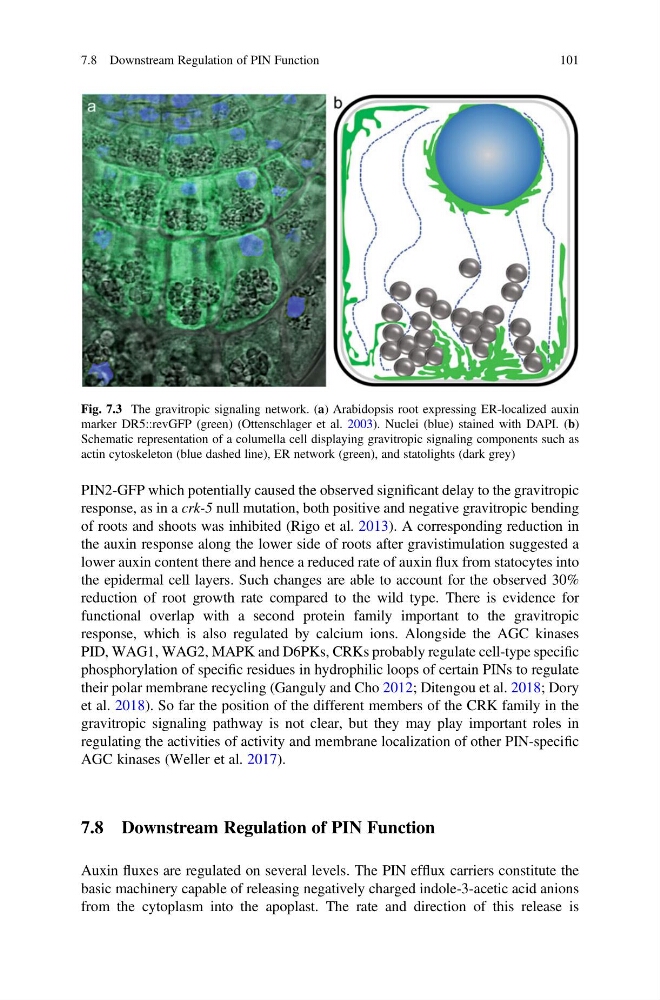
Fig. 7.3 The gravitropic signaling network. (a) Arabidopsis root expressing ER-localized auxin
marker DR5::revGFP (green) (Ottenschlager et al. 2003). Nuclei (blue) stained with DAPI. (b)
Schematic representation of a columella cell displaying gravitropic signaling components such as
actin cytoskeleton (blue dashed line), ER network (green), and statolights (dark grey)
7.8 Downstream Regulation of PIN Function
101
response, as in a crk-5 null mutation, both positive and negative gravitropic bending
of roots and shoots was inhibited (Rigo et al. 2013). A corresponding reduction in
the auxin response along the lower side of roots after gravistimulation suggested a
lower auxin content there and hence a reduced rate of auxin flux from statocytes into
the epidermal cell layers. Such changes are able to account for the observed 30%
reduction of root growth rate compared to the wild type. There is evidence for
functional overlap with a second protein family important to the gravitropic
response, which is also regulated by calcium ions. Alongside the AGC kinases
PID, WAG1, WAG2, MAPK and D6PKs, CRKs probably regulate cell-type specific
phosphorylation of specific residues in hydrophilic loops of certain PINs to regulate
their polar membrane recycling (Ganguly and Cho 2012; Ditengou et al. 2018; Dory
et al. 2018). So far the position of the different members of the CRK family in the
gravitropic signaling pathway is not clear, but they may play important roles in
regulating the activities of activity and membrane localization of other PIN-specific
AGC kinases (Weller et al. 2017).
7.8 Downstream Regulation of PIN Function
Auxin fluxes are regulated on several levels. The PIN efflux carriers constitute the
basic machinery capable of releasing negatively charged indole-3-acetic acid anions
from the cytoplasm into the apoplast. The rate and direction of this release is
Fig. 7.3 The gravitropic signaling network. (a) Arabidopsis root expressing ER-localized auxin
marker DR5::revGFP (green) (Ottenschlager et al. 2003). Nuclei (blue) stained with DAPI. (b)
Schematic representation of a columella cell displaying gravitropic signaling components such as
actin cytoskeleton (blue dashed line), ER network (green), and statolights (dark grey)
7.8 Downstream Regulation of PIN Function
101