

81
Moreover, heme oxygenases (HOs) and NADPH oxidases (NOXs) play important roles in the biosynthetic oxygen sensing of cells. NOX-2, one of the three isoforms of NOX, is used for superoxide production from molecular O 2 . Hypoxic
conditions can cause a decrease in NOX-2-derived ROS concentrations, due to the
low K m values (18 μM) of NOX-2; this helps Ca
+
release in pulmonary artery SMCs
[239]. However, some studies also suggest that hypoxia increases NOX-2 activity,
therefore causing the generation of a greater amount of ROS [233]. On the other
hand, Ca
+
-activated K
+
channels in glomus cells were shown to be related to the
activity of HO-2, an isoform of HO which can convert heme to CO, biliverdin, and
Fe(II) using O 2 and NADPH [237].
The effectiveness of an oxygen sensor can be determined by evaluating (a) its
sensitivity to small changes in intracellular O 2 levels and (b) the subsequent diversity of triggered cellular responses. Taking this considerations into account, PHDs
and FIHs appear to be the most critical oxygen sensors responsible for controlling
HIF activity [94]. Deactivation of these two sensors leads to HIFα stabilization,
initiating the regulation of hundreds of different genes. Using O 2 as a controlling
parameter to engineer vascular tissues demands a clear understanding of the biochemical events that follow changes in O 2 tension, as well as the net response of the
cells and how O 2 affects their collective behaviors.
4.2.1.2 Cellular Responses to Different Oxygen Concentrations
Metabolism and Oxygen Uptake Rate
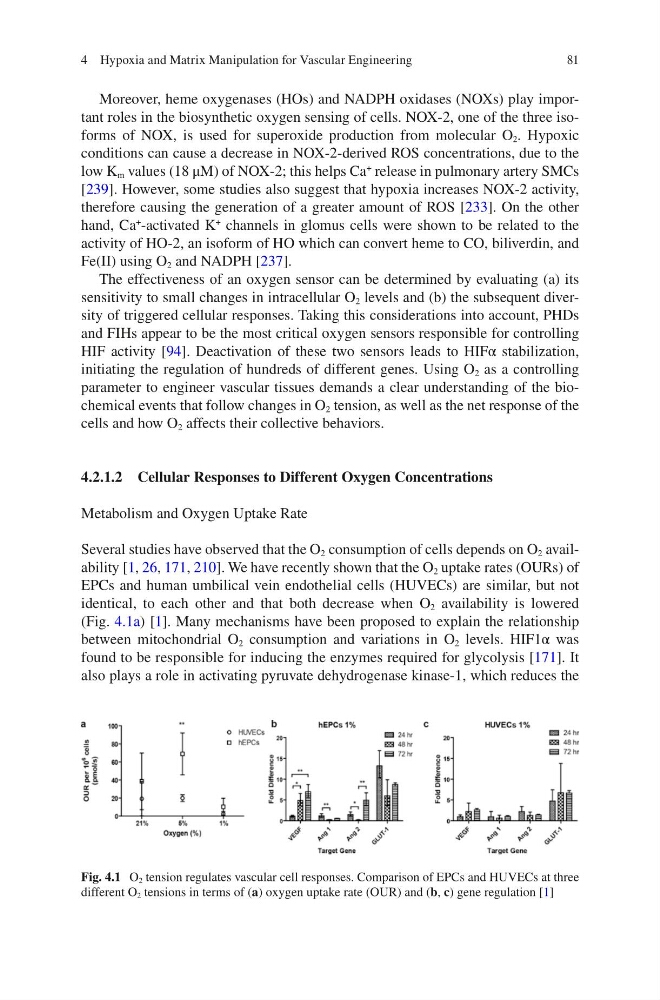
Several studies have observed that the O 2 consumption of cells depends on O 2 availability [1, 26, 171, 210]. We have recently shown that the O 2 uptake rates (OURs) of
EPCs and human umbilical vein endothelial cells (HUVECs) are similar, but not
identical, to each other and that both decrease when O 2 availability is lowered
(Fig. 4.1a) [1]. Many mechanisms have been proposed to explain the relationship
between mitochondrial O 2 consumption and variations in O 2 levels. HIF1α was
found to be responsible for inducing the enzymes required for glycolysis [171]. It
also plays a role in activating pyruvate dehydrogenase kinase-1, which reduces the
Fig. 4.1 O 2 tension regulates vascular cell responses. Comparison of EPCs and HUVECs at three
different O 2 tensions in terms of (a) oxygen uptake rate (OUR) and (b, c) gene regulation [1]
4 Hypoxia and Matrix Manipulation for Vascular Engineering
Moreover, heme oxygenases (HOs) and NADPH oxidases (NOXs) play important roles in the biosynthetic oxygen sensing of cells. NOX-2, one of the three isoforms of NOX, is used for superoxide production from molecular O 2 . Hypoxic
conditions can cause a decrease in NOX-2-derived ROS concentrations, due to the
low K m values (18 μM) of NOX-2; this helps Ca
+
release in pulmonary artery SMCs
[239]. However, some studies also suggest that hypoxia increases NOX-2 activity,
therefore causing the generation of a greater amount of ROS [233]. On the other
hand, Ca
+
-activated K
+
channels in glomus cells were shown to be related to the
activity of HO-2, an isoform of HO which can convert heme to CO, biliverdin, and
Fe(II) using O 2 and NADPH [237].
The effectiveness of an oxygen sensor can be determined by evaluating (a) its
sensitivity to small changes in intracellular O 2 levels and (b) the subsequent diversity of triggered cellular responses. Taking this considerations into account, PHDs
and FIHs appear to be the most critical oxygen sensors responsible for controlling
HIF activity [94]. Deactivation of these two sensors leads to HIFα stabilization,
initiating the regulation of hundreds of different genes. Using O 2 as a controlling
parameter to engineer vascular tissues demands a clear understanding of the biochemical events that follow changes in O 2 tension, as well as the net response of the
cells and how O 2 affects their collective behaviors.
4.2.1.2 Cellular Responses to Different Oxygen Concentrations
Metabolism and Oxygen Uptake Rate
Several studies have observed that the O 2 consumption of cells depends on O 2 availability [1, 26, 171, 210]. We have recently shown that the O 2 uptake rates (OURs) of
EPCs and human umbilical vein endothelial cells (HUVECs) are similar, but not
identical, to each other and that both decrease when O 2 availability is lowered
(Fig. 4.1a) [1]. Many mechanisms have been proposed to explain the relationship
between mitochondrial O 2 consumption and variations in O 2 levels. HIF1α was
found to be responsible for inducing the enzymes required for glycolysis [171]. It
also plays a role in activating pyruvate dehydrogenase kinase-1, which reduces the
Fig. 4.1 O 2 tension regulates vascular cell responses. Comparison of EPCs and HUVECs at three
different O 2 tensions in terms of (a) oxygen uptake rate (OUR) and (b, c) gene regulation [1]
4 Hypoxia and Matrix Manipulation for Vascular Engineering