

131
5.2.3 Laser-Based 3D Printing
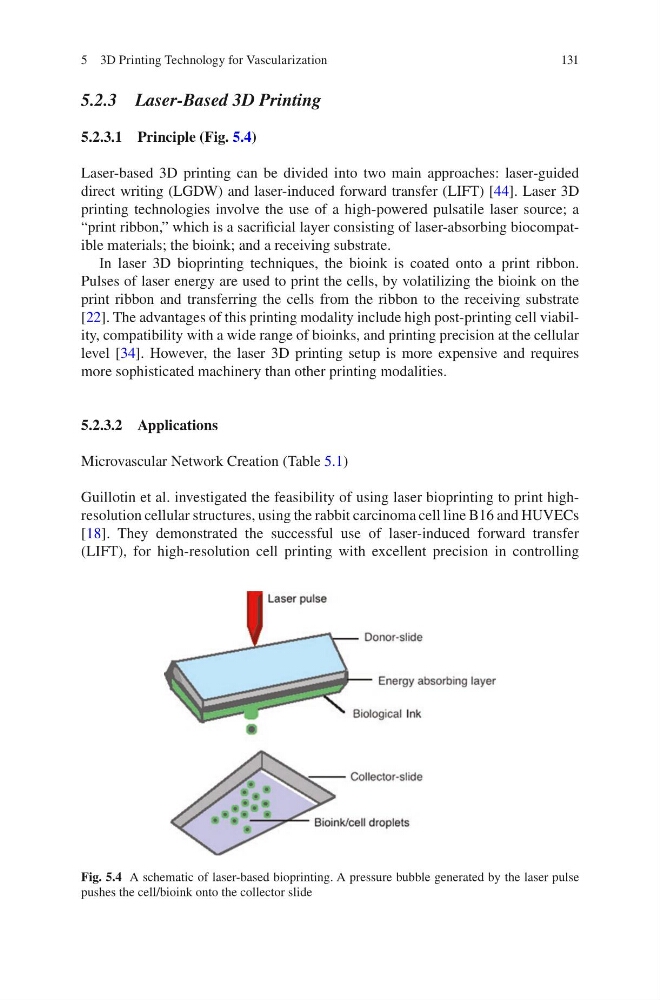
5.2.3.1 Principle (Fig. 5.4)
Laser-based 3D printing can be divided into two main approaches: laser-guided
direct writing (LGDW) and laser-induced forward transfer (LIFT) [44]. Laser 3D
printing technologies involve the use of a high-powered pulsatile laser source; a
“print ribbon,” which is a sacrificial layer consisting of laser-absorbing biocompatible materials; the bioink; and a receiving substrate.
In laser 3D bioprinting techniques, the bioink is coated onto a print ribbon.
Pulses of laser energy are used to print the cells, by volatilizing the bioink on the
print ribbon and transferring the cells from the ribbon to the receiving substrate
[22]. The advantages of this printing modality include high post-printing cell viability, compatibility with a wide range of bioinks, and printing precision at the cellular
level [34]. However, the laser 3D printing setup is more expensive and requires
more sophisticated machinery than other printing modalities.
5.2.3.2 Applications
Microvascular Network Creation (Table 5.1)
Guillotin et al. investigated the feasibility of using laser bioprinting to print highresolution cellular structures, using the rabbit carcinoma cell line B16 and HUVECs
[18]. They demonstrated the successful use of laser-induced forward transfer
(LIFT), for high-resolution cell printing with excellent precision in controlling
Fig. 5.4 A schematic of laser-based bioprinting. A pressure bubble generated by the laser pulse
pushes the cell/bioink onto the collector slide
5 3D Printing Technology for Vascularization
5.2.3 Laser-Based 3D Printing
5.2.3.1 Principle (Fig. 5.4)
Laser-based 3D printing can be divided into two main approaches: laser-guided
direct writing (LGDW) and laser-induced forward transfer (LIFT) [44]. Laser 3D
printing technologies involve the use of a high-powered pulsatile laser source; a
“print ribbon,” which is a sacrificial layer consisting of laser-absorbing biocompatible materials; the bioink; and a receiving substrate.
In laser 3D bioprinting techniques, the bioink is coated onto a print ribbon.
Pulses of laser energy are used to print the cells, by volatilizing the bioink on the
print ribbon and transferring the cells from the ribbon to the receiving substrate
[22]. The advantages of this printing modality include high post-printing cell viability, compatibility with a wide range of bioinks, and printing precision at the cellular
level [34]. However, the laser 3D printing setup is more expensive and requires
more sophisticated machinery than other printing modalities.
5.2.3.2 Applications
Microvascular Network Creation (Table 5.1)
Guillotin et al. investigated the feasibility of using laser bioprinting to print highresolution cellular structures, using the rabbit carcinoma cell line B16 and HUVECs
[18]. They demonstrated the successful use of laser-induced forward transfer
(LIFT), for high-resolution cell printing with excellent precision in controlling
Fig. 5.4 A schematic of laser-based bioprinting. A pressure bubble generated by the laser pulse
pushes the cell/bioink onto the collector slide
5 3D Printing Technology for Vascularization