

106
levels of oxygen to 3D cardiomyocyte cultures. A study by Chin et al. [39] made a
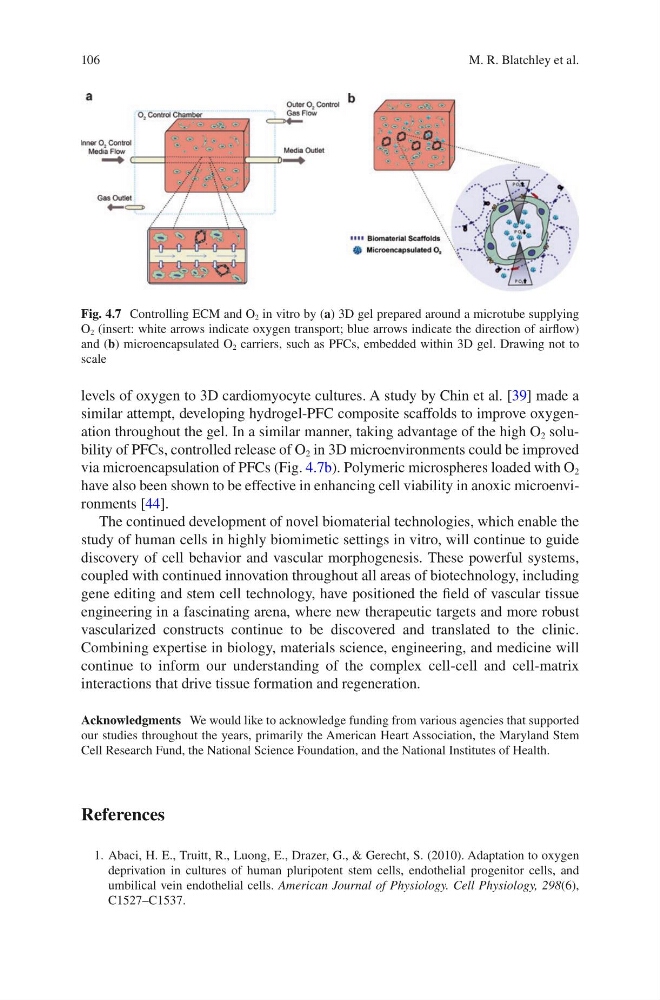
similar attempt, developing hydrogel-PFC composite scaffolds to improve oxygenation throughout the gel. In a similar manner, taking advantage of the high O 2 solubility of PFCs, controlled release of O 2 in 3D microenvironments could be improved
via microencapsulation of PFCs (Fig. 4.7b). Polymeric microspheres loaded with O 2
have also been shown to be effective in enhancing cell viability in anoxic microenvironments [44].
The continued development of novel biomaterial technologies, which enable the
study of human cells in highly biomimetic settings in vitro, will continue to guide
discovery of cell behavior and vascular morphogenesis. These powerful systems,
coupled with continued innovation throughout all areas of biotechnology, including
gene editing and stem cell technology, have positioned the field of vascular tissue
engineering in a fascinating arena, where new therapeutic targets and more robust
vascularized constructs continue to be discovered and translated to the clinic.
Combining expertise in biology, materials science, engineering, and medicine will
continue to inform our understanding of the complex cell-cell and cell-matrix
interactions that drive tissue formation and regeneration.
Acknowledgments We would like to acknowledge funding from various agencies that supported
our studies throughout the years, primarily the American Heart Association, the Maryland Stem
Cell Research Fund, the National Science Foundation, and the National Institutes of Health.
References
1. Abaci, H. E., Truitt, R., Luong, E., Drazer, G., & Gerecht, S. (2010). Adaptation to oxygen
deprivation in cultures of human pluripotent stem cells, endothelial progenitor cells, and
umbilical vein endothelial cells. American Journal of Physiology. Cell Physiology, 298(6),
C1527–C1537.
Fig. 4.7 Controlling ECM and O 2 in vitro by (a) 3D gel prepared around a microtube supplying
O 2 (insert: white arrows indicate oxygen transport; blue arrows indicate the direction of airflow)
and (b) microencapsulated O 2 carriers, such as PFCs, embedded within 3D gel. Drawing not to
scale
M. R. Blatchley et al.
levels of oxygen to 3D cardiomyocyte cultures. A study by Chin et al. [39] made a
similar attempt, developing hydrogel-PFC composite scaffolds to improve oxygenation throughout the gel. In a similar manner, taking advantage of the high O 2 solubility of PFCs, controlled release of O 2 in 3D microenvironments could be improved
via microencapsulation of PFCs (Fig. 4.7b). Polymeric microspheres loaded with O 2
have also been shown to be effective in enhancing cell viability in anoxic microenvironments [44].
The continued development of novel biomaterial technologies, which enable the
study of human cells in highly biomimetic settings in vitro, will continue to guide
discovery of cell behavior and vascular morphogenesis. These powerful systems,
coupled with continued innovation throughout all areas of biotechnology, including
gene editing and stem cell technology, have positioned the field of vascular tissue
engineering in a fascinating arena, where new therapeutic targets and more robust
vascularized constructs continue to be discovered and translated to the clinic.
Combining expertise in biology, materials science, engineering, and medicine will
continue to inform our understanding of the complex cell-cell and cell-matrix
interactions that drive tissue formation and regeneration.
Acknowledgments We would like to acknowledge funding from various agencies that supported
our studies throughout the years, primarily the American Heart Association, the Maryland Stem
Cell Research Fund, the National Science Foundation, and the National Institutes of Health.
References
1. Abaci, H. E., Truitt, R., Luong, E., Drazer, G., & Gerecht, S. (2010). Adaptation to oxygen
deprivation in cultures of human pluripotent stem cells, endothelial progenitor cells, and
umbilical vein endothelial cells. American Journal of Physiology. Cell Physiology, 298(6),
C1527–C1537.
Fig. 4.7 Controlling ECM and O 2 in vitro by (a) 3D gel prepared around a microtube supplying
O 2 (insert: white arrows indicate oxygen transport; blue arrows indicate the direction of airflow)
and (b) microencapsulated O 2 carriers, such as PFCs, embedded within 3D gel. Drawing not to
scale
M. R. Blatchley et al.