

104
3, 6, 37, 74, 169]. Stiffness gradients can also be controlled to study ranges of
viscoelasticity and their effect on cell fate, migration, and other parameters [84].
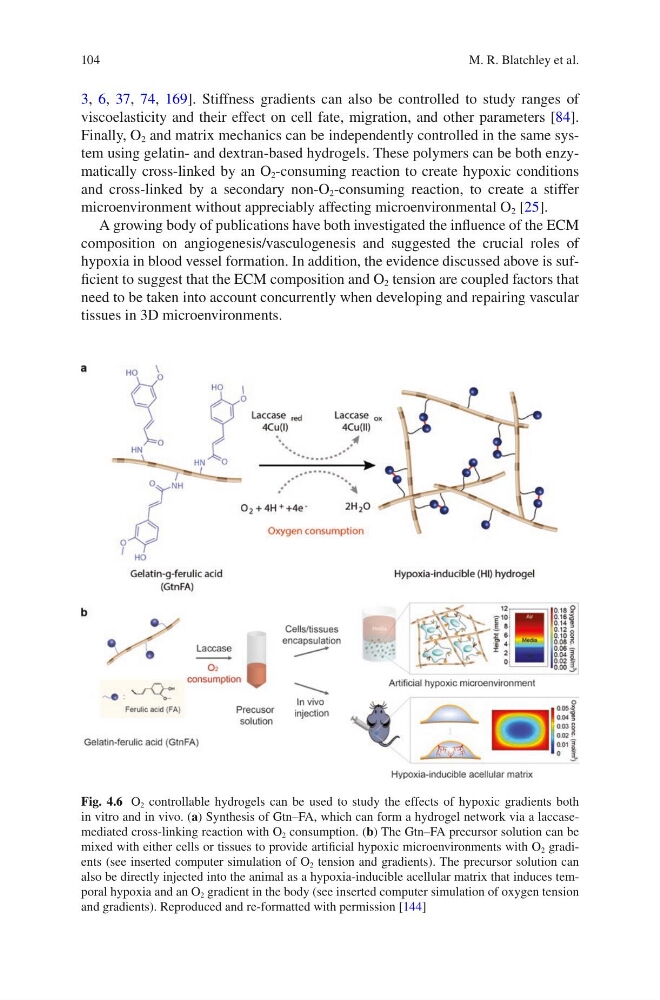
Finally, O 2 and matrix mechanics can be independently controlled in the same system using gelatin- and dextran-based hydrogels. These polymers can be both enzymatically cross-linked by an O 2 -consuming reaction to create hypoxic conditions
and cross- linked by a secondary non-O 2 -consuming reaction, to create a stiffer
microenvironment without appreciably affecting microenvironmental O 2 [25].
A growing body of publications have both investigated the influence of the ECM
composition on angiogenesis/vasculogenesis and suggested the crucial roles of
hypoxia in blood vessel formation. In addition, the evidence discussed above is sufficient to suggest that the ECM composition and O 2 tension are coupled factors that
need to be taken into account concurrently when developing and repairing vascular
tissues in 3D microenvironments.
Fig. 4.6 O 2 controllable hydrogels can be used to study the effects of hypoxic gradients both
in vitro and in vivo. (a) Synthesis of Gtn–FA, which can form a hydrogel network via a laccasemediated cross-linking reaction with O 2 consumption. (b) The Gtn–FA precursor solution can be
mixed with either cells or tissues to provide artificial hypoxic microenvironments with O 2 gradients (see inserted computer simulation of O 2 tension and gradients). The precursor solution can
also be directly injected into the animal as a hypoxia-inducible acellular matrix that induces temporal hypoxia and an O 2 gradient in the body (see inserted computer simulation of oxygen tension
and gradients). Reproduced and re-formatted with permission [144]
M. R. Blatchley et al.
3, 6, 37, 74, 169]. Stiffness gradients can also be controlled to study ranges of
viscoelasticity and their effect on cell fate, migration, and other parameters [84].
Finally, O 2 and matrix mechanics can be independently controlled in the same system using gelatin- and dextran-based hydrogels. These polymers can be both enzymatically cross-linked by an O 2 -consuming reaction to create hypoxic conditions
and cross- linked by a secondary non-O 2 -consuming reaction, to create a stiffer
microenvironment without appreciably affecting microenvironmental O 2 [25].
A growing body of publications have both investigated the influence of the ECM
composition on angiogenesis/vasculogenesis and suggested the crucial roles of
hypoxia in blood vessel formation. In addition, the evidence discussed above is sufficient to suggest that the ECM composition and O 2 tension are coupled factors that
need to be taken into account concurrently when developing and repairing vascular
tissues in 3D microenvironments.
Fig. 4.6 O 2 controllable hydrogels can be used to study the effects of hypoxic gradients both
in vitro and in vivo. (a) Synthesis of Gtn–FA, which can form a hydrogel network via a laccasemediated cross-linking reaction with O 2 consumption. (b) The Gtn–FA precursor solution can be
mixed with either cells or tissues to provide artificial hypoxic microenvironments with O 2 gradients (see inserted computer simulation of O 2 tension and gradients). The precursor solution can
also be directly injected into the animal as a hypoxia-inducible acellular matrix that induces temporal hypoxia and an O 2 gradient in the body (see inserted computer simulation of oxygen tension
and gradients). Reproduced and re-formatted with permission [144]
M. R. Blatchley et al.