

series acquisition. The most complex data collection software is Leginon, developed to fully automate data collection across various electron cryo-microscopy
modalities [47] and microscope manufacturers, and can be installed across multiple
computers controlling all microscopes in a facility [48]. To achieve automated tilt
series acquisition, the predictive codebase of UCSF Tomo has been incorporated
into Leginon [49].
The user must identify parameters for data collection optimal to answering the
biological question. For frozen-hydrated biological specimens the main limitation
to resolution is radiation damage. This means that data collection parameters need
to be carefully optimised to reduce the extent of this damage while simultaneously
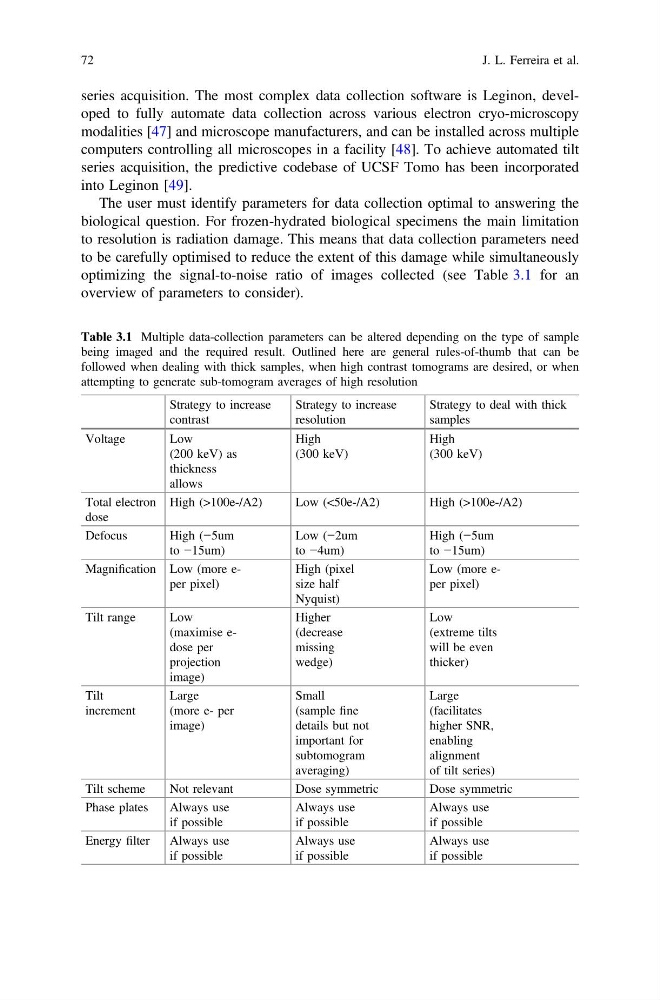
optimizing the signal-to-noise ratio of images collected (see Table 3.1 for an
overview of parameters to consider).
Table 3.1 Multiple data-collection parameters can be altered depending on the type of sample
being imaged and the required result. Outlined here are general rules-of-thumb that can be
followed when dealing with thick samples, when high contrast tomograms are desired, or when
attempting to generate sub-tomogram averages of high resolution
Strategy to increase
contrast
Strategy to increase
resolution
Strategy to deal with thick
samples
Voltage
Low
(200 keV) as
thickness
allows
High
(300 keV)
High
(300 keV)
Total electron
dose
High (>100e-/A2)
Low (<50e-/A2)
High (>100e-/A2)
Defocus
High (−5um
to −15um)
Low (−2um
to −4um)
High (−5um
to −15um)
Magnification Low (more eper pixel)
High (pixel
size half
Nyquist)
Low (more eper pixel)
Tilt range
Low
(maximise edose per
projection
image)
Higher
(decrease
missing
wedge)
Low
(extreme tilts
will be even
thicker)
Tilt
increment
Large
(more e- per
image)
Small
(sample fine
details but not
important for
subtomogram
averaging)
Large
(facilitates
higher SNR,
enabling
alignment
of tilt series)
Tilt scheme
Not relevant
Dose symmetric
Dose symmetric
Phase plates
Always use
if possible
Always use
if possible
Always use
if possible
Energy filter
Always use
if possible
Always use
if possible
Always use
if possible
72
J. L. Ferreira et al.
modalities [47] and microscope manufacturers, and can be installed across multiple
computers controlling all microscopes in a facility [48]. To achieve automated tilt
series acquisition, the predictive codebase of UCSF Tomo has been incorporated
into Leginon [49].
The user must identify parameters for data collection optimal to answering the
biological question. For frozen-hydrated biological specimens the main limitation
to resolution is radiation damage. This means that data collection parameters need
to be carefully optimised to reduce the extent of this damage while simultaneously
optimizing the signal-to-noise ratio of images collected (see Table 3.1 for an
overview of parameters to consider).
Table 3.1 Multiple data-collection parameters can be altered depending on the type of sample
being imaged and the required result. Outlined here are general rules-of-thumb that can be
followed when dealing with thick samples, when high contrast tomograms are desired, or when
attempting to generate sub-tomogram averages of high resolution
Strategy to increase
contrast
Strategy to increase
resolution
Strategy to deal with thick
samples
Voltage
Low
(200 keV) as
thickness
allows
High
(300 keV)
High
(300 keV)
Total electron
dose
High (>100e-/A2)
Low (<50e-/A2)
High (>100e-/A2)
Defocus
High (−5um
to −15um)
Low (−2um
to −4um)
High (−5um
to −15um)
Magnification Low (more eper pixel)
High (pixel
size half
Nyquist)
Low (more eper pixel)
Tilt range
Low
(maximise edose per
projection
image)
Higher
(decrease
missing
wedge)
Low
(extreme tilts
will be even
thicker)
Tilt
increment
Large
(more e- per
image)
Small
(sample fine
details but not
important for
subtomogram
averaging)
Large
(facilitates
higher SNR,
enabling
alignment
of tilt series)
Tilt scheme
Not relevant
Dose symmetric
Dose symmetric
Phase plates
Always use
if possible
Always use
if possible
Always use
if possible
Energy filter
Always use
if possible
Always use
if possible
Always use
if possible
72
J. L. Ferreira et al.