

1.12 The Importance of Sample Geometry
The ‘slab’ geometry common to microtome sections and vitreous thin films is
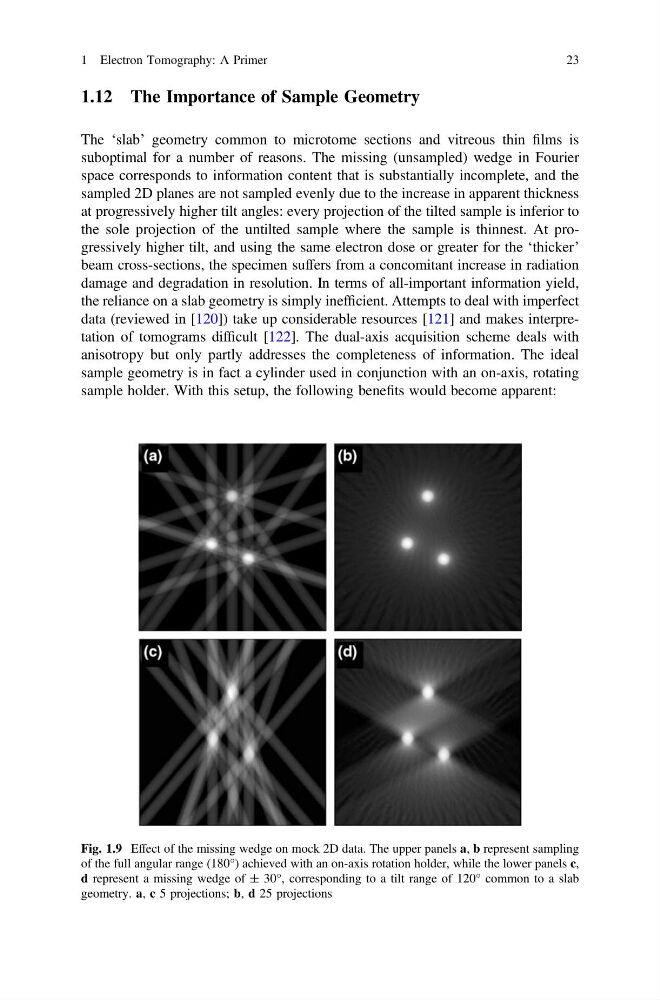
suboptimal for a number of reasons. The missing (unsampled) wedge in Fourier
space corresponds to information content that is substantially incomplete, and the
sampled 2D planes are not sampled evenly due to the increase in apparent thickness
at progressively higher tilt angles: every projection of the tilted sample is inferior to
the sole projection of the untilted sample where the sample is thinnest. At progressively higher tilt, and using the same electron dose or greater for the ‘thicker’
beam cross-sections, the specimen suffers from a concomitant increase in radiation
damage and degradation in resolution. In terms of all-important information yield,
the reliance on a slab geometry is simply inefficient. Attempts to deal with imperfect
data (reviewed in [120]) take up considerable resources [121] and makes interpretation of tomograms difficult [122]. The dual-axis acquisition scheme deals with
anisotropy but only partly addresses the completeness of information. The ideal
sample geometry is in fact a cylinder used in conjunction with an on-axis, rotating
sample holder. With this setup, the following benefits would become apparent:
Fig. 1.9 Effect of the missing wedge on mock 2D data. The upper panels a, b represent sampling
of the full angular range (180°) achieved with an on-axis rotation holder, while the lower panels c,
d represent a missing wedge of ± 30°, corresponding to a tilt range of 120° common to a slab
geometry. a, c 5 projections; b, d 25 projections
1 Electron Tomography: A Primer
23
The ‘slab’ geometry common to microtome sections and vitreous thin films is
suboptimal for a number of reasons. The missing (unsampled) wedge in Fourier
space corresponds to information content that is substantially incomplete, and the
sampled 2D planes are not sampled evenly due to the increase in apparent thickness
at progressively higher tilt angles: every projection of the tilted sample is inferior to
the sole projection of the untilted sample where the sample is thinnest. At progressively higher tilt, and using the same electron dose or greater for the ‘thicker’
beam cross-sections, the specimen suffers from a concomitant increase in radiation
damage and degradation in resolution. In terms of all-important information yield,
the reliance on a slab geometry is simply inefficient. Attempts to deal with imperfect
data (reviewed in [120]) take up considerable resources [121] and makes interpretation of tomograms difficult [122]. The dual-axis acquisition scheme deals with
anisotropy but only partly addresses the completeness of information. The ideal
sample geometry is in fact a cylinder used in conjunction with an on-axis, rotating
sample holder. With this setup, the following benefits would become apparent:
Fig. 1.9 Effect of the missing wedge on mock 2D data. The upper panels a, b represent sampling
of the full angular range (180°) achieved with an on-axis rotation holder, while the lower panels c,
d represent a missing wedge of ± 30°, corresponding to a tilt range of 120° common to a slab
geometry. a, c 5 projections; b, d 25 projections
1 Electron Tomography: A Primer
23