

8.6.4 Mean Shift Filtering
Mean shift filtering is another kernel-based filtering technique. It is different in that
the kernel moves until a stable “centroid” is found. Both distance and densitydifference are included in the centroid calculation. The centroid is calculated using
either uniform or Gaussian kernels for both distance and density. The sizes of these
kernels are user-defined parameters [55].
8.6.5 Non-local Means Filter
This filter is a type of texture filter. The similarity between two pixels is defined as a
function of the difference between the pixel values within kernels surrounding the
pixels. This therefore encodes both the spatial variation and orientation in
the similarity measure. Because of the cost of a comparison of all possible kernels,
the comparisons are limited to small kernels (few pixels: *3) and search regions
(about twice the kernel size). The input parameters are therefore the kernel size, the
search area size and a decay factor for the Gaussian weighting kernel [56].
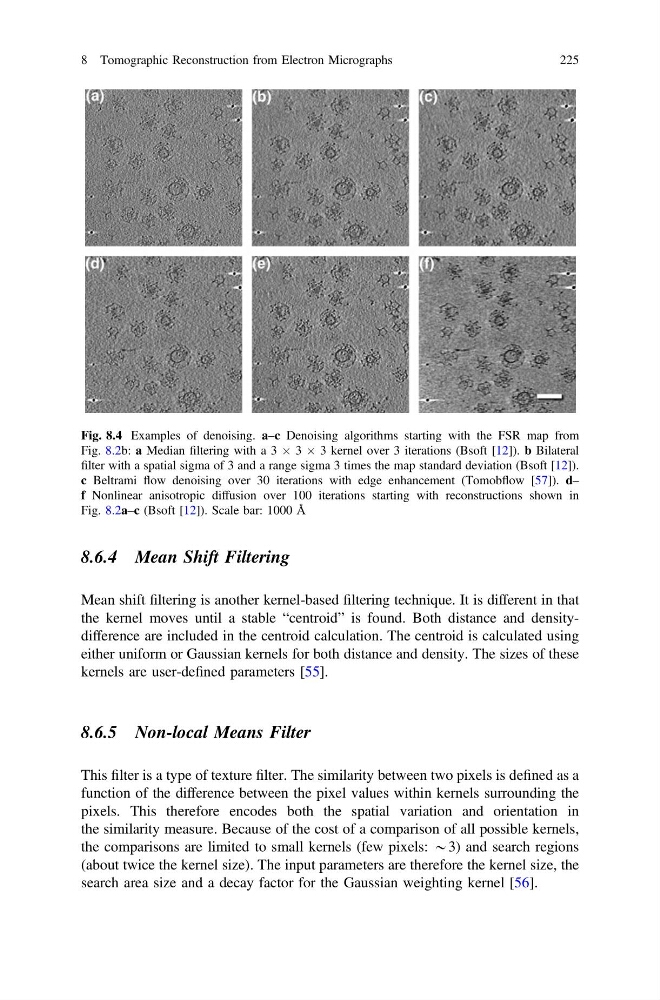
Fig. 8.4 Examples of denoising. a–c Denoising algorithms starting with the FSR map from
Fig. 8.2b: a Median filtering with a 3 Â 3 Â 3 kernel over 3 iterations (Bsoft [12]). b Bilateral
filter with a spatial sigma of 3 and a range sigma 3 times the map standard deviation (Bsoft [12]).
c Beltrami flow denoising over 30 iterations with edge enhancement (Tomobflow [57]). d–
f Nonlinear anisotropic diffusion over 100 iterations starting with reconstructions shown in
Fig. 8.2a–c (Bsoft [12]). Scale bar: 1000 Å
8 Tomographic Reconstruction from Electron Micrographs
225
Mean shift filtering is another kernel-based filtering technique. It is different in that
the kernel moves until a stable “centroid” is found. Both distance and densitydifference are included in the centroid calculation. The centroid is calculated using
either uniform or Gaussian kernels for both distance and density. The sizes of these
kernels are user-defined parameters [55].
8.6.5 Non-local Means Filter
This filter is a type of texture filter. The similarity between two pixels is defined as a
function of the difference between the pixel values within kernels surrounding the
pixels. This therefore encodes both the spatial variation and orientation in
the similarity measure. Because of the cost of a comparison of all possible kernels,
the comparisons are limited to small kernels (few pixels: *3) and search regions
(about twice the kernel size). The input parameters are therefore the kernel size, the
search area size and a decay factor for the Gaussian weighting kernel [56].
Fig. 8.4 Examples of denoising. a–c Denoising algorithms starting with the FSR map from
Fig. 8.2b: a Median filtering with a 3 Â 3 Â 3 kernel over 3 iterations (Bsoft [12]). b Bilateral
filter with a spatial sigma of 3 and a range sigma 3 times the map standard deviation (Bsoft [12]).
c Beltrami flow denoising over 30 iterations with edge enhancement (Tomobflow [57]). d–
f Nonlinear anisotropic diffusion over 100 iterations starting with reconstructions shown in
Fig. 8.2a–c (Bsoft [12]). Scale bar: 1000 Å
8 Tomographic Reconstruction from Electron Micrographs
225