

Ultrathin sectioning: Fill the boat of the Jumbo Diamond knife with Tween water
and insert a coverslip. The carbon coated coverslips are very hydrophobic and it
is difficult to keep them submerged in pure water in the knife boat. The use of
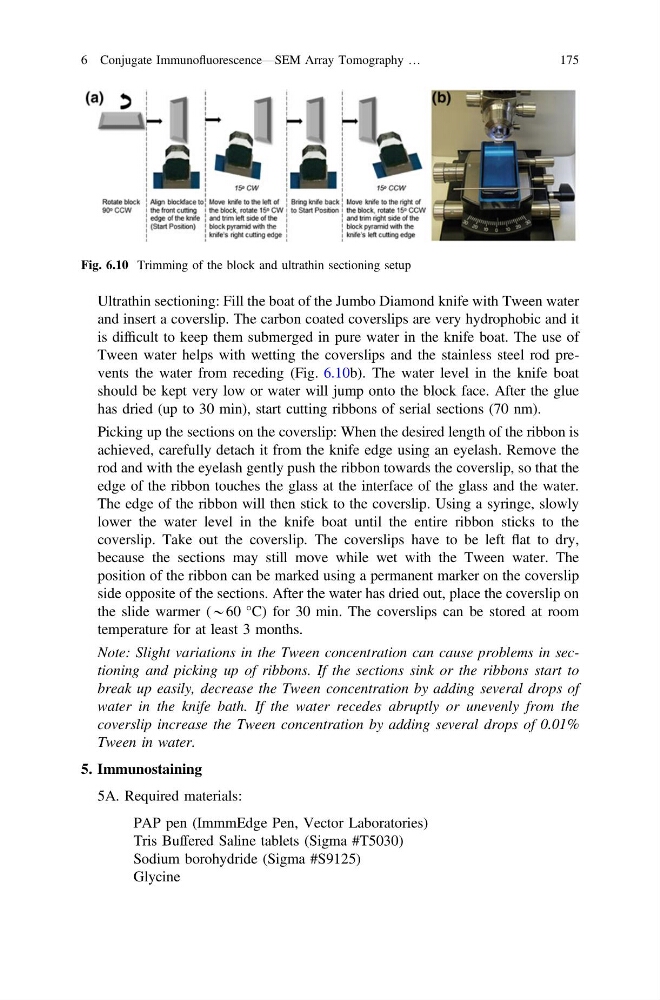
Tween water helps with wetting the coverslips and the stainless steel rod prevents the water from receding (Fig. 6.10b). The water level in the knife boat
should be kept very low or water will jump onto the block face. After the glue
has dried (up to 30 min), start cutting ribbons of serial sections (70 nm).
Picking up the sections on the coverslip: When the desired length of the ribbon is
achieved, carefully detach it from the knife edge using an eyelash. Remove the
rod and with the eyelash gently push the ribbon towards the coverslip, so that the
edge of the ribbon touches the glass at the interface of the glass and the water.
The edge of the ribbon will then stick to the coverslip. Using a syringe, slowly
lower the water level in the knife boat until the entire ribbon sticks to the
coverslip. Take out the coverslip. The coverslips have to be left flat to dry,
because the sections may still move while wet with the Tween water. The
position of the ribbon can be marked using a permanent marker on the coverslip
side opposite of the sections. After the water has dried out, place the coverslip on
the slide warmer (*60 °C) for 30 min. The coverslips can be stored at room
temperature for at least 3 months.
Note: Slight variations in the Tween concentration can cause problems in sectioning and picking up of ribbons. If the sections sink or the ribbons start to
break up easily, decrease the Tween concentration by adding several drops of
water in the knife bath. If the water recedes abruptly or unevenly from the
coverslip increase the Tween concentration by adding several drops of 0.01%
Tween in water.
5. Immunostaining
5A. Required materials:
PAP pen (ImmmEdge Pen, Vector Laboratories)
Tris Buffered Saline tablets (Sigma #T5030)
Sodium borohydride (Sigma #S9125)
Glycine
Fig. 6.10 Trimming of the block and ultrathin sectioning setup
6 Conjugate Immunofluorescence—SEM Array Tomography …
175
and insert a coverslip. The carbon coated coverslips are very hydrophobic and it
is difficult to keep them submerged in pure water in the knife boat. The use of
Tween water helps with wetting the coverslips and the stainless steel rod prevents the water from receding (Fig. 6.10b). The water level in the knife boat
should be kept very low or water will jump onto the block face. After the glue
has dried (up to 30 min), start cutting ribbons of serial sections (70 nm).
Picking up the sections on the coverslip: When the desired length of the ribbon is
achieved, carefully detach it from the knife edge using an eyelash. Remove the
rod and with the eyelash gently push the ribbon towards the coverslip, so that the
edge of the ribbon touches the glass at the interface of the glass and the water.
The edge of the ribbon will then stick to the coverslip. Using a syringe, slowly
lower the water level in the knife boat until the entire ribbon sticks to the
coverslip. Take out the coverslip. The coverslips have to be left flat to dry,
because the sections may still move while wet with the Tween water. The
position of the ribbon can be marked using a permanent marker on the coverslip
side opposite of the sections. After the water has dried out, place the coverslip on
the slide warmer (*60 °C) for 30 min. The coverslips can be stored at room
temperature for at least 3 months.
Note: Slight variations in the Tween concentration can cause problems in sectioning and picking up of ribbons. If the sections sink or the ribbons start to
break up easily, decrease the Tween concentration by adding several drops of
water in the knife bath. If the water recedes abruptly or unevenly from the
coverslip increase the Tween concentration by adding several drops of 0.01%
Tween in water.
5. Immunostaining
5A. Required materials:
PAP pen (ImmmEdge Pen, Vector Laboratories)
Tris Buffered Saline tablets (Sigma #T5030)
Sodium borohydride (Sigma #S9125)
Glycine
Fig. 6.10 Trimming of the block and ultrathin sectioning setup
6 Conjugate Immunofluorescence—SEM Array Tomography …
175