

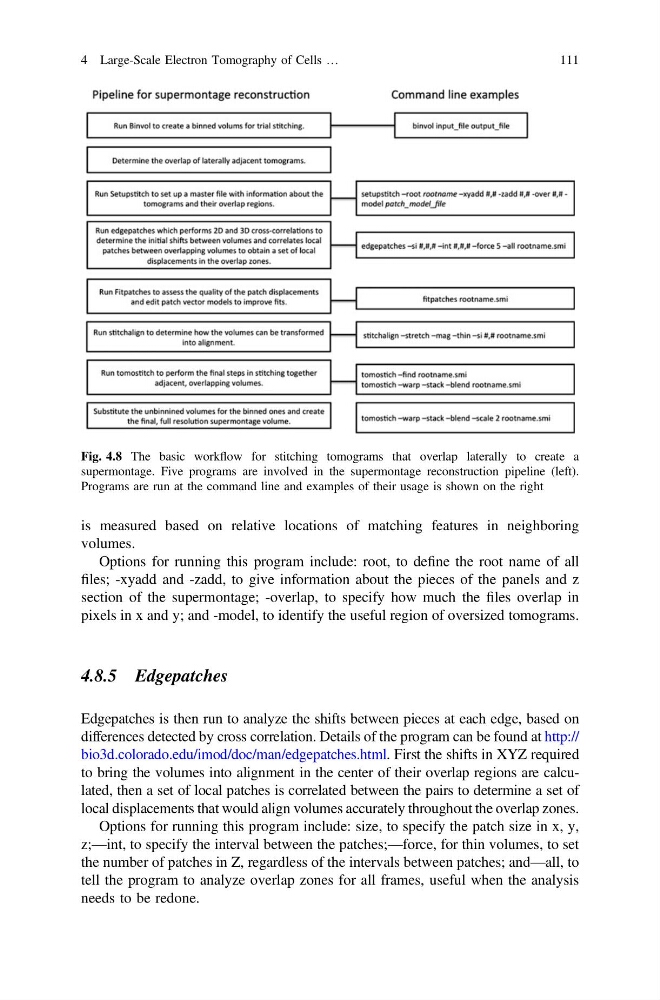
Fig. 4.8 The basic workflow for stitching tomograms that overlap laterally to create a
supermontage. Five programs are involved in the supermontage reconstruction pipeline (left).
Programs are run at the command line and examples of their usage is shown on the right
is measured based on relative locations of matching features in neighboring
volumes.
Options for running this program include: root, to define the root name of all
files; -xyadd and -zadd, to give information about the pieces of the panels and z
section of the supermontage; -overlap, to specify how much the files overlap in
pixels in x and y; and -model, to identify the useful region of oversized tomograms.
4.8.5 Edgepatches
Edgepatches is then run to analyze the shifts between pieces at each edge, based on
differences detected by cross correlation. Details of the program can be found at http://
bio3d.colorado.edu/imod/doc/man/edgepatches.html. First the shifts in XYZ required
to bring the volumes into alignment in the center of their overlap regions are calculated, then a set of local patches is correlated between the pairs to determine a set of
local displacements that would align volumes accurately throughout the overlap zones.
Options for running this program include: size, to specify the patch size in x, y,
z;—int, to specify the interval between the patches;—force, for thin volumes, to set
the number of patches in Z, regardless of the intervals between patches; and—all, to
tell the program to analyze overlap zones for all frames, useful when the analysis
needs to be redone.
4 Large-Scale Electron Tomography of Cells …
111
supermontage. Five programs are involved in the supermontage reconstruction pipeline (left).
Programs are run at the command line and examples of their usage is shown on the right
is measured based on relative locations of matching features in neighboring
volumes.
Options for running this program include: root, to define the root name of all
files; -xyadd and -zadd, to give information about the pieces of the panels and z
section of the supermontage; -overlap, to specify how much the files overlap in
pixels in x and y; and -model, to identify the useful region of oversized tomograms.
4.8.5 Edgepatches
Edgepatches is then run to analyze the shifts between pieces at each edge, based on
differences detected by cross correlation. Details of the program can be found at http://
bio3d.colorado.edu/imod/doc/man/edgepatches.html. First the shifts in XYZ required
to bring the volumes into alignment in the center of their overlap regions are calculated, then a set of local patches is correlated between the pairs to determine a set of
local displacements that would align volumes accurately throughout the overlap zones.
Options for running this program include: size, to specify the patch size in x, y,
z;—int, to specify the interval between the patches;—force, for thin volumes, to set
the number of patches in Z, regardless of the intervals between patches; and—all, to
tell the program to analyze overlap zones for all frames, useful when the analysis
needs to be redone.
4 Large-Scale Electron Tomography of Cells …
111