

showed the great influence that the X-ray beam can have in the dynamics of
formation/destruction of luminescent silver clusters in LTA and FAU zeolites
[68]. Recently the characterization of luminescent silver clusters confined in LTA
zeolites using a combination of X-ray-excited optical luminescence and extended
X-ray absorption fine structure (XEOL-EXAFS) pointed to the presence of tetrahedral silver clusters in the center of sodalite cages, suggesting that their optical
properties originate from a confined two-electron superatom quantum system
[81]. This study highlights the usefulness of this combinatorial approach in
deciphering the exact structure of the luminescence silver species. Additionally, Xray-based characterization techniques such as energy-dispersive X-ray spectroscopy
(EDX) and X-ray photoelectron spectroscopy (XPS) have been employed to monitor
the electronic states and perform the elemental analysis of silver-exchanged zeolites
[98, 99].
Complementary to the structural, electronic, and compositional information
obtained by X-ray-based techniques, theoretical modeling is a powerful tool that
can be applied to elucidate the physicochemical properties of silver clusters in
zeolites and predict, in a quantitative way, the impact that different factors will
have on their optical properties. At present, due to the complexity of the Ag-zeolite
systems, few studies dealing with the theoretical modeling of the optical properties
of silver clusters confined in zeolites have been reported. A representative example is
the work carried by Cuong and collaborators [100]. Starting from fully silverexchanged LTA zeolites, they predicted the absorption bands of two possible
emitting species. However, this study was not compared to experimental data to
further confirm the validity of the model.
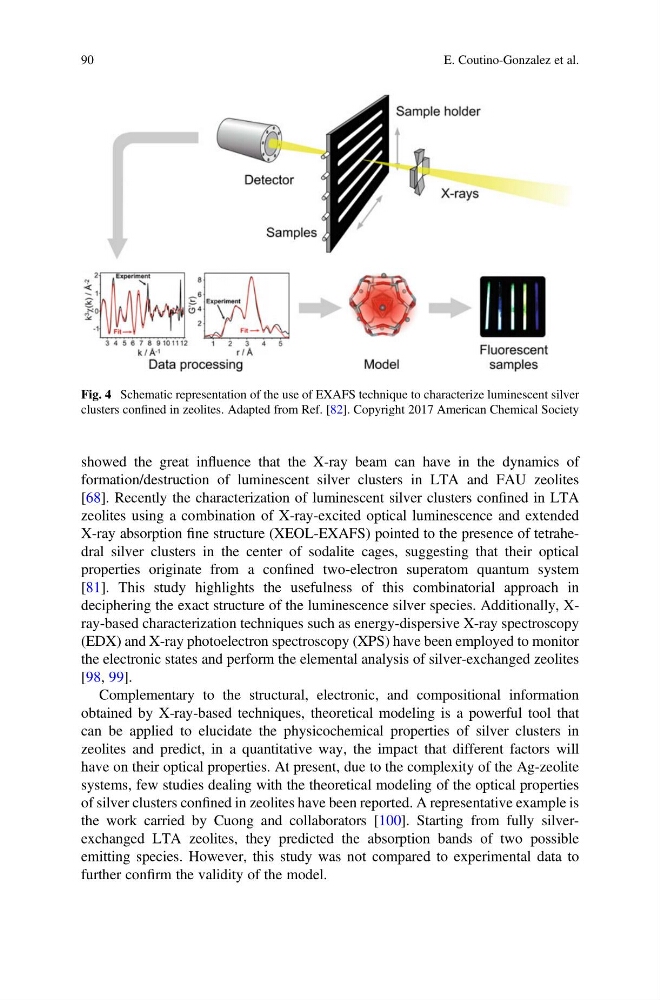
Fig. 4 Schematic representation of the use of EXAFS technique to characterize luminescent silver
clusters confined in zeolites. Adapted from Ref. [82]. Copyright 2017 American Chemical Society
90
E. Coutino-Gonzalez et al.
formation/destruction of luminescent silver clusters in LTA and FAU zeolites
[68]. Recently the characterization of luminescent silver clusters confined in LTA
zeolites using a combination of X-ray-excited optical luminescence and extended
X-ray absorption fine structure (XEOL-EXAFS) pointed to the presence of tetrahedral silver clusters in the center of sodalite cages, suggesting that their optical
properties originate from a confined two-electron superatom quantum system
[81]. This study highlights the usefulness of this combinatorial approach in
deciphering the exact structure of the luminescence silver species. Additionally, Xray-based characterization techniques such as energy-dispersive X-ray spectroscopy
(EDX) and X-ray photoelectron spectroscopy (XPS) have been employed to monitor
the electronic states and perform the elemental analysis of silver-exchanged zeolites
[98, 99].
Complementary to the structural, electronic, and compositional information
obtained by X-ray-based techniques, theoretical modeling is a powerful tool that
can be applied to elucidate the physicochemical properties of silver clusters in
zeolites and predict, in a quantitative way, the impact that different factors will
have on their optical properties. At present, due to the complexity of the Ag-zeolite
systems, few studies dealing with the theoretical modeling of the optical properties
of silver clusters confined in zeolites have been reported. A representative example is
the work carried by Cuong and collaborators [100]. Starting from fully silverexchanged LTA zeolites, they predicted the absorption bands of two possible
emitting species. However, this study was not compared to experimental data to
further confirm the validity of the model.
Fig. 4 Schematic representation of the use of EXAFS technique to characterize luminescent silver
clusters confined in zeolites. Adapted from Ref. [82]. Copyright 2017 American Chemical Society
90
E. Coutino-Gonzalez et al.