

the different silver species formed in zeolite matrices. For instance, the cause of the
yellow color of activated silver-containing LTA zeolites was thoroughly studied by
Calzaferri and collaborators [84–97]. They showed that upon activation under high
vacuum, silver-exchanged LTA zeolites turned yellow at room temperature and
brick-red at 200
C and that all absorption bands appearing in the UV-Vis region
were dependent on the hydration of the Ag ions. They explain this dynamical change
of colors as electronic transitions from the lone pairs of oxygen atoms of the zeolite
framework to the empty 5 s orbital of the Ag ions (ligand-to-metal charge transfer,
LMCT). In a different study, a correlation between the tentative positions of silver
ions in the zeolite lattice with respect to their electronic transitions was reported [85]
based on a full UV-Vis spectral characterization and molecular orbital characterization. In this study, the water dependence of the silver clusters absorption bands was
also observed.
The detailed investigation on the interactions of the different silver species
contained in zeolite matrices and their environments under different reducing
gases was explored by Baumann and co-workers [86] by means of IR transmission
spectroscopy. They proved that at different stages of silver clusters formation,
interactions of certain gases (CO, CO 2 ) with different silver species gave rise to
structural changes and kinetics of clusters formation. In a subsequent study, Bo and
Kevan [87] demonstrated by far-infrared experiments that the transformation
between silver ionic clusters and silver metal nanoparticles in RHO zeolites could
be cycled by reduction and oxidation reactions. Even further, the analysis performed
by Wang and collaborators [88], in which in situ FT-IR spectroscopy was employed
to probe the locations of silver ions in silver-exchanged LTA zeolites, showed
evidence of different silver species inside the zeolite framework. Although it is
difficult to find direct evidence for the different interactions between silver clusters
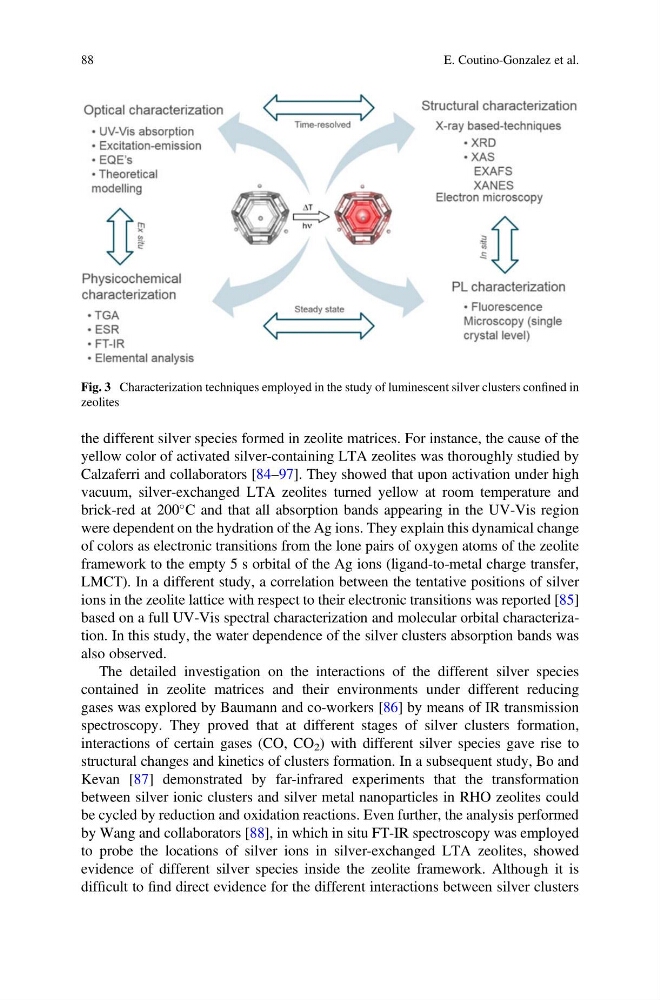
Fig. 3 Characterization techniques employed in the study of luminescent silver clusters confined in
zeolites
88
E. Coutino-Gonzalez et al.
yellow color of activated silver-containing LTA zeolites was thoroughly studied by
Calzaferri and collaborators [84–97]. They showed that upon activation under high
vacuum, silver-exchanged LTA zeolites turned yellow at room temperature and
brick-red at 200
C and that all absorption bands appearing in the UV-Vis region
were dependent on the hydration of the Ag ions. They explain this dynamical change
of colors as electronic transitions from the lone pairs of oxygen atoms of the zeolite
framework to the empty 5 s orbital of the Ag ions (ligand-to-metal charge transfer,
LMCT). In a different study, a correlation between the tentative positions of silver
ions in the zeolite lattice with respect to their electronic transitions was reported [85]
based on a full UV-Vis spectral characterization and molecular orbital characterization. In this study, the water dependence of the silver clusters absorption bands was
also observed.
The detailed investigation on the interactions of the different silver species
contained in zeolite matrices and their environments under different reducing
gases was explored by Baumann and co-workers [86] by means of IR transmission
spectroscopy. They proved that at different stages of silver clusters formation,
interactions of certain gases (CO, CO 2 ) with different silver species gave rise to
structural changes and kinetics of clusters formation. In a subsequent study, Bo and
Kevan [87] demonstrated by far-infrared experiments that the transformation
between silver ionic clusters and silver metal nanoparticles in RHO zeolites could
be cycled by reduction and oxidation reactions. Even further, the analysis performed
by Wang and collaborators [88], in which in situ FT-IR spectroscopy was employed
to probe the locations of silver ions in silver-exchanged LTA zeolites, showed
evidence of different silver species inside the zeolite framework. Although it is
difficult to find direct evidence for the different interactions between silver clusters
Fig. 3 Characterization techniques employed in the study of luminescent silver clusters confined in
zeolites
88
E. Coutino-Gonzalez et al.