

local lattice damage) and/or by oxygen of the hydration water present in the zeolites
[19, 27]. Several parameters (Fig. 2) are of paramount importance to achieve the
formation of luminescent silver clusters in zeolites. Regarding the starting zeolite
material, the presence of cages and cavities of appropriate dimensions will limit the
size of the formed clusters, next to this, the silicon-to-aluminum ratio plays an
important role since this will dictate the cation exchange capacity of the zeolites.
Moreover, the counter-balancing cations present in the zeolite topologies is also an
important parameter to consider.
2.3 Structure-to-Properties Relationship of Silver Clusters
Confined in Zeolites
One of the ultimate goals in the study of functional metal clusters is the correlation
between their atomic scale organization and physicochemical properties. In the case
of luminescent silver clusters confined in zeolites, a detailed structural and electronic
characterization is required to understand the size-to-structure functional relationship and for rational material optimization [80]. However, the analysis of such
sub-nanometer species is challenging due to the sensitivity of silver clusters and
zeolite frameworks to radiation damage imposed by highly energetic beam probes
used in high-resolution techniques [68, 80]. A recent report demonstrated that by
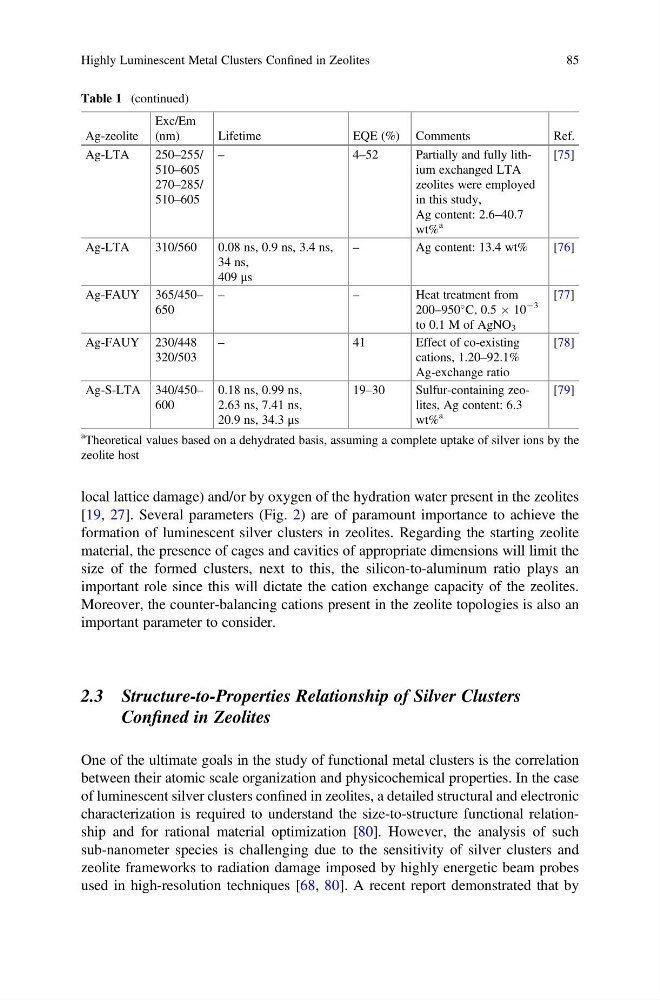
Table 1 (continued)
Ag-zeolite
Exc/Em
(nm)
Lifetime
EQE (%) Comments
Ref.
Ag-LTA
250–255/
510–605
270–285/
510–605
–
4–52
Partially and fully lithium exchanged LTA
zeolites were employed
in this study,
Ag content: 2.6–40.7
wt%
a
[75]
Ag-LTA
310/560
0.08 ns, 0.9 ns, 3.4 ns,
34 ns,
409 μs
–
Ag content: 13.4 wt%
[76]
Ag-FAUY 365/450–
650
–
–
Heat treatment from
200–950
C, 0.5 Â 10
À3
to 0.1 M of AgNO 3
[77]
Ag-FAUY 230/448
320/503
–
41
Effect of co-existing
cations, 1.20–92.1%
Ag-exchange ratio
[78]
Ag-S-LTA 340/450–
600
0.18 ns, 0.99 ns,
2.63 ns, 7.41 ns,
20.9 ns, 34.3 μs
19–30
Sulfur-containing zeolites, Ag content: 6.3
wt%
a
[79]
a Theoretical values based on a dehydrated basis, assuming a complete uptake of silver ions by the
zeolite host
Highly Luminescent Metal Clusters Confined in Zeolites
85
[19, 27]. Several parameters (Fig. 2) are of paramount importance to achieve the
formation of luminescent silver clusters in zeolites. Regarding the starting zeolite
material, the presence of cages and cavities of appropriate dimensions will limit the
size of the formed clusters, next to this, the silicon-to-aluminum ratio plays an
important role since this will dictate the cation exchange capacity of the zeolites.
Moreover, the counter-balancing cations present in the zeolite topologies is also an
important parameter to consider.
2.3 Structure-to-Properties Relationship of Silver Clusters
Confined in Zeolites
One of the ultimate goals in the study of functional metal clusters is the correlation
between their atomic scale organization and physicochemical properties. In the case
of luminescent silver clusters confined in zeolites, a detailed structural and electronic
characterization is required to understand the size-to-structure functional relationship and for rational material optimization [80]. However, the analysis of such
sub-nanometer species is challenging due to the sensitivity of silver clusters and
zeolite frameworks to radiation damage imposed by highly energetic beam probes
used in high-resolution techniques [68, 80]. A recent report demonstrated that by
Table 1 (continued)
Ag-zeolite
Exc/Em
(nm)
Lifetime
EQE (%) Comments
Ref.
Ag-LTA
250–255/
510–605
270–285/
510–605
–
4–52
Partially and fully lithium exchanged LTA
zeolites were employed
in this study,
Ag content: 2.6–40.7
wt%
a
[75]
Ag-LTA
310/560
0.08 ns, 0.9 ns, 3.4 ns,
34 ns,
409 μs
–
Ag content: 13.4 wt%
[76]
Ag-FAUY 365/450–
650
–
–
Heat treatment from
200–950
C, 0.5 Â 10
À3
to 0.1 M of AgNO 3
[77]
Ag-FAUY 230/448
320/503
–
41
Effect of co-existing
cations, 1.20–92.1%
Ag-exchange ratio
[78]
Ag-S-LTA 340/450–
600
0.18 ns, 0.99 ns,
2.63 ns, 7.41 ns,
20.9 ns, 34.3 μs
19–30
Sulfur-containing zeolites, Ag content: 6.3
wt%
a
[79]
a Theoretical values based on a dehydrated basis, assuming a complete uptake of silver ions by the
zeolite host
Highly Luminescent Metal Clusters Confined in Zeolites
85