

regarded as a luminescent label. This functionality is ideal for establishing communication from the inside of the channels to the outside or vice versa. The first report
on such a communication was published in a paper entitled “Trapping Energy from
and Injecting Energy into Dye-Zeolite Nanoantennae” [86]. We show the essentials
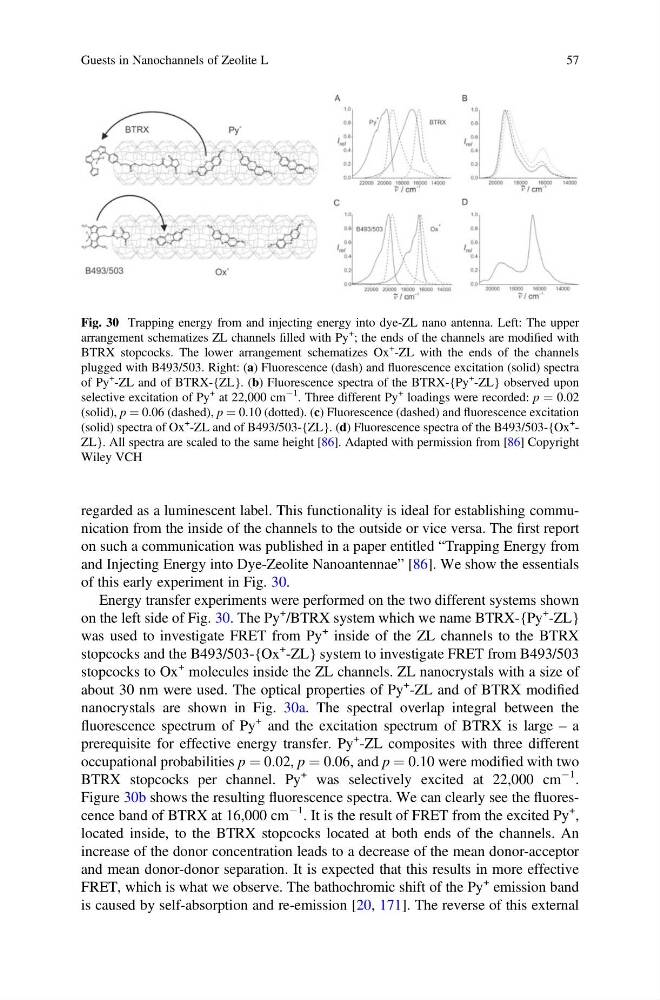
of this early experiment in Fig. 30.
Energy transfer experiments were performed on the two different systems shown
on the left side of Fig. 30. The Py
+ /BTRX system which we name BTRX-{Py
+
-ZL}
was used to investigate FRET from Py
+ inside of the ZL channels to the BTRX
stopcocks and the B493/503-{Ox
+
-ZL} system to investigate FRET from B493/503
stopcocks to Ox
+ molecules inside the ZL channels. ZL nanocrystals with a size of
about 30 nm were used. The optical properties of Py
+
-ZL and of BTRX modified
nanocrystals are shown in Fig. 30a. The spectral overlap integral between the
fluorescence spectrum of Py
+ and the excitation spectrum of BTRX is large – a
prerequisite for effective energy transfer. Py
+
-ZL composites with three different
occupational probabilities p ¼ 0.02, p ¼ 0.06, and p ¼ 0.10 were modified with two
BTRX stopcocks per channel. Py
+ was selectively excited at 22,000 cm
À1 .
Figure 30b shows the resulting fluorescence spectra. We can clearly see the fluorescence band of BTRX at 16,000 cm
À1 . It is the result of FRET from the excited Py
+
,
located inside, to the BTRX stopcocks located at both ends of the channels. An
increase of the donor concentration leads to a decrease of the mean donor-acceptor
and mean donor-donor separation. It is expected that this results in more effective
FRET, which is what we observe. The bathochromic shift of the Py
+ emission band
is caused by self-absorption and re-emission [20, 171]. The reverse of this external
Fig. 30 Trapping energy from and injecting energy into dye-ZL nano antenna. Left: The upper
arrangement schematizes ZL channels filled with Py
+ ; the ends of the channels are modified with
BTRX stopcocks. The lower arrangement schematizes Ox
+ -ZL with the ends of the channels
plugged with B493/503. Right: (a) Fluorescence (dash) and fluorescence excitation (solid) spectra
of Py
+ -ZL and of BTRX-{ZL}. (b) Fluorescence spectra of the BTRX-{Py
+ -ZL} observed upon
selective excitation of Py
+ at 22,000 cm
À1
. Three different Py
+ loadings were recorded: p ¼ 0.02
(solid), p ¼ 0.06 (dashed), p ¼ 0.10 (dotted). (c) Fluorescence (dashed) and fluorescence excitation
(solid) spectra of Ox
+ -ZL and of B493/503-{ZL}. (d) Fluorescence spectra of the B493/503-{Ox
+ -
ZL}. All spectra are scaled to the same height [86]. Adapted with permission from [86] Copyright
Wiley VCH
Guests in Nanochannels of Zeolite L
57
on such a communication was published in a paper entitled “Trapping Energy from
and Injecting Energy into Dye-Zeolite Nanoantennae” [86]. We show the essentials
of this early experiment in Fig. 30.
Energy transfer experiments were performed on the two different systems shown
on the left side of Fig. 30. The Py
+ /BTRX system which we name BTRX-{Py
+
-ZL}
was used to investigate FRET from Py
+ inside of the ZL channels to the BTRX
stopcocks and the B493/503-{Ox
+
-ZL} system to investigate FRET from B493/503
stopcocks to Ox
+ molecules inside the ZL channels. ZL nanocrystals with a size of
about 30 nm were used. The optical properties of Py
+
-ZL and of BTRX modified
nanocrystals are shown in Fig. 30a. The spectral overlap integral between the
fluorescence spectrum of Py
+ and the excitation spectrum of BTRX is large – a
prerequisite for effective energy transfer. Py
+
-ZL composites with three different
occupational probabilities p ¼ 0.02, p ¼ 0.06, and p ¼ 0.10 were modified with two
BTRX stopcocks per channel. Py
+ was selectively excited at 22,000 cm
À1 .
Figure 30b shows the resulting fluorescence spectra. We can clearly see the fluorescence band of BTRX at 16,000 cm
À1 . It is the result of FRET from the excited Py
+
,
located inside, to the BTRX stopcocks located at both ends of the channels. An
increase of the donor concentration leads to a decrease of the mean donor-acceptor
and mean donor-donor separation. It is expected that this results in more effective
FRET, which is what we observe. The bathochromic shift of the Py
+ emission band
is caused by self-absorption and re-emission [20, 171]. The reverse of this external
Fig. 30 Trapping energy from and injecting energy into dye-ZL nano antenna. Left: The upper
arrangement schematizes ZL channels filled with Py
+ ; the ends of the channels are modified with
BTRX stopcocks. The lower arrangement schematizes Ox
+ -ZL with the ends of the channels
plugged with B493/503. Right: (a) Fluorescence (dash) and fluorescence excitation (solid) spectra
of Py
+ -ZL and of BTRX-{ZL}. (b) Fluorescence spectra of the BTRX-{Py
+ -ZL} observed upon
selective excitation of Py
+ at 22,000 cm
À1
. Three different Py
+ loadings were recorded: p ¼ 0.02
(solid), p ¼ 0.06 (dashed), p ¼ 0.10 (dotted). (c) Fluorescence (dashed) and fluorescence excitation
(solid) spectra of Ox
+ -ZL and of B493/503-{ZL}. (d) Fluorescence spectra of the B493/503-{Ox
+ -
ZL}. All spectra are scaled to the same height [86]. Adapted with permission from [86] Copyright
Wiley VCH
Guests in Nanochannels of Zeolite L
57